Why anxiety can spike the day after drinking
Why alcohol may bring short relief and next-day anxiety, what sleep and withdrawal have to do with it, and when to seek help.

- The next-day state is a pile-up: body sensations, wrecked sleep, memory gaps, shame, and uncertainty all arriving together.
- The experience is real, but one symptom, or one label you found online, can’t establish a diagnosis.
- Small supports work best when they target the exact point where your pattern breaks down.
- Persistent impairment, medical concerns, or safety risks deserve a professional assessment.
It’s 7 a.m. Last night was completely ordinary. This morning your heart is going like you sprinted here, and every sentence you said between nine and midnight has come back for quality inspection.
Online, people call this hangxiety. The word is casual. The experience isn’t.
Alcohol can reduce anxiety in the short term, then disrupt sleep, contribute to dehydration and physical discomfort, and produce rebound symptoms as its effects wear off. Heavy or regular use can create withdrawal that needs medical attention.
The calm comes with a rebound
Alcohol can temporarily take the edge off tension and self-consciousness. As those effects wear off, your body and brain are swinging back toward balance. The National Institute on Alcohol Abuse and Alcoholism describes this as a “mini-withdrawal” that can leave people more restless and anxious than they were before the first drink.
That doesn’t mean every anxious morning is alcohol withdrawal, and it doesn’t mean one bad hangover proves an alcohol use disorder. It just explains why the relief and the next-day alarm belong to the same sequence.
The emotional contrast is what gets people. Last night you were loose enough to tell a story to the entire table. This morning a harmless text reads like a subpoena.
Your body is sending several signals at once
Hangovers can include thirst, headache, nausea, stomach pain, fatigue, vertigo, sweating, increased blood pressure, irritability, and anxiety. Alcohol can increase urination, irritate your stomach, contribute to inflammation, and shred your sleep into pieces.
A lot of those sensations overlap with panic. A racing heart on top of bad sleep and dehydration gets read as proof that something terrible is underway. Then body monitoring and catastrophic thinking pile on another layer.
There’s no reliable trick that instantly reverses any of this. Coffee may crank up the jitters, and more alcohol postpones the problem rather than solving it. Time is doing most of the repair here, which is offensively unmarketable but true.
Memory gaps invite anxious storytelling
If you can’t remember part of the evening, your mind will happily fill the blank with worst-case footage. So you scan messages, inspect photos, and ask friends whether you embarrassed yourself. Reassurance helps briefly, and then a new possibility shows up.
Take proportionate action. Check for concrete evidence once. If you know you hurt someone, apologize without making them soothe you about it. If you’ve got a genuine safety concern, contact the relevant person or service.
After that, separate the facts from the imagined scenes. “I sent three messages at midnight” is a fact. “Everyone secretly hates me” is a conclusion. You can take responsibility for your behavior without holding a full trial on evidence you don’t have.
Care for the morning, carefully
Stop drinking, rest, and don’t drive or do anything else hazardous while you’re impaired or hungover. Drink fluids according to your medical needs and eat something you can tolerate if you can manage it. Be careful with medications, because alcohol interacts with plenty of prescription and over-the-counter products.
NIAAA specifically warns that alcohol with acetaminophen can be toxic to the liver, and that aspirin and ibuprofen can irritate the stomach further. Ask a pharmacist or clinician what’s safe for you instead of assuming every pain reliever is a neutral hangover accessory.
Keep the day small. Repeated pulse checks, punishing exercise, too much caffeine, and social-media forensics all make the alarm louder. And if you can, postpone any major relationship or career conclusions until you’ve slept and the acute effects have passed. A hungover afternoon is a terrible courtroom.
Know when this is more than a hangover
Alcohol poisoning is an emergency. Call emergency services if someone is difficult to wake, confused, vomiting repeatedly, having seizures, breathing slowly or irregularly, or showing pale, blue, or clammy skin. Don’t leave an unconscious person alone, and don’t assume they can sleep it off.
Withdrawal can also be dangerous for people who drink heavily or regularly. Tremor, sweating, agitation, nausea, insomnia, hallucinations, seizures, and severe confusion can all require urgent medical treatment. If you might be physically dependent, don’t attempt an unsupported sudden stop based on this article.
A clinician can assess the risk and figure out whether medically supervised withdrawal is needed. Emergency symptoms need immediate care, not a future appointment.
Look at the pattern, not just the worst morning
Write down how much you meant to drink, how much you actually drank, the setting, the reason, your sleep, the next-day anxiety, and the consequences. Standard drink sizes are usually smaller than whatever you poured, so use a reliable guide rather than counting containers.
Then ask whether alcohol is quietly becoming the price of socializing, sleeping, dating, or shutting off work. Do you drink more or longer than you planned? Have you tried to cut down and found it harder than expected? Does drinking produce conflict, missed obligations, risky situations, or continued use even as the anxiety gets worse?
Alcohol use disorder is diagnosed from a pattern of impairment and symptoms over time, not from moral character or one regrettable Saturday. It’s treatable, and getting help doesn’t require waiting around for a dramatic rock bottom.
Run a safer comparison
If you’re not at risk for withdrawal and a clinician hasn’t advised otherwise, compare a few alcohol-free social occasions against drinking ones. Keep the settings similar enough that you learn something. Track your sleep, your next-day anxiety, and whether you actually enjoyed the event.
You might also set a limit before you go, alternate with nonalcoholic drinks, eat beforehand, or skip it entirely. The safest amount for your anxiety may be less than what your friends drink, and for some people it may be none.
If changing the plan feels impossible once you’ve started, that’s more important information than any perfectly designed tracking sheet. Bring it to a primary care or addiction professional.
Treat both sides when both are present
Anxiety can increase the urge to drink, and repeated drinking can worsen anxiety, sleep, and functioning. Treat only one side and the other one stands ready to restart the loop.
Effective care can include psychotherapy, medication for anxiety, medication for alcohol use disorder, peer support, and medical management, depending on what you need. Some anxiety medications and alcohol interact dangerously, so tell your prescribers honestly what you’re using. I’d rather have an uncomfortable conversation than a dangerous prescription.
Get an evaluation if next-day anxiety is frequent, if drinking is escalating, if you’re using alcohol to head off withdrawal or panic, or if it’s affecting work, school, health, or relationships. If you might harm yourself, call or text 988 or go to an emergency department. Alcohol increases impulsivity, so don’t wait alone with an acute safety concern.
Friends can help without turning into investigators. If someone is physically safe but ashamed, offer water, food, rest, and a factual account of the evening. Don’t tease them with invented stories, and don’t keep supplying reassurance every time the same doubt circles back. If you saw dangerous drinking, say so plainly when they’re sober, and help them get connected to care.
And if you’re worried about someone else’s drinking, you can’t diagnose or control them. You can name specific behavior, hold boundaries around safety, refuse to ride with an impaired driver, and get guidance for yourself. Caring doesn’t require absorbing every consequence.
Try one honest prediction
Before the next event, write down what you expect alcohol to give you and what the next morning usually costs. Choose the plan while you’re sober, and tell one person you trust if support would help.
The next day, compare the prediction to what happened. The point isn’t to shame yourself into changing. It’s to stop letting tonight’s relief write tomorrow’s contract in invisible ink.
The bottom line: Short relief carries a next-day invoice. Treat the pattern as data rather than as a verdict, and get help early if alcohol is becoming the main way you enter, exit, or recover from anxiety.
Sources: National Institute on Alcohol Abuse and Alcoholism, “Hangovers,” “Alcohol Use Disorder: From Risk to Diagnosis to Recovery,” and “Mental Health Issues: Alcohol Use Disorder and Common Co-occurring Conditions”; National Institute of Mental Health, “Anxiety Disorders”; National Institute for Health and Care Excellence, “Generalised anxiety disorder and panic disorder in adults” (CG113).
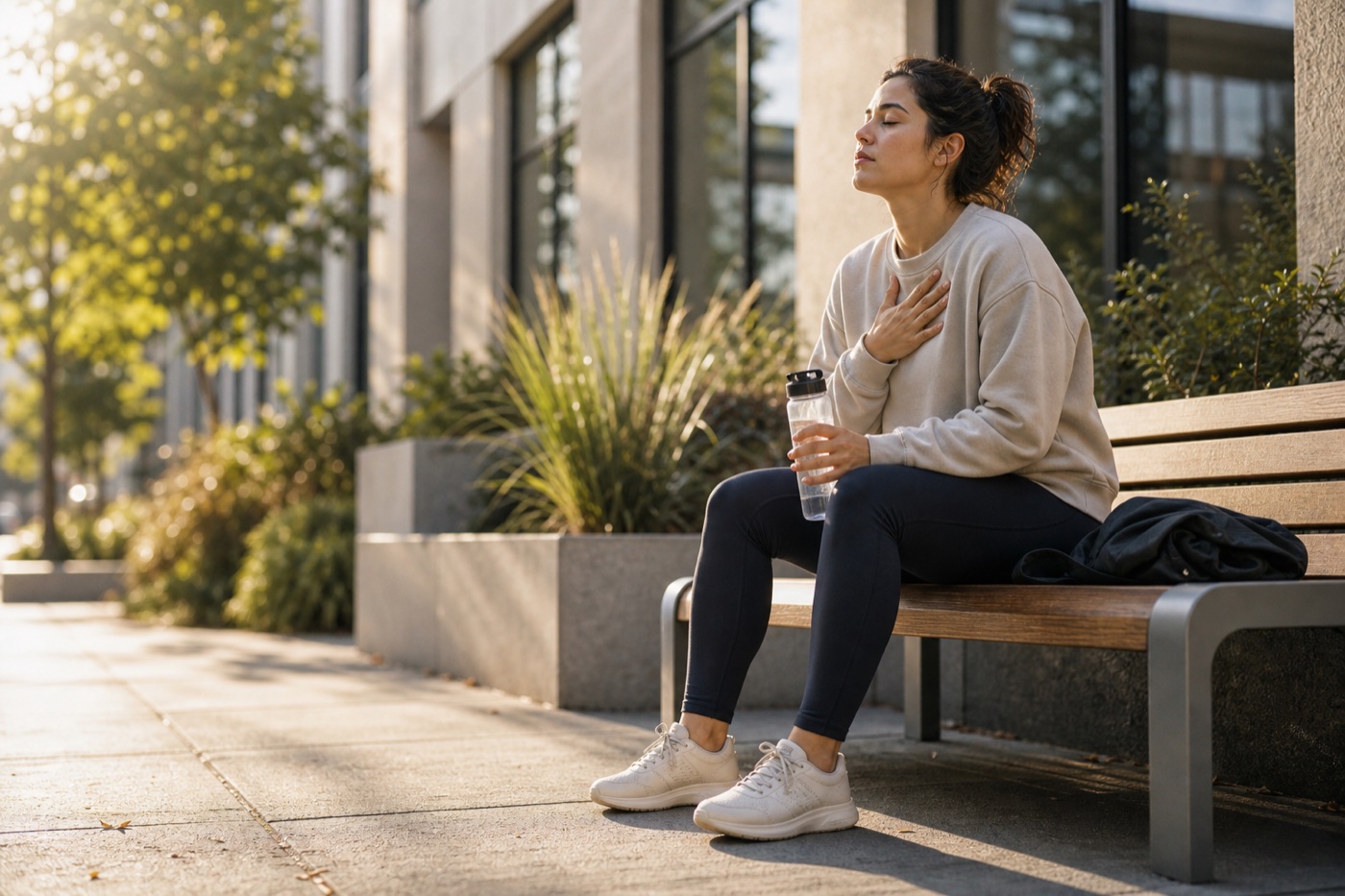
Panic attacks: what’s happening and what helps.
Why a panic attack feels like a heart attack, what to do in the moment, what helps long term, and when to get checked out. A quick, evidence-based read.

Why does anxiety make me feel sick?
Why anxiety can cause nausea, cramps, diarrhea, and appetite changes, plus how to calm the loop without dismissing a real medical problem.

What to expect at your first visit.
What we ask, what we don’t, what you leave with, and how to make your first telehealth psychiatry visit count. A quick, plain-language guide from Sigma Psychiatry.
Would a clearer evaluation help?
A free 15-minute intro call can help you decide whether a psychiatric evaluation makes sense.