Why can't I sleep? Your brain at 3 a.m.
The anxiety-sleep loop, the sleep hygiene that actually matters versus the myths, why CBT-I is first-line treatment, and when sleeplessness signals something treatable.
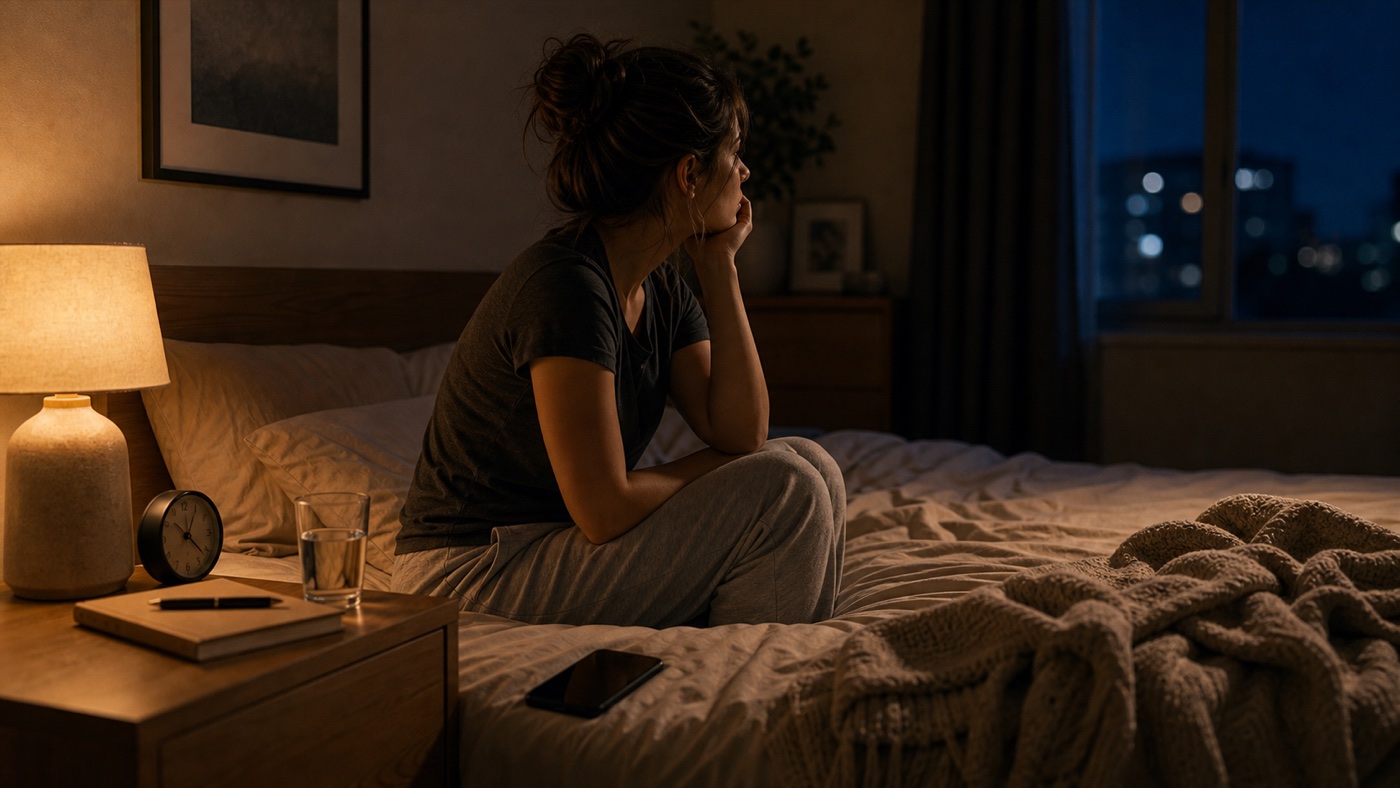
- Anxiety and insomnia feed each other: a wired brain won't power down, and a sleepless night makes the next day's anxiety worse. Round and round it goes.
- Most "sleep hygiene" tips are fine but mild. A few rules do real work; the rest is the wellness equivalent of decorative throw pillows.
- For chronic insomnia, the first-line treatment isn't a pill. It's CBT-I, a short, structured therapy that outperforms sleep meds over the long run.
- Sleeplessness that drags on, or comes with low mood, racing thoughts, or loud snoring with gasping, can signal something treatable. Worth a look.
It's 3:14 a.m. The house is dead quiet, your partner is sleeping the untroubled sleep of someone who isn't currently relitigating a conversation from 2019, and you're wide awake doing mental math on exactly how few hours of sleep you can still technically get if you fall asleep right now. Spoiler: doing that math is the single most effective way to guarantee you won't. Welcome to 3 a.m., where your brain finally has the floor and absolutely refuses to yield it.
If this is you on a regular basis, you're in enormous company. Insomnia is one of the most common health complaints there is. Roughly a third of adults report symptoms of it, and a smaller but very real slice deal with the full chronic version: trouble sleeping at least three nights a week, for three months or more, with the days getting wrecked because of it. So no, you're not broken, and no, you're not the only person staring at the ceiling tonight.
The loop nobody warns you about
Here's the cruel design flaw. Anxiety and insomnia aren't two separate problems that happen to be hanging out together. They're a feedback loop, and they feed each other with real enthusiasm.
Anxiety keeps your nervous system in a low-grade "something might be wrong" state, which is the exact opposite of what sleep requires. Sleep is a letting-go act, and a brain scanning for threats doesn't let go. So you lie down and the day's worries, plus a few surprise guests from years past, all clock in for the night shift.
Then the second half kicks in. You sleep badly, and a sleep-deprived brain is a more anxious, more reactive, more catastrophizing brain the next day. Small problems look bigger. Your emotional shock absorbers are shot. And that worse day hands you a worse night, which hands you a worse day. The loop doesn't care which came first. It just keeps spinning.
This is why "just relax" is such useless advice. Telling an anxious insomniac to relax is like telling someone to be taller. The intent is sweet. The mechanism is missing.
Sleep hygiene: what actually matters vs. the throw pillows
You've heard the sleep hygiene list a thousand times. Some of it genuinely helps. A lot of it's filler that makes people feel productive about their insomnia without moving the needle. Let me sort the pile.
The stuff that actually earns its keep:
- A consistent wake-up time. Every single day, including weekends, even after a bad night. This is the most underrated lever there is. Your body clock anchors to when you get up, not when you go to bed.
- Get out of bed when you can't sleep. If you've been lying there awake and frustrated for what feels like 20-ish minutes, get up. Go sit somewhere dim and boring until you're sleepy, then return. Staying in bed wide awake teaches your brain that bed is where you do your anxious thinking. Bad lesson.
- Protect the back end of your caffeine. Caffeine has a long half-life, so that 4 p.m. coffee is still partying in your system at bedtime. Afternoon and evening caffeine is the easiest big win most people ignore.
- Keep the bed for sleep and sex. Not for work, doomscrolling, or staging your nightly worry summit. You're rebuilding the association between "bed" and "sleep."
The decorative throw pillows (fine, pleasant, not going to fix chronic insomnia on their own): the precise temperature of your room, blue-light glasses, a specific herbal tea, an elaborate nine-step wind-down ritual, the perfect pillow you ordered at 3 a.m. last week. None of it's harmful. It's just that if you've got a real anxiety-sleep loop, optimizing your pillowcase is rearranging furniture in a house with a plumbing problem.
And the biggest myth of all: "trying harder" to sleep. Sleep is the one performance that gets worse the more effort you put in. Effort is arousal, and arousal is the enemy of sleep. The goal isn't to achieve sleep. It's to stop standing in its way.
The first-line treatment isn't a pill
This surprises almost everyone, so I'll say it plainly. For chronic insomnia, the recommended first-line treatment isn't a sleeping pill. It's a short, structured therapy called CBT-I, cognitive behavioral therapy for insomnia. Major medical groups, including the American College of Physicians, recommend trying it first for adults with chronic insomnia.
CBT-I isn't lying on a couch talking about your childhood. It's a focused, practical, usually six-ish-session program that retrains the broken sleep system. It typically includes:
- Re-anchoring your sleep window so your time in bed matches the sleep your body's actually producing (counterintuitive, weirdly effective)
- Breaking the "bed equals anxiety" association
- Defusing the racing 3 a.m. thoughts instead of wrestling them
- Resetting the unhelpful beliefs about sleep that quietly crank up the pressure
Here's the kicker. Sleep medications can knock you out tonight, and sometimes that's genuinely the right call for a short stretch. But over the long run, CBT-I tends to outperform them, and its gains stick around after you finish, which is the opposite of what happens when you stop a sleep med. It's the difference between renting sleep and owning it.
When sleeplessness is a signal, not just a nuisance
Sometimes insomnia is its own standalone problem. Sometimes it's the smoke detector going off about something else, and that something else is treatable. A few patterns are worth flagging to a clinician rather than white-knuckling:
- Sleep problems plus persistent low mood. Trouble sleeping (or sleeping way too much) is one of the textbook features of depression. Treat the sleep alone and the mood keeps dragging it back down.
- Waking at 3 or 4 a.m. and not getting back down, especially paired with that hollow, can't-shake-it low feeling. Early-morning waking is a classic depression calling card.
- A mind that won't stop racing, looping, planning, dreading. That's often anxiety running the show, and anxiety responds to treatment.
- Loud snoring with pauses or gasping, or waking up unrefreshed no matter how long you were in bed. That can point to sleep apnea, which is a medical issue worth evaluating, not a willpower issue.
- Insomnia that's lasted months and is steadily eating your days. Chronic is exactly when a real evaluation pays off.
None of this is meant to scare you at 3 a.m., which, let's be honest, is the worst possible hour to read a bullet list about your health. The point is gentler than that: persistent sleeplessness is a fixable problem far more often than people assume, and the fix usually isn't more discipline.
The bottom line. Anxiety and insomnia are a loop, not two random roommates, and you usually can't out-discipline a loop. The real fixes are unglamorous: a rock-steady wake time, getting out of bed when you're wired, and CBT-I, which beats sleeping pills over the long haul. And if your sleeplessness is traveling with low mood or relentless racing thoughts, that's a signal, not a character flaw. So put down the 3 a.m. sleep math. If your nights have gone sideways and stayed there, we'll sort out what's actually driving it together.
Sources: National Heart, Lung, and Blood Institute, "Insomnia" (nhlbi.nih.gov); American College of Physicians, clinical guideline on management of chronic insomnia disorder in adults (acpjournals.org); Cleveland Clinic, "Insomnia" (my.clevelandclinic.org); National Institute of Mental Health, "Depression" (nimh.nih.gov). Retrieved 2026-05-29.

What actually helps anxiety
The treatments with real evidence, the ones that are overrated, and where to start.

Panic attacks: what's happening and what helps
Why it feels like a heart attack, and the simple things that actually bring it down.
Why do I feel anxious all the time?
Anxious for no clear reason? What generalized anxiety is, why your body stays on alert, and what actually helps.
Tired of being tired?
If your nights have gone sideways and your days are paying for it, that's worth talking about. Ask us anything on a free 15-minute intro call.