What should you say after your child hears you argue?
How to repair after your child hears an argument, restore a sense of safety, avoid pulling them into the conflict, and change the pattern when needed.
- One disagreement does not define a family; hostility, fear, repetition, and lack of repair matter more.
- Tell your child plainly that the argument was not their fault or their job to fix.
- Give a truthful, age-appropriate explanation without turning the child into a judge, messenger, or confidant.
- Repair only counts when the adults also change how future conflict is handled.
The dishwasher is still open. One parent is standing by the sink, the other by the hallway, and the conversation has become much louder than the problem deserved. Then you notice your child in the doorway, holding one sock and the expression of someone who has accidentally walked into the final scene of a courtroom drama.
You can’t make them unhear it. You can help them understand what happened, restore a sense of safety, and show what repair looks like. The goal isn’t to pretend loving adults never disagree. It’s to keep children from carrying an adult conflict as if it were their fault, their assignment, or a forecast of catastrophe.
Conflict is not all the same
Research doesn’t say that every disagreement harms children. Studies distinguish hostile, threatening, disengaged, and unresolved conflict from constructive disagreement. A large meta-analysis linked hostility and other unconstructive patterns with children’s emotional, behavioral, cognitive, and physiological responses. A newer systematic synthesis found that constructive conflict was associated with greater emotional security and social problem-solving, although the studies were varied and many other factors influenced outcomes.
That distinction matters. Two adults disagreeing about a budget, listening, and reaching a plan is different from screaming, contempt, threats, breaking objects, prolonged silent punishment, or forcing a child to take sides. Volume matters, but so do fear, unpredictability, and whether anyone ever sees the adults come back together.
I’ll ask what the child actually witnessed. Did they hear one sharp exchange or months of hostility through the wall? Did anyone threaten to leave, hurt themselves, or hurt someone else? Was the child named in the argument? Repair needs to fit the event. A tidy sentence can’t wallpaper over an unsafe pattern.
Say the part children often guess wrong
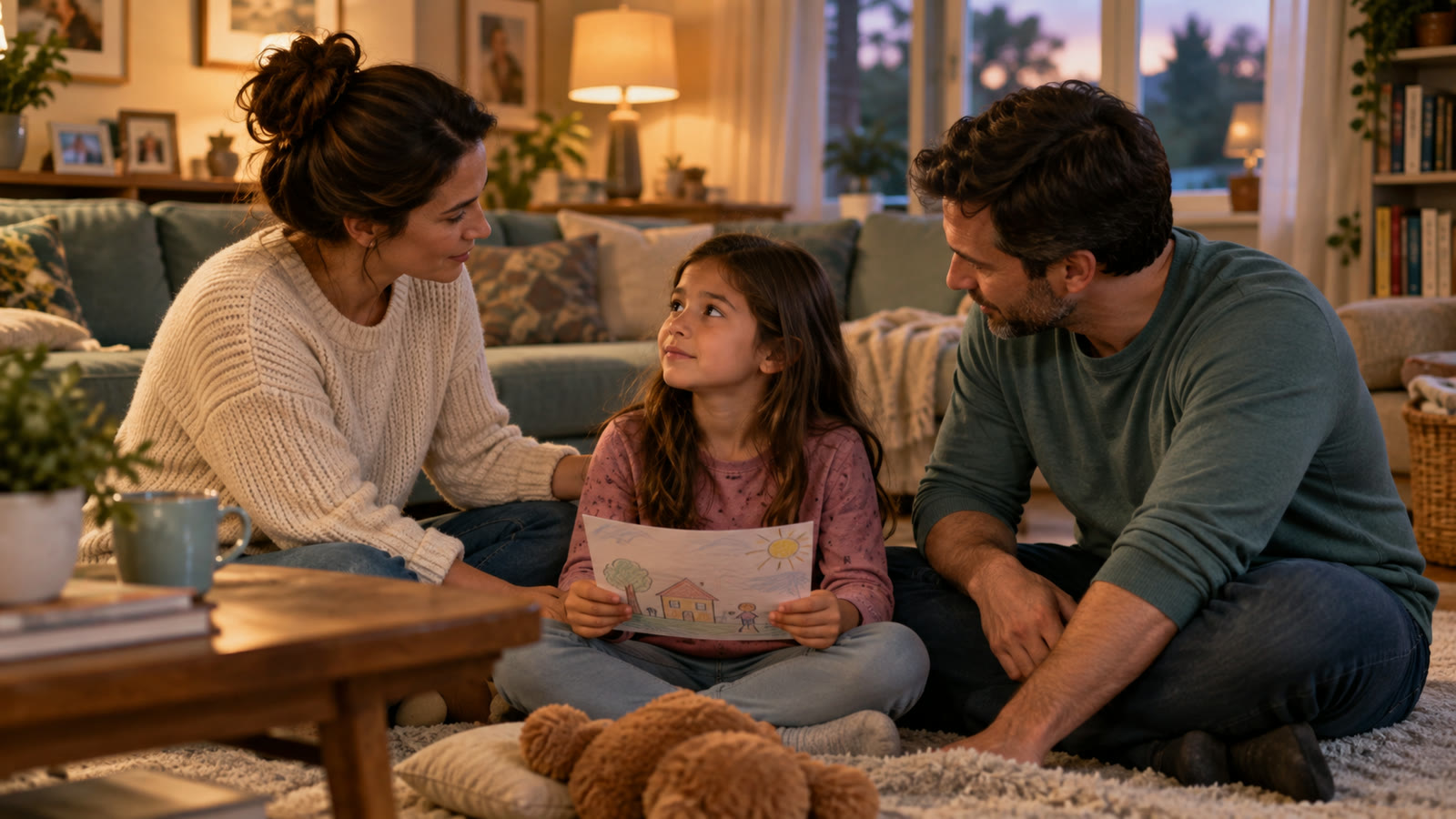
Start after everyone is calm enough to speak without restarting the fight. If it’s safe and genuine, both adults can talk with the child together. That alone communicates that the adults are back on the same parenting team, even if the original issue isn’t completely solved.
Try: “You heard us arguing. We got too loud, and that may have felt scary. The disagreement was between adults. It wasn’t caused by you, and it isn’t your job to fix. We love you, and we’re working on handling this better.”
Don’t rush past the middle sentence. Children commonly make themselves central to events they don’t understand. If the argument mentioned money, lateness, chores, or parenting, they may decide their needs caused it. Say directly that they didn’t.
Ask one open question: “What did you hear, and what did you think was happening?” Their answer may surprise you. They might fear divorce, worry someone will be hurt, or simply want to know whether movie night still exists. Answer the question they have, not the seminar you prepared in the shower.
Check again later, because children don’t always have the question ready on schedule. Bedtime, the school run, or the next disagreement may bring it back. You can say, “You can ask me about what happened whenever you need to.”
Truthful does not mean adult-sized
Offer an age-appropriate explanation: “We disagreed about money,” or “We were both stressed and spoke disrespectfully.” You don’t need to reveal finances, infidelity, legal concerns, sex, substance use, or a detailed catalogue of the other parent’s failures. The child needs orientation, not a seat on the investigative committee.
Don’t ask, “Who do you think was right?” Don’t use the child to deliver a message, confirm your version, monitor the other parent, or provide emotional comfort. A child can love both adults without approving every behavior. Making them manage divided loyalty doesn’t create honesty. It creates a job they can’t safely resign from.
If separation or another major change is genuinely possible, don’t promise that nothing will change. Say what is known now: “We’re working on an adult problem. You’ll be told about any plan that affects you. Both of us love you, and you will be cared for.” Reassurance should be sturdy enough to survive reality.
Let them see some of the repair
Children often witness the rupture and miss the resolution because adults make up privately. You don’t have to perform affection on command, but it can help to let the child see a brief, truthful repair: “We talked. We still have work to do, but we’re calmer and we have a plan for tonight.”
If you insulted, threatened, or shouted, name your behavior without an excuse: “I yelled. That wasn’t okay. Being angry didn’t make yelling necessary. Next time I’m going to pause before I keep talking.” An apology that ends with “but your mother” or “but your father” has quietly put its coat back on and left.
Constructive disagreement includes listening, problem-solving, compromise, warmth, and resolution. It doesn’t require identical opinions. Children can learn that people they love may disagree without the relationship becoming unsafe. They learn that lesson from what the adults repeatedly do, not from a laminated family slogan.
Try one small step today: agree on a pause sentence with the other adult, such as “We’re too heated to solve this well. We’ll return at eight.” Use it before the next conflict reaches the child’s doorway. The return time matters. A pause without a return can feel like abandonment wearing sensible shoes.
Change the pattern, not only the speech
If arguments are frequent, move difficult conversations away from children’s hearing, reduce predictable triggers, and set rules against contempt, threats, name-calling, interrogation, and recruiting allies. Couples therapy or family therapy may help when both adults can participate safely. Individual support can help you regulate, clarify boundaries, or make decisions even if the other adult won’t attend.
Violence, threats, coercive control, stalking, forced sex, destruction of property, or fear of retaliation isn’t a communication-style problem. A joint repair conversation or couples therapy may be unsafe. Prioritize safety planning with a qualified domestic-violence resource or clinician. If anyone is in immediate danger, call 911.
Pay attention after the argument. A child may need support if they develop persistent sleep problems, stomachaches, headaches, clinginess, aggression, school difficulty, panic, withdrawal, or repeated efforts to monitor the adults. One quiet evening doesn’t prove they’re fine, and one worried question doesn’t prove lasting harm.
Ask a pediatrician or child mental health professional for help when distress persists, functioning changes, or conflict remains intense. If your child talks about self-harm, suicide, or not wanting to live, take it seriously. In the United States, call or text 988 for crisis support; use 911 for immediate life-threatening danger.
The bottom line: After your child hears an argument, name what happened, say it wasn’t their fault or job to fix, answer their actual questions, and let them see an honest repair. Then change the pattern that produced the fear. Children don’t need a conflict-free home. They need adults who keep conflict safe, contained, and repairable.
Sources: van Eldik and colleagues, interparental relationship meta-analysis, Psychological Bulletin (2020); Ran and colleagues, interparental conflict and youth anxiety meta-analysis, Journal of Youth and Adolescence (2021); Zhang and Wu, constructive interparental conflict systematic research synthesis, Journal of Marital and Family Therapy (2026); American Academy of Pediatrics, HealthyChildren.org, Family Arguments (updated 2025).

How do you parent when you disagree about discipline?
How to align in front of children without pretending you think alike.
How do you repair after yelling at your child?
What a full apology sounds like and how to change the next repetition.

Is this normal conflict or emotional abuse?
How to tell ordinary disagreement from control, humiliation, and fear.
Is conflict starting to shape the whole household?
A free 15-minute intro call can help you decide whether psychiatric care fits the next step.