When your child refuses school: what the morning fight is telling you
Why school refusal can show up as stomachaches or panic, what parents and young people should assess, and how a supported return works.
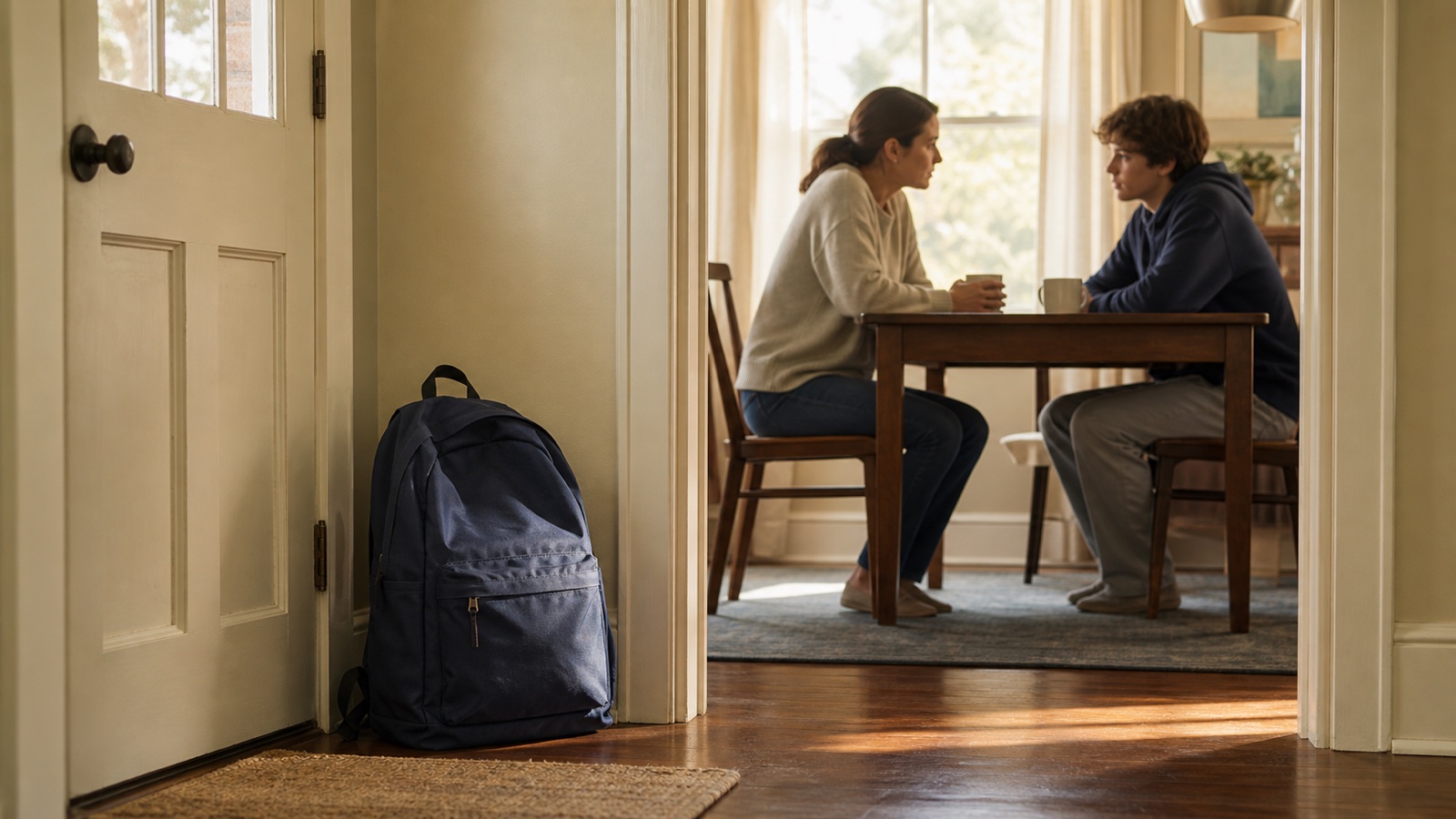
- School refusal describes a behavior, not a diagnosis. Anxiety can be one cause, but bullying, learning problems, depression, sleep disruption, family change, medical illness, or an unsafe school environment may also matter.
- You rarely solve this by deciding whether your kid is “really sick” or “just avoiding.” The physical symptoms can be completely real, and staying home can still strengthen the cycle.
- Look at the sequence, the real-life cost, and the exceptions before you turn a pattern into an identity.
- Safety, consent, functioning, and freedom matter more than a tidy label from the internet.
It’s 7:12 a.m. The backpack is packed. The shoes have vanished into a dimension nobody can locate. And the stomachache, the one that made a full recovery by 10 a.m. Saturday, has returned with immaculate timing.
You’re now standing in a hallway deciding, in about 90 seconds, whether you’re a pushover or a tyrant. Neither option is on the menu, but the clock doesn’t know that.
Start here: school refusal is a description of behavior, not a diagnosis. Anxiety can be one cause, but bullying, learning problems, depression, sleep disruption, family change, medical illness, or an unsafe school environment may also matter.
And you rarely settle this by deciding whether your kid is “really sick” or “just avoiding.” That’s the wrong fork in the road. Physical symptoms can be entirely real, and staying home can still strengthen the cycle. Both things.
The morning fight is doing a job
Start with what the pattern accomplishes in the next few minutes, because it’s accomplishing something reliable. Staying home relieves anxiety immediately, even when the actual driver is bullying, a learning difficulty, depression, sleep, or illness. The payoff may be relief, certainty, connection, or escape, which is exactly why the behavior repeats when the longer-term cost is obvious to everyone in the house.
The delayed cost deserves equal billing. The central trap is reducing all of this to defiance before anybody has understood the timing, the function, and what’s actually happening at school. What helps briefly can later produce resentment, distance, lost time, or less freedom. That sequence is worth more than another round of blaming yourself.
Adults and young people also understand the same event differently, and often reasonably so. Caregivers stay responsible for safety, and young people still deserve dignity, developmentally appropriate privacy, and a real voice in this. Curiosity gathers far more useful information than a kitchen-table diagnosis.
So retire “Why is this happening to us?” It’s a question with no landing gear. Try a narrower one: what happened, what did I expect, what did I do, and what changed right after? That’s where a small intervention can actually fit.
Slow the morning down until you can see it
Take one recent morning and map it end to end. The cue is usually distress, physical symptoms, delay, or shutdown intensifying as departure gets closer. Then note the interpretation, the body’s response, the urge, the action, the immediate result, and the delayed result. The visible behavior is only one link in a longer chain, and it’s rarely the link worth attacking at 7:12.
Find the earliest point where choice was still available. You may not control the first surge of fear, shame, anger, or urgency, in your kid or in yourself. You can often control whether that surge turns into avoidance, an accusation, silence, or a decision made at peak intensity.
Useful clues include:
- Symptoms cluster on school mornings.
- The young person can name a specific unsafe or overwhelming part of school.
- The absence is growing, and returning feels harder each day.
Hunt for the exceptions too. Notice the people, settings, timing, sleep, preparation, or degree of safety that makes a morning go better. Exceptions don’t make the concern imaginary. They show you which conditions are worth recreating on purpose instead of hoping for.
Then check the first story against a wider record. Include the exact words or behavior, recent stress, sleep, health changes, power differences, and what a trusted observer noticed. Feelings are important evidence about experience. They’re just not a complete recording of the event.
Safety and autonomy have to share the room
Begin with safety, then preserve as much autonomy as you can. Ask directly about self-harm, abuse, exploitation, violence, and substance risk when it’s indicated. Direct questions don’t plant ideas; they tell your kid you can hear the answer.
Explain privacy and its limits clearly instead of treating every request for space as proof of danger. Those are two different things, and confusing them is how you lose the next disclosure.
Online explanations tend to sound more certain than they are. A careful assessment considers development, culture, medical conditions, sleep, stress, trauma, mood, substance use, environment, and power. That slower differential is less satisfying at midnight. It also protects you from a confident, incomplete answer that you then build a whole plan around.
Worth repeating because it does real work: school refusal describes a behavior, not a diagnosis, and different causes need different supports. A bullying problem and a sleep problem look identical at 7:12 a.m. and require completely different fixes.
A pediatrician, school professional, therapist, or child and adolescent clinician can help assess all of this in context. Development, learning, sleep, health, stress, family conditions, and mental health all matter. Persistent distress, a major functional change, or safety concerns deserve direct evaluation.
Change tomorrow morning, not your whole parenting
Insight is only worth what it changes about the next repetition. Here’s the concrete version: coordinate with your child, the school, the pediatrician, and any clinician on a graded return and a plan for the underlying cause. Keep it small enough to use near the real cue, not just in a calm Sunday conversation where everyone agrees.
- Check medical and immediate safety concerns.
- Ask what happens before, during, and after arrival.
- Contact school supports early.
- Build a timely, supported return plan with professionals.
A different response may feel stiff, fake, weak, or unfinished the first few times. That discomfort usually reflects unfamiliarity rather than danger. You’re allowed to sound awkward while your family learns that another outcome is possible.
Measure progress by flexibility, not perfection. Improvement might mean pausing sooner, asking more directly, recovering faster, tolerating a little uncertainty, or holding one limit without a speech attached. One additional available move is meaningful change.
And a bad morning doesn’t prove the pattern is permanent. Review the cue, the vulnerability, the action, and the consequence without staging a full trial in your head. Repair what needs repairing, adjust the next attempt, and judge the pattern across many mornings rather than one hard Tuesday.
When this needs a professional, not another pep talk
Seek prompt evaluation when the absence persists, symptoms are severe, bullying or discrimination is possible, or there are signs of depression, self-harm, substance use, psychosis, or danger. And young people deserve private time to talk with a clinician. I ask for it every time, because the most important sentence often arrives once the parent steps out.
If you do come in, bring two or three concrete examples. Describe the distress, the physical symptoms, the delay or shutdown as departure approaches, what you feared, what you did, how long it lasted, and what it cost. Specific sequences tell me far more than a collection of internet labels.
Urgent support comes first when there’s suicidal intent, violence, abuse, severe confusion, an inability to meet basic needs, or another immediate danger. Nobody needs a perfect label before safety gets addressed. If you’re in crisis, call or text 988.
For nonurgent care, seek an evaluation when the absence persists, distress is severe, safety is uncertain, or your child can’t resume ordinary learning and routines. Depending on the cause, useful next steps may include individual therapy, family or relationship work, medical review, school support, a medication discussion, or environmental change.
One small experiment, tonight
Tonight, retire “Why won’t you just go?” and ask instead: “Which 20 minutes of the school day feels hardest, and what happens there?” That question has an answer. The other one only has a fight.
Before you ask, write down what you predict you’ll hear. Afterward, record what you actually heard, mixed results included. The gap between prediction and observation is the new information, and it’s the one thing lying awake at 2 a.m. can never supply.
Keep it small enough to repeat. A dramatic one-time effort produces a story. Ordinary practice produces data. Ask the same question a few more nights before you decide whether it’s working.
The bottom line: School refusal is a description of behavior, not a diagnosis. Anxiety can be one cause, but bullying, learning problems, depression, sleep disruption, family change, medical illness, or an unsafe school environment may also matter. The goal isn’t to eliminate every uncomfortable feeling before 8 a.m. It’s to understand the sequence, protect safety and dignity, and make one more deliberate response available. Start with the smallest repeatable change, then judge it by what happens in real life rather than by whether it felt effortless.
Sources: American Academy of Child and Adolescent Psychiatry, “School Refusal”; American Academy of Pediatrics, “School Avoidance: Tips for Concerned Parents” (2024); National Institute of Mental Health, child and adolescent mental health resources.

When to take a struggling child to a psychiatrist.
How to tell the difference between a hard phase and something worth a psychiatric evaluation, what to watch for, and what a first visit for a child is really like.

What to say when your child asks for therapy
What to say when a child directly asks for therapy, how to protect trust and privacy, and how to arrange the first appropriate appointment.
More than sadness: signs worth taking seriously.
Depression often looks like exhaustion, irritability, or numbness, not just tears. The signs worth taking seriously, when to seek help, and what actually treats it.
Would a clearer view of this pattern help?
A free 15-minute intro call can help you decide whether a psychiatric evaluation makes sense.