Does telehealth psychiatry actually work?
What the research says about video psychiatry versus in-person care, why it works well for psychiatry specifically, and when in-person still matters. A quick, evidence-based read.
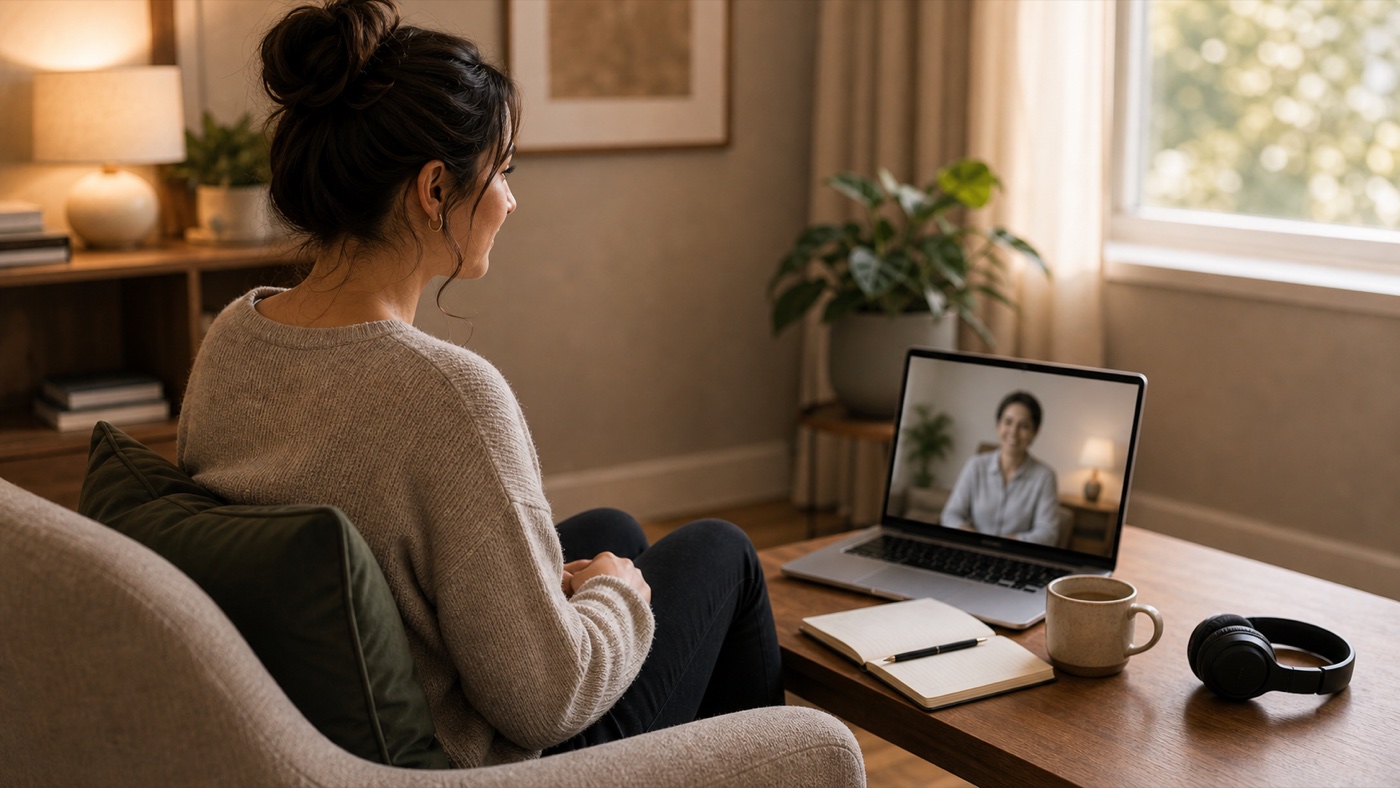
- For common conditions like anxiety and depression, systematic reviews find largely no significant difference in outcomes between video and in-person psychiatry.
- Psychiatry runs on conversation and careful observation, which is exactly what video preserves well.
- Telehealth removes real barriers: no commute, fewer missed appointments, easier continuity, and access to clinicians who would otherwise be out of reach.
- It isn't right for everything. Some controlled-medication rules and higher-acuity situations still call for in-person care.
- The thing that actually matters is a clinician who tells you honestly when video is enough and when it isn't.
A patient told me recently that she'd been white-knuckling a panic disorder for two years before she booked her first appointment. Not because she couldn't find a psychiatrist. Because the idea of sitting in a waiting room, getting called back, and walking past strangers on the worst day of her week felt like more than she could manage. Her first visit with me happened from her kitchen table, with her dog asleep on her feet and a cup of tea she actually finished. By minute ten she was telling me things she said she'd never told anyone in person.
So when people ask me whether telehealth psychiatry "actually works," I get it. A little skepticism is healthy. Can a video visit really be as good as sitting in the same room? For psychiatry specifically, the evidence is reassuring, and honestly, it's not particularly close.
What the research actually shows
Multiple systematic reviews comparing telehealth with in-person mental health care have found largely no significant difference in outcomes for common conditions like anxiety and depression. Symptom improvement and patient satisfaction track closely between the two formats.
That's worth sitting with for a second. We're not talking about telehealth being a tolerable compromise, the thing you settle for when the real thing isn't available. By the evidence, it's a genuine alternative, not a watered-down version of care.
Why does that surprise people? Because we carry an instinct that closeness equals quality, that being in the same physical room must count for something the camera can't capture. For a lot of medicine, that instinct is right. You can't palpate an abdomen over Zoom. But psychiatry is a different kind of specialty, and that's the part worth understanding.
Why it fits psychiatry so well
Most of what I do in a visit, I do with my eyes and ears. I'm listening to how you tell your story, watching your face, noticing the pauses, tracking your energy and your mood. A camera carries almost all of that. Here's where it lands so well:
- It's built on conversation and observation. Psychiatry doesn't depend on touch the way many specialties do. The tools of the trade are dialogue and careful attention, and video preserves both.
- People open up more from their own space. There's something about being on your own turf, in clothes you chose, with your own coffee, that lowers the guard. I see people get to the real thing faster from their living room than they often do in a clinic.
- No commute means you actually show up. Fewer missed appointments, easier continuity over months and years. In psychiatry, where consistency is half the treatment, that matters enormously.
- It widens access. If you live an hour from the nearest psychiatrist, or you're a parent who can't carve out half a day for a thirty-minute visit, video is the difference between getting care and going without.
What about building trust through a screen?
This is the worry I hear most, and it's a good one. Can you really build a therapeutic relationship through a laptop? In my experience, yes, and the research on satisfaction backs that up.
Part of it's that we're all fluent in video now in a way we weren't a few years ago. But part of it's more specific to this work. When you're in your own environment, you tend to be more yourself. I get to see a slice of your actual life: the kid who wanders in, the photos on the wall behind you, whether you've slept. Those details aren't noise. They're clinical signal, and I'd never get them in a beige office.
When in-person still matters
Telehealth isn't right for everything, and any psychiatrist who tells you otherwise is selling you something. There are real limits, and I'd rather be straight with you about them.
- Some controlled-medication rules require an in-person relationship. Adult stimulant prescribing in New Jersey is one example. The regulations here are specific, and they change, so the right answer depends on your state and your medication.
- Higher-acuity or safety situations may need more than video. If someone is in crisis, or needs a level of care that a screen can't safely provide, that calls for a different setting, sometimes urgently.
- A few situations are just better in the room. That's not a failure of telehealth. It's a clinician knowing the limits of the format.
A good clinician tells you honestly when in-person is the right call, rather than forcing the format because it's convenient for the practice. That honesty is the whole game.
So how do you decide?
For most people seeking help with anxiety, depression, focus, mood, or the ordinary hard stretches of life, telehealth is a strong first choice. It works about as well as in-person and removes the barriers that keep people from starting at all. And starting is usually the hardest part.
If your situation has a wrinkle, a controlled medication, a safety concern, something that needs hands-on assessment, the right move is a quick, honest conversation about it. That's a five-minute discussion, not a reason to avoid care altogether.
The bottom line. For most psychiatric care, telehealth works about as well as in-person and removes real barriers to getting help. The key isn't the camera. It's a clinician who knows when video is enough and when it isn't, and who'll tell you the truth either way. If a waiting room is the thing standing between you and feeling better, that's a problem we can solve.
Sources: systematic reviews comparing telehealth and in-person mental health care, including npj Digital Medicine, 2024 (nature.com) and the Milbank Memorial Fund review of telebehavioral health, finding largely no significant differences for adults with anxiety and depression. Retrieved 2026-05-29.
What to expect at your first visit
What we ask, what we don't, and how to make the first appointment count.
Therapy, medication, or both? How to actually decide
How clinicians weigh therapy, medication, and combined care, and how the choice gets made with you, not for you.

The only personality model scientists actually trust
Those four-letter "type" quizzes are basically horoscopes with extra steps. The Big Five isn't.
Care that comes to you.
Ask us anything on a free 15-minute intro call.