Homesick in college? What helps you feel at home
Why college homesickness can hit after move-in, what helps you build belonging without cutting off home, and when distress deserves more support.
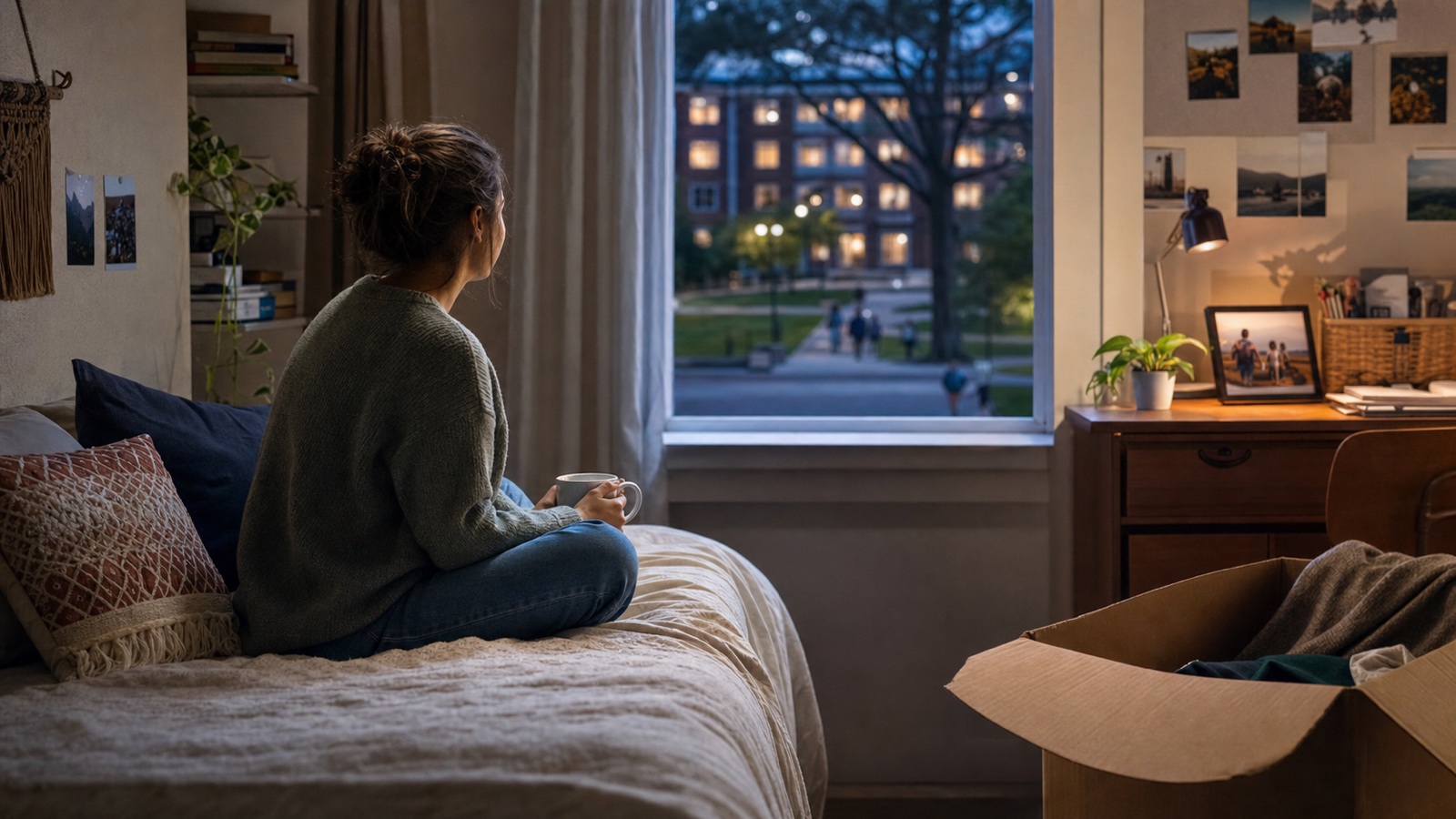
- Homesickness is an attachment response to losing familiar people, places, routines, and competence. It doesn’t mean you chose the wrong college.
- Staying connected to home can help, but constant remote contact can crowd out the local experiences that make campus feel familiar.
- Belonging usually grows through repeated, ordinary contact rather than one cinematic friendship moment.
- Get more support when distress is worsening or interfering with sleep, eating, classes, relationships, substance use, or safety.
The dorm door clicks shut after your family leaves. The room still smells like cardboard and somebody else’s cleaning spray. At 5:42 p.m., the hallway fills with voices from people who seem to have formed lifelong friendships during the elevator ride.
You text home that everything’s good. Then you eat crackers over the sink because the dining hall feels like a stage and you’ve forgotten how doors work.
Homesickness can make a perfectly reasonable transition feel like evidence that you’re failing. It isn’t. You’ve lost hundreds of small cues that used to tell your body, “You know how to live here.” Building new ones takes repetition, not a better personality.
Missing home doesn’t mean college was a mistake
Homesickness isn’t only missing your parents or your bed. You may miss the dog, your sibling’s noise, food that appears without a logistics meeting, streets you can navigate half asleep, or friends who already understand the backstory. You’re also missing competence. At home, you knew where to buy toothpaste. Here, even laundry has become field research.
A longitudinal study of first-year students found that homesickness generally decreased a little across the first semester, but people’s paths varied. Higher homesickness was linked with more difficulty adjusting socially on campus. It wasn’t linked with worse academic outcomes in that study. That’s reassuring, but it doesn’t mean the experience is trivial.
You can be excited and homesick at the same time. You can like your roommate and still want your old kitchen. Mixed feelings aren’t a referendum. They’re what happens when attachment and growth arrive with one set of luggage.
Contact with home should be a bridge, not a bunker
Some advice treats calling home as a weakness. That’s unnecessarily stern. Familiar relationships can steady you, remind you who you are, and make the transition less lonely. The useful question isn’t whether you should call. It’s whether contact leaves you more able to live where you are.
If every uncomfortable moment triggers a long video call, the relief may be immediate while the local world stays unfamiliar. The group chat can keep home warm, but it can’t hand you a campus life. Try predictable contact instead of continuous contact: a short call after dinner, a weekend video chat, or voice notes you can answer between classes.
Parents can help by listening without turning each hard evening into an extraction plan. “Do you want comfort, ideas, or help making a plan?” works better than “I knew this school was too far.” If visits home are frequent, notice whether returning to campus gets easier or whether each trip restarts the goodbye.
Belonging is usually built in boring installments
College marketing loves the sweeping lawn and spontaneous friend group. Real belonging is often less photogenic. It’s recognizing the person at the front desk, sitting near the same classmate twice, learning which dining-hall table has an outlet, and showing up to a club before you feel like a club person.
Research on student loneliness suggests that programs centered on social connection can help, although the evidence varies and no single activity works for everyone. One randomized trial found that a structured peer connection program improved belonging and reduced loneliness and depressive symptoms among new students. The practical lesson isn’t that you need a formal program. It’s that repeated, meaningful contact has more chance to grow than waiting alone for instant chemistry.
Choose one recurring place with a shared task: a study group, campus job, volunteer shift, intramural team, faith community, lab, rehearsal, or club that actually interests you. Shared activity gives conversation somewhere to stand. Friendship is less likely to bloom when every interaction begins with an audition for friendship.
Make the new place easier to recognize
Homesickness often spikes during unstructured transitions: waking up, returning to the room, eating alone, or watching the campus empty on a weekend. Give those moments a little scaffolding. Pick a breakfast location, a walking route, a library floor, and a regular time to do laundry. Routine isn’t glamorous, but neither is wondering for the fourth time where you left your student card.
Bring a few sensory anchors from home: a familiar mug, playlist, blanket, spice, photo, or bedtime ritual. Then add something local. Buy fruit at the nearby market. Learn one campus landmark each day. Find the bench where the afternoon sun lands. You’re not replacing home. You’re teaching your brain that this place also contains predictability.
Protect the basics without expecting them to cure the feeling. Regular sleep, meals, movement, medication routines, and daylight make adjustment less difficult to carry. Skipping food and sleeping at random won’t create homesickness, but they can make every emotional problem louder.
Don’t let social media grade your transition
Your feed may show roommates decorating together, orientation groups at midnight, and captions announcing that everyone has found their people. It won’t show the silent walk back after the photo or the student calling home from a bathroom stall. Comparing your full nervous system with somebody else’s highlight reel is poor data analysis.
Set a small boundary around scrolling during the hours when homesickness hits hardest. Use that time for a local action with a low social threshold: eat in a public space, ask a classmate one practical question, attend the first 20 minutes of an event, or study where other people are present. You don’t have to be dazzling. You’re collecting familiarity.
I’d rather see you make one repeatable connection than accept six invitations that leave you depleted. A useful week doesn’t need a movie montage. It needs a few places where your absence might eventually be noticed.
Know when adjustment needs more support
Homesickness can include sadness, crying, worry, irritability, appetite changes, poor concentration, and urges to go home. Seek help when symptoms are intense, worsening, lasting for weeks without movement, or interfering with classes, sleep, eating, hygiene, relationships, or your ability to leave the room. Escalating substance use, panic, persistent hopelessness, or thoughts of self-harm also deserve prompt attention.
Campus counseling, student health, disability services, academic advising, residence-life staff, and a trusted faculty member solve different parts of the problem. You don’t need to decide which office perfectly owns your distress before asking. Start with one and say what’s happening concretely: “I’m missing classes because I can’t get myself out of my room.”
If you might hurt yourself, can’t stay safe, or are in immediate danger, call or text 988 in the United States, call emergency services, or go to the nearest emergency department. Being away from home doesn’t mean you have to manage a crisis alone.
Try one home thing and one here thing
Today, choose one action that maintains home and one that invests locally. Send the photo to your sibling, then eat dinner in the dining hall. Schedule Sunday’s call, then ask the person beside you what they thought of class. Make your familiar tea, then drink it on the quad.
You don’t have to prove independence by cutting off what steadies you. You also don’t have to wait until you feel brave to build a life where you are. Home can remain yours while this place becomes knowable.
The bottom line: Homesickness doesn’t prove you’re at the wrong college or bad at independence. Keep a steady bridge to home while building small, repeated points of contact where you are. Protect your routine, choose one recurring local activity, and get help when distress is shrinking your ability to function or stay safe. Belonging usually arrives by accumulation, not revelation.
Sources: English and colleagues, “Homesickness and adjustment across the first year of college,” Emotion (2017); Ellard, Dennison, and Tuomainen, “Interventions addressing loneliness amongst university students,” Child and Adolescent Mental Health (2023); Costello and colleagues, “Facilitating connection to enhance college student well-being,” American Journal of Community Psychology (2022); Roxas and colleagues, “Homesickness among rural Appalachian university students,” Journal of American College Health (2023).
Why do I feel lonely in college?
Why being surrounded by people can still feel lonely and how connection starts small.

Why do I feel behind even when I’m doing okay?
How borrowed timelines turn ordinary progress into a private emergency.

What do you say when you call a therapist?
A practical script for taking the first step without having the whole story ready.
Is the transition becoming too much to carry alone?
A free 15-minute intro call can help you decide whether a psychiatric evaluation makes sense.