Why siblings fight, and when parents should step in
What ordinary sibling conflict can teach, when power or harm changes the response, and how parents can coach without becoming a courtroom.
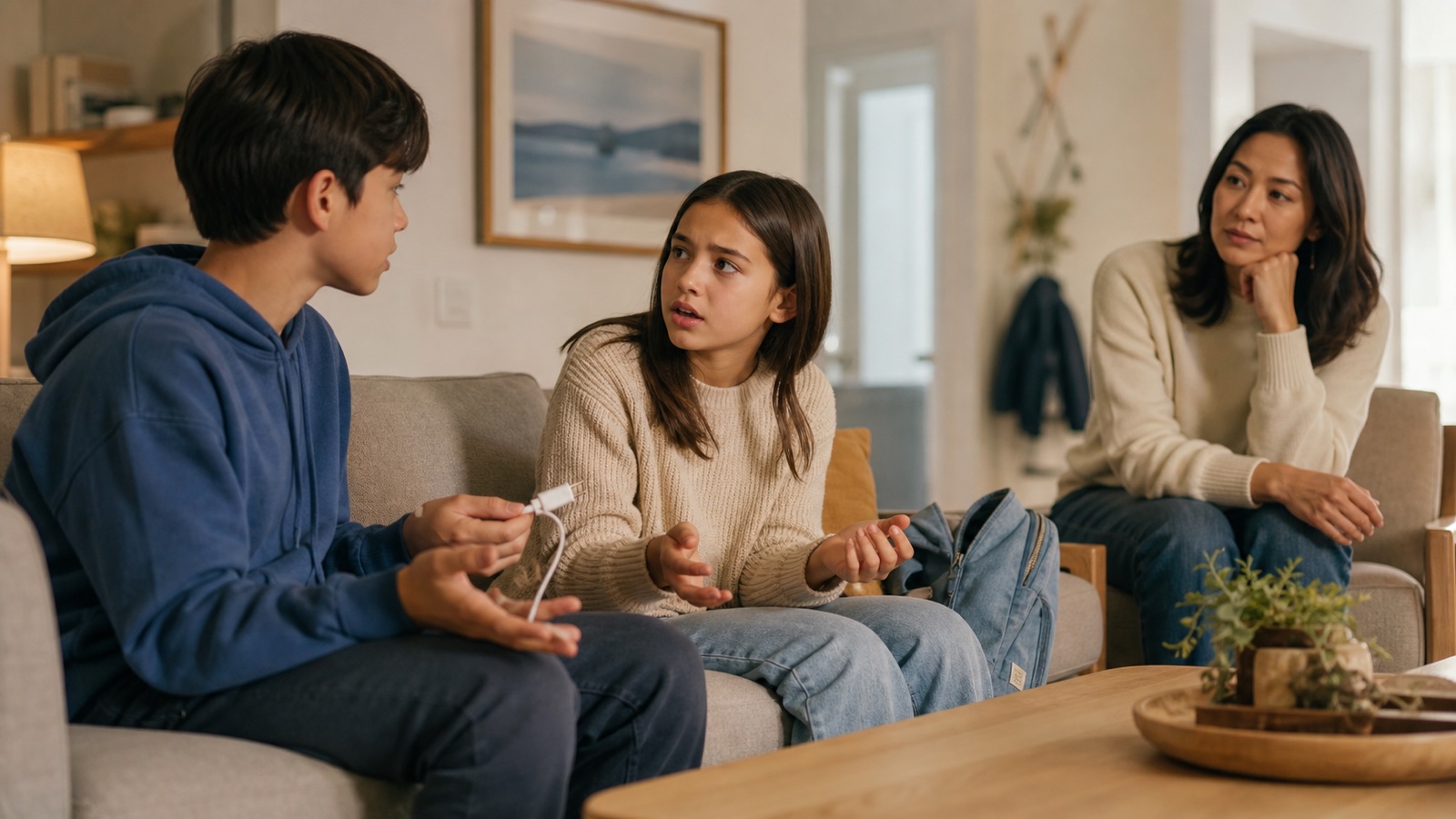
- Sibling conflict can involve competition, limited space, different needs, and problem-solving skills that are still under construction. It becomes more concerning when there’s a persistent power imbalance, fear, humiliation, injury, or one child can’t escape.
- Parents don’t need to determine who is morally correct in every dispute. They do need to protect safety and prevent a stronger child from turning conflict into domination.
- Look for the sequence, the real-life cost, and the exceptions before you turn a pattern into an identity.
- Safety, consent, functioning, and freedom matter more than a tidy label you found online.
Somebody used the wrong charger. Within 12 seconds, the hearing has expanded to cover every injustice committed since preschool.
Sibling conflict can involve competition, limited space, different needs, and problem-solving skills that are still under construction. It becomes more concerning when there’s a persistent power imbalance, fear, humiliation, injury, or one child can’t escape.
Here’s the part that takes the pressure off: you don’t have to determine who is morally correct in every dispute. You do have to protect safety and prevent a stronger child from turning conflict into domination.
Shame can turn a loud house into a verdict about your parenting. A more specific description creates room to notice the cue, understand what the fight is actually doing, and choose a response, without turning one difficult pattern into a family identity.
You’re not the judge. You’re the coach.
Start with what the fight accomplishes in the next few minutes. Siblings do practice negotiation through conflict, but unequal power or repeated targeting turns practice into harm. The immediate change may be relief, certainty, connection, or escape, and that’s why the same scene repeats even when its later cost is obvious to everyone in the house.
The delayed cost deserves equal attention. The central trap is investigating who started it while missing the pattern, the safety, and the skills neither child can use yet. What helps briefly can later produce resentment, distance, lost time, or less freedom. Understanding that sequence is more useful than declaring a winner.
Adults and young people may understand the same event very differently. Caregivers stay responsible for safety, while young people deserve dignity, developmentally appropriate privacy, and a real voice. Curiosity gathers more useful information than a kitchen-table diagnosis.
So swap “Who started it?” for a narrower review: what happened, what did each of them predict, what did they do, and what changed immediately? That sequence reveals where a small intervention can actually fit.
Map one fight, exceptions included
Take one recent example and walk it start to finish. The cue may be a loud argument that makes every disagreement look equally dangerous. Then note the interpretation, the body response, the urge, the action, the immediate result, and the delayed result. Volume is only one link in the chain, and it’s a poor measure of the rest.
Then find the earliest point where choice was still available. You probably can’t control the first surge of fear, shame, anger, or urgency, theirs or your own. You can often change whether it becomes avoidance, accusation, overwork, silence, or a decision made at peak intensity.
Here’s what actually matters:
- Both children can stop and recover.
- The same child is repeatedly targeted or afraid.
- Conflict includes threats, cruelty, sexual behavior, weapons, injury, or serious property destruction.
Look for the exceptions, too. Notice the people, settings, timing, sleep, preparation, or degree of safety that makes flexibility easier. Exceptions don’t make the concern imaginary; they show which conditions and skills may be worth recreating on purpose.
And check the first story against a wider record. Include the exact words or behavior, recent stress, sleep, health changes, power differences, and what a trusted observer noticed. Feelings are important evidence about experience, but they aren’t a complete recording of the event.
Safety and autonomy have to share the room
Begin with safety, then preserve as much autonomy as you can. Ask directly about self-harm, abuse, exploitation, violence, and substance risk when that’s indicated. Explain privacy and its limits clearly instead of treating every request for space as proof of danger.
Online explanations can make all of this sound far more certain than it is. A careful assessment considers development, culture, medical conditions, sleep, stress, trauma, mood, substance use, environment, and power. That slower differential is what keeps you from settling for a confident but incomplete answer.
Explanation isn’t permission for harm. Ordinary conflict allows recovery and shifting roles; bullying involves repeated harm and a power imbalance. That’s the line worth watching. The practical standards remain consent, accountability, safety, respect for another person’s freedom, and what happens after an impact is named.
A pediatrician, school professional, therapist, or child and adolescent clinician can help assess what’s happening in context. Development, learning, sleep, health, stress, family conditions, and mental health all matter. Persistent distress, major functional change, or safety concerns deserve direct evaluation.
Coach the next fight, not the last one
Insight earns its keep when it changes the next repetition. Here’s the concrete version: stop unsafe behavior, regulate first, hear each account separately when you need to, and coach one specific repair. Pick something small enough to use in the real moment rather than only when everybody’s already calm.
- Separate first when bodies are unsafe.
- Hear each child without forcing an immediate apology.
- Coach a concrete repair and a plan for next time.
- Track patterns rather than judging one loud moment.
A different response may feel rude, fake, weak, or unfinished at first, to you and to them. That discomfort can reflect unfamiliarity rather than danger. Practice is allowed to feel awkward while everyone learns that another outcome’s possible.
Measure progress by flexibility, not perfection. Improvement might mean pausing sooner, asking more directly, recovering faster, tolerating a little uncertainty, or protecting one limit. I’ll take that over a perfectly adjudicated charger dispute every time: one additional available move is meaningful change.
And a lapse doesn’t prove the pattern is permanent. Review the cue, the vulnerability, the action, and the consequence without staging a trial in the kitchen. Repair any impact, adjust the next attempt, and judge the pattern across repetitions rather than on one hard day.
When it’s past what parenting advice can fix
Consult a pediatric or mental health professional when aggression is frequent, escalating, developmentally concerning, or linked with trauma, major mood changes, school problems, or safety risk. Speak with each child privately.
If you do seek care, bring two or three concrete examples. Describe the loud argument that made every disagreement look equally dangerous, what you feared, what you did, how long the response lasted, and what it cost. Specific sequences are far more informative than a collection of internet labels.
Urgent support comes first when there’s suicidal intent, violence, abuse, severe confusion, inability to meet basic needs, or another immediate danger. None of this needs a perfect label before safety gets addressed.
For nonurgent care, seek an evaluation when there’s injury, threats, sexual behavior, cruelty, fear, weapon access, or one child can’t be safe at home. Depending on the cause, useful next steps may include individual therapy, family or relationship work, medical review, school support, a medication discussion, or environmental change.
Try one small experiment today
During the next low-level dispute, ask each child to name the problem, their need, and one workable trade. Step in directly if power or safety is unequal.
Before you try it, write down what you predict will happen. Afterward, record what actually happened, including the mixed and unimpressive results. The difference between prediction and observation is what gives you something new to work with.
Keep it small enough to repeat. A dramatic one-time family meeting may produce a story; ordinary practice produces data. Run the same step several times before you decide whether it helps.
The bottom line: Sibling conflict can involve competition, limited space, different needs, and still-developing problem-solving. It becomes more concerning when there’s a persistent power imbalance, fear, humiliation, injury, or one child can’t escape. The goal isn’t to eliminate every uncomfortable feeling. It’s to understand the sequence, protect safety and dignity, and make one more deliberate response available. Start with the smallest repeatable change, then judge it by what happens in real life rather than by whether it felt effortless.
Sources: National Institute of Mental Health, child and adolescent mental health resources; U.S. Surgeon General, “Protecting Youth Mental Health”; American Academy of Child and Adolescent Psychiatry family resources.

How to hold a family meeting that does not become another fight
How to keep a family meeting short, specific, and safe, with a structure parents and young people can actually use.

Autism and mental health: how a psychiatrist can help.
Psychiatry does not treat autism itself, but it can treat the anxiety, mood, sleep, focus, and irritability that often come with it. What that looks like, for kids and adults.

More than sadness: signs worth taking seriously.
Depression often looks like exhaustion, irritability, or numbness, not just tears. The signs worth taking seriously, when to seek help, and what actually treats it.
Would a clearer view of this pattern help?
A free 15-minute intro call can help you decide whether a psychiatric evaluation makes sense.