What if your teen asks you not to post their photo?
A teen can love the family photo and still want a say in where it goes. Ask before posting, make an easy repair if you already shared it, and build a family rule everyone can follow.
- A request for photo privacy is worth hearing, even when the image seems harmless to you.
- Ask before posting and make no the easiest answer your teen can give.
- If you already posted, take it down and repair without making your teen defend the request.
- Agree on a photo rule that adults and teens can both follow.
The photo looks lovely. The answer is still no.
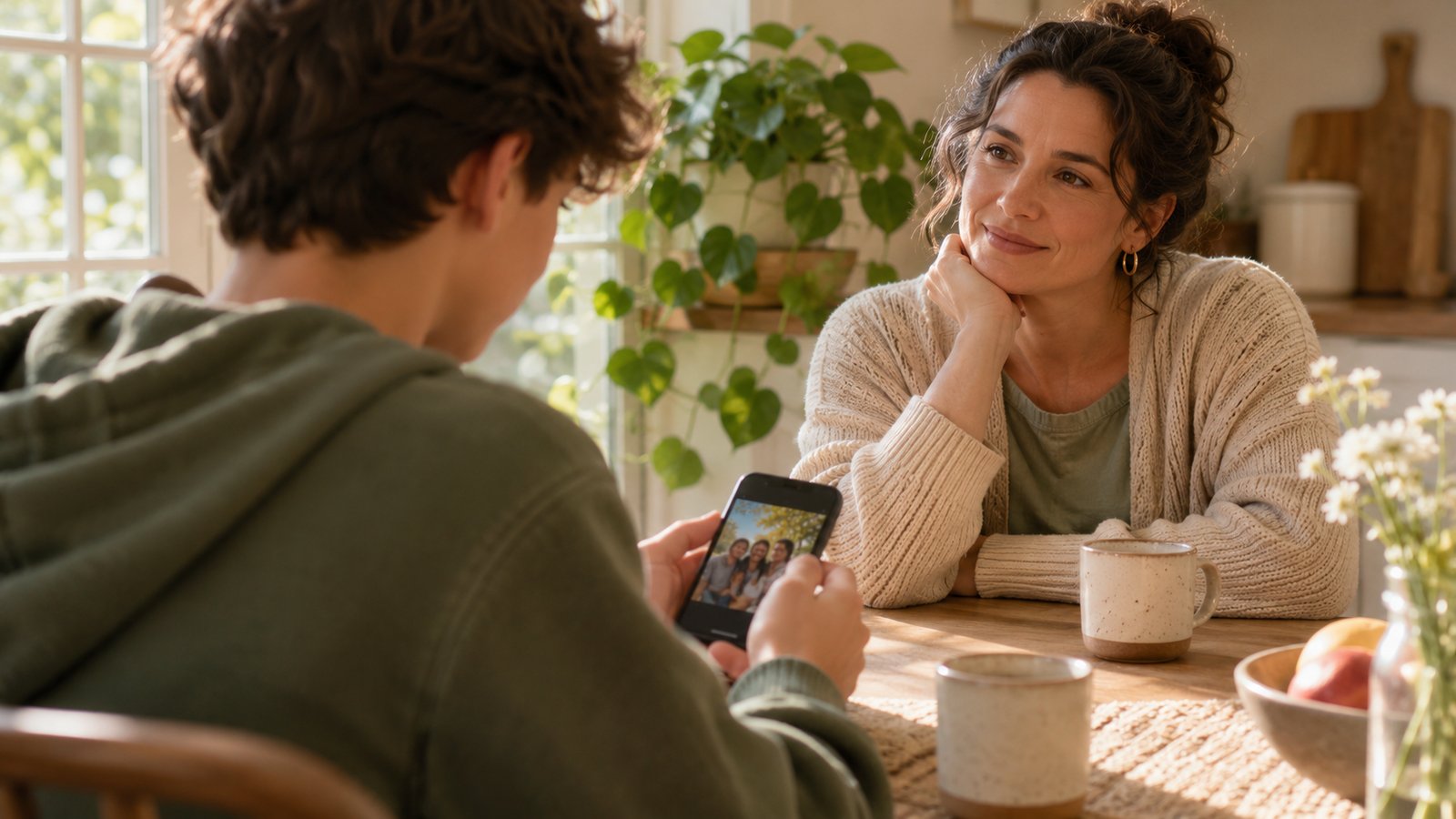
You’re clearing the breakfast plates when your teen sees last night’s family photo on your phone. Everyone looks happy. You’ve already picked a caption. Then your teen says, “Please don’t post that one.” The request lands oddly hard. You weren’t trying to embarrass anyone. You wanted Grandma to see the day. For a moment, a simple photo starts to feel like a vote on whether you’re a good parent.
It isn’t. Your teen may like the picture and still dislike having classmates, distant relatives, or strangers see it. They may want control over how they look online. They might not have a polished reason. You don’t need one before you pause. The American Academy of Pediatrics advises families to think about a child’s privacy and to ask older children before sharing. That’s a practical standard, not a verdict on every parent who has ever posted a birthday cake.
Ask before the upload, not after the argument
A useful question is, “Would you be okay with sharing this, and with whom?” A family group text, a private account, and a public profile aren’t the same audience. Your teen may agree to one and decline another. You can ask whether a different photo works, but don’t turn the choice into a negotiation they must win. If the answer is no, choose a picture without them or tell the story without an image.
Try to make the question real. If your face says “Please say yes so this post can go up,” your teen may hear pressure instead of choice. I’d rather see a parent practice one calm pause than deliver a speech about digital safety while the upload bar moves. Ask, wait, and accept the answer. That small sequence tells your teen that their preferences can matter even when an adult is excited.
Privacy settings help, but they can’t make a photo fully private. People can save, forward, or screenshot what they see. That doesn’t mean you must never share a family memory. It means your teen deserves a say before their image becomes part of an audience they didn’t choose. You can love a memory without publishing it.
If it is already up, repair is possible
Suppose you posted the photo yesterday, and your teen just found it. Start with “I didn’t ask you first. I’m sorry. I’ll take it down.” Then do that. Don’t ask them to prove the post was harmful or list who viewed it. They’re telling you about a boundary. You can acknowledge it before you know every consequence. Deleting a post can’t guarantee every copy disappears, but it’s still a meaningful repair.
You may feel defensive if the photo was ordinary and kind. Notice the difference between intent and impact. Your intent was to share affection. Their experience may be loss of choice. Both can be true. You don’t have to declare yourself a terrible parent to change course. And you don’t need your teen to comfort you for the mistake. A short apology followed by a changed habit usually carries more weight than a long explanation.
If another relative posted it, ask them politely to remove it. You can say, “We’re asking before sharing pictures of the kids. Could you take that one down?” You don’t owe the extended family a report on your teen’s feelings. If the relative pushes back, keep the rule simple. Your teen shouldn’t have to debate an adult in a comment thread to protect their own image.
Make a rule that works in both directions
At a calm time, decide what counts as sharing. Does a message to one grandparent need permission? What about a large family chat, a school page, or a public feed? There isn’t one answer for every household. Write down a workable rule: ask before posting an identifiable photo; show the exact image and caption; respect no; and check before tagging. You can revisit it as your teen grows.
Let your teen see that adults follow the rule too. You might ask before forwarding a funny screenshot of their text. They can learn to ask before posting a photo of a sibling or friend. The AAP tells teens not to forward a text or photo without permission. It’s easier to teach that habit when adults model it. This isn’t a clever way to win obedience. It’s how a shared standard becomes believable.
Some parents worry that saying yes to privacy means giving up every safety decision. It doesn’t. You still need to respond if an image shows danger, exploitation, or bullying. You can explain when safety requires an adult step. But a cheerful photo from a family meal rarely needs to become a test of parental authority. Keeping those situations separate helps your teen trust you when safety really is at stake.
Your teen may also change their mind. They might want a photo removed after they agreed to it. You can talk about what changed and what can be done now. A post can be deleted, though copies may remain. Treating a revised preference seriously teaches more than insisting that yesterday’s yes is a permanent contract. Online audiences shift; teenagers do too.
Let the next photo be an easy experiment
Before the next gathering, tell your teen, “I’ll ask before I share pictures with you in them. You can say no without a debate.” Then keep that promise once. If you’re disappointed, tell another adult privately. Your teen doesn’t need to manage your feelings about a missing post. A private album or printed photo may still let your family enjoy the moment together.
If photo disagreements are part of a larger pattern of conflict, bullying, or online harm, ask your teen what is happening and consider support from a pediatrician or mental health professional. One request for privacy alone isn’t a symptom to diagnose. Often, it’s simply a young person practicing a reasonable boundary in a world that makes sharing nearly frictionless.
The bottom line: Ask first, accept no, and repair promptly when you miss. A family photo can stay a family memory without becoming everybody’s content.
If you’re in a mental health crisis in the United States, call or text 988; for immediate danger, call 911.
Sources: American Academy of Pediatrics, sharenting guidance; American Academy of Pediatrics, teen media guidance.

Why do I regret opening up, even when it went well?
Why emotional disclosure can trigger regret after a good conversation, how responsiveness shapes intimacy, and what helps you resist the cleanup spiral.

Introvert or socially anxious? How to tell what is actually draining you
How introversion differs from fear of judgment, why both can coexist, and what to notice before forcing yourself to socialize more.

What if therapy feels stuck?
When therapy feels repetitive or unhelpful, you can name it. Review your goals, ask what should change, and decide together whether another approach fits.
Want help sorting through what you are noticing?
A free 15-minute intro call can help you decide whether psychiatric care fits the next step.