How do you help a teenager who feels left out?
How to listen when a teenager feels excluded, tell friendship pain from bullying, and help them find safer places to belong.
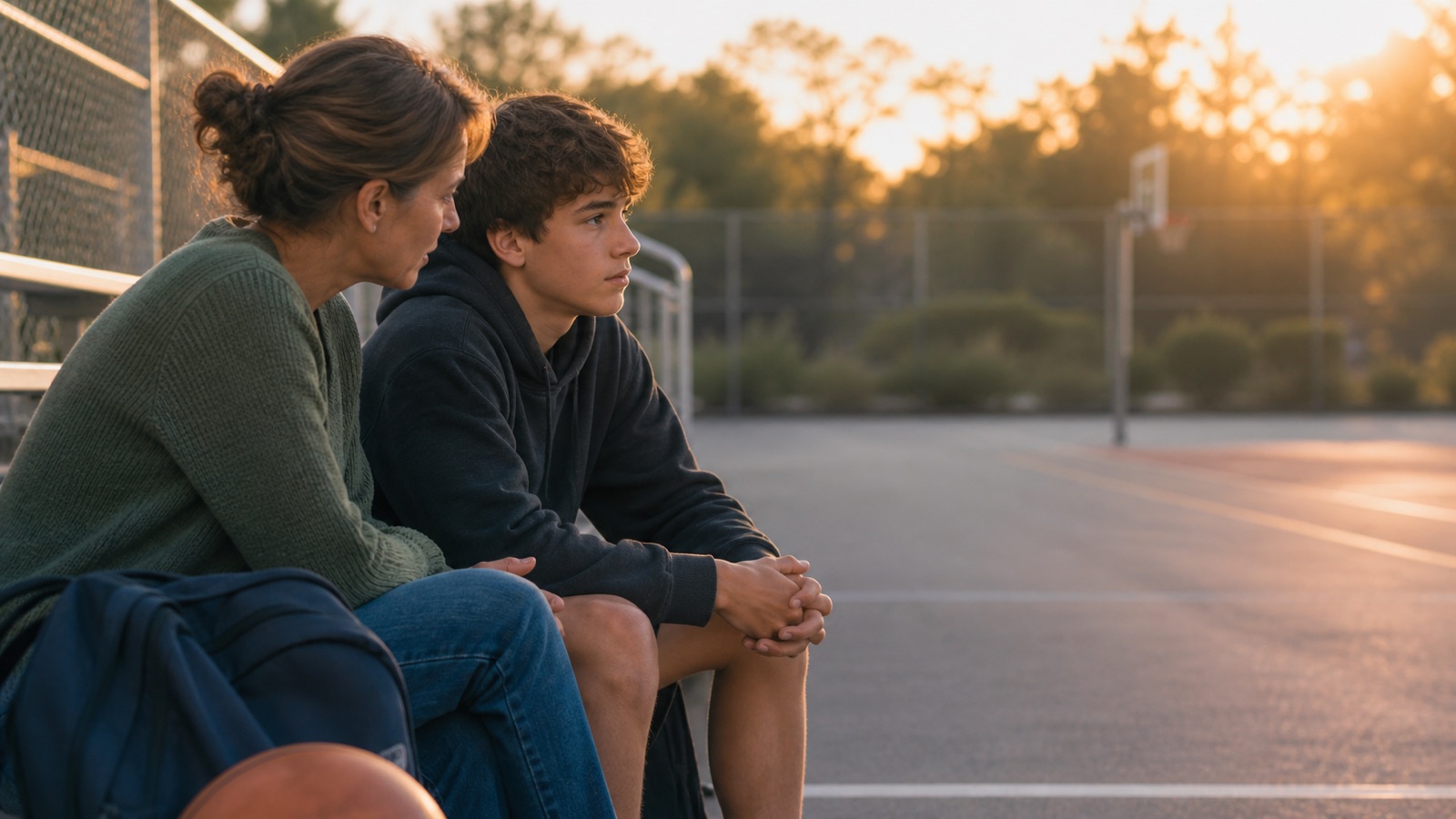
- Being left out can be ordinary friendship pain, a repeated exclusion pattern, or bullying; ask enough to understand before choosing a response.
- Your first job is to make the truth safe to tell, not to solve the entire social world before dinner.
- School connectedness and repeated contact around shared interests can create more realistic openings than telling a teen to be more social.
- Major changes in sleep, school attendance, mood, eating, self-worth, or safety deserve professional attention.
Your teenager gets into the car and closes the door harder than necessary. Their phone lights up, they flip it face down, and the answer to “How was school?” is “Fine” in a tone that has never once meant fine. Later, you learn there was a group photo from the weekend. Everyone seems to be in it except them.
You want to call the other parents, email the school, confiscate the phone, and deliver a small lecture about how these kids won’t matter in 10 years. Your nervous system has opened four browser tabs. Your teenager may only need you to sit down.
Peer exclusion can hurt sharply in adolescence, when belonging and social status carry enormous weight. You can’t guarantee an invitation or manufacture a best friend. You can help your teenager feel less alone, figure out what’s actually happening, and build a response that doesn’t make tomorrow at school harder.
Do not rush past the part where it hurts
Adults sometimes minimize exclusion because it isn’t physical danger: “They’re just being dramatic” or “Friend groups change.” Friend groups do change. The pain can still be real. Research consistently links peer victimization with more internalizing symptoms and lower self-esteem, though an association doesn’t mean every excluded teen will develop a mental health condition.
Start with something plain: “That sounds painful. Would listening, thinking together, or action help most?” Your teen may not know yet. You can say, “We don’t have to solve it tonight. Understanding comes first.”
Avoid silver linings in the first five minutes. Telling them these aren’t real friends may be accurate, but it can also sound like they were foolish for caring. Telling them to ignore it asks the person with the least social power to perform emotional invisibility. Listening isn’t passive. It’s how you keep the next piece of information coming.
Find out whether this is a bruise, a pattern, or a safety problem
One missed invitation can sting without being a campaign. Repeatedly excluding someone, spreading rumors, humiliating them, threatening them, impersonating them online, sharing private images, or recruiting others to isolate them is different. Bullying generally involves unwanted aggression and a real or perceived power imbalance, often with repetition or the likelihood of repetition.
Ask specific, neutral questions: “What happened before this?” “Who was there?” “Has it happened more than once?” “Does anything continue online or after school?” “Are you worried about going tomorrow?” Don’t conduct the conversation like a deposition. A teenager who feels interrogated may start protecting you from the details.
Also ask what they want kept private and explain the limits honestly. You can respect their voice without promising secrecy if someone is being threatened, assaulted, stalked, exploited, or pushed toward self-harm. If you may need to involve the school or another adult, say so before you do it when safety allows.
The group chat can make a school day last all night
Digital exclusion has peculiar efficiency. Your teen can watch the gathering they missed unfold in real time, then wake to comments about it. Removing the phone forever isn’t usually a realistic social strategy, and it may cut them off from supportive people too.
Instead, ask which digital moments do the most damage. Maybe it’s location sharing, late-night notifications, a particular thread, or repeatedly checking a story. Help them choose one boundary for tonight: mute the chat until morning, turn off location visibility, move the app off the home screen, or leave the phone charging outside the bedroom. The goal isn’t to prove they’re above it. It’s to give their brain several hours without live commentary.
Save screenshots of threats, impersonation, harassment, or harmful image-sharing before blocking or reporting. Keep the evidence privately. Don’t repost it to rally adults online. A parent counterattack can expand the audience faster than the original harm.
Belonging is easier to build around something than from nothing
“Make new friends” is technically a plan in the same way “become fluent in Italian” is a Tuesday activity. Friendship usually grows from repeated, low-pressure contact. A club, job, team, class, volunteer shift, youth group, gaming community with reasonable safety, or creative project gives conversation a subject other than “Will anyone decide to include you?”
Ask where your teenager feels even five percent more like themselves. Is there one classmate who seems kind, one teacher’s room that feels calmer, or one activity they’ve been curious about? Help remove practical friction: a ride, a fee, the first email, or permission to try twice before deciding. Don’t fill every afternoon in a panic. One tolerable doorway is more useful than a social rehabilitation tour.
CDC guidance emphasizes school connectedness, meaning students feel that adults and peers at school care about them and their learning. Connectedness is associated with better mental health and lower risk behavior. It isn’t created by putting up a belonging poster. It grows through safe adults, predictable inclusion, meaningful participation, and environments where social rank doesn’t control every interaction.
Bring the school a pattern and a concrete request
If exclusion is repeated, affects attendance or learning, or includes bullying, contact a specific adult who can observe the setting: a counselor, advisor, coach, teacher, or administrator. Share dates, locations, people involved, online spillover, and the effect on school functioning. Avoid diagnosing motives you can’t know.
Ask for actions that can be seen: an adult check-in before lunch, supervision in the hallway where incidents occur, a seating or group-work change, a safe place during an unstructured period, or a follow-up date. “Please keep an eye on it” is kind but vaporous.
I’d include the teenager in the plan as much as possible. Adults sometimes design an intervention that is technically protective and socially radioactive by second period. Ask what response would feel safest, what they fear will happen, and which adult they can tolerate checking in with. Safety can override preference, but preference still contains essential intelligence.
Watch the whole teenager, not only the friend group
Look for changes in sleep, appetite, concentration, school attendance, grades, activities, irritability, substance use, hopelessness, or statements about disappearing or not mattering. Ask directly about self-harm and suicidal thoughts when you’re concerned. Asking doesn’t plant the idea. It opens a door that shame often keeps shut.
A pediatrician or mental health clinician can help when distress persists, daily functioning changes, anxiety or depression symptoms grow, or the social pattern may involve ADHD, autism, social anxiety, trauma, or another concern. The goal isn’t to diagnose friendship. It’s to understand whether something treatable is making connection harder or making the pain more dangerous.
If your teenager has suicidal thoughts, call or text 988 in the United States for crisis support. If they may act, can’t stay safe, have been seriously harmed, or there’s immediate danger, call 911 or go to the nearest emergency department. Stay with them and reduce access to lethal means while help is coming.
Tonight, try this: “This is painful. Nothing changes without talking with you unless safety requires it. What part feels worst right now?” You can’t make every seat at the table available. You can make home a place where your teenager doesn’t have to audition for care.
The bottom line: You can’t negotiate your teenager into someone else’s group. You can believe the pain, distinguish ordinary shifts from repeated harm, involve the right adults, and create realistic routes toward belonging. The first protective relationship in this story may be the one they already have with you.
Sources: Centers for Disease Control and Prevention, school connectedness and classroom social-dynamics guidance (updated 2024, accessed August 2026); Ahmed and colleagues, ABCD longitudinal study of peer victimization, support, and mental health, Journal of Child Psychology and Psychiatry (2024); Mullan and colleagues, peer victimization, self-esteem, and internalizing symptoms systematic review and meta-analysis, PLOS ONE (2023); Hunt and colleagues, social inclusion interventions for adolescent anxiety and depression systematic review, International Journal of Environmental Research and Public Health (2023).

How much privacy should a teenager have?
How to protect trust while staying available for real safety concerns.

What to say when your child asks for therapy
How to respond without panic, dismissal, or turning the moment into an interview.

What should you do if your teenager is self-harming?
How to respond calmly, assess immediate safety, and connect them with care.
Would a clearer plan help?
A free 15-minute intro call can help you decide whether psychiatric care could support your family.