Is my teenager’s gaming actually a problem?
How to tell enthusiastic gaming from a pattern that is harming sleep, school, health, or family life, and how to respond without turning every game into a battle.
- Hours matter less than whether gaming is crowding out sleep, school, health, relationships, or the ability to stop.
- Gaming can provide friendship, competence, creativity, and relief; understanding that function makes boundaries more effective.
- Gaming disorder is a specific pattern of impaired control and meaningful impairment, not a label for every enthusiastic player.
- Calm, predictable limits and attention to underlying problems work better than diagnosing your teenager during a match.
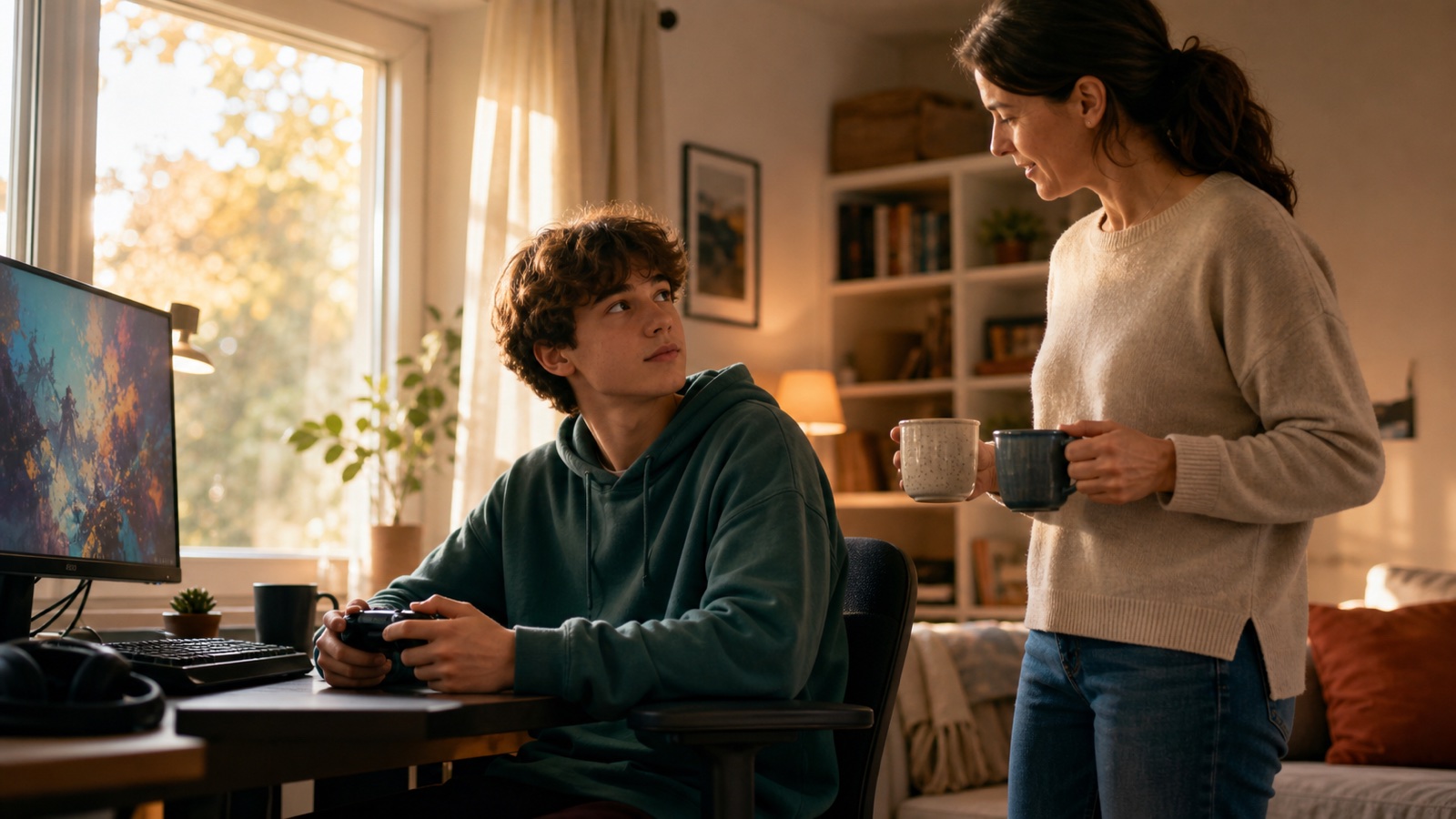
It’s 11:18 p.m. Light from the monitor is spilling under your teenager’s door, homework is open but untouched, and “one more match” has apparently become a unit of time with no known conversion. You knock. They shout that they can’t pause. You’re no longer discussing a game. You’re negotiating with a small international incident.
Parents often ask how many hours make gaming a problem. Time matters, especially when it displaces sleep or responsibilities, but there isn’t one magic number that diagnoses a teenager. The better questions are about control, consequences, priority, and what the gaming is doing in your child’s life.
Loving games isn’t the same as losing control
Games can be social, strategic, creative, competitive, and genuinely fun. A teenager may be talking with close friends, leading a team, building something elaborate, or finally feeling competent after a school day that supplied very little of that feeling. If you describe all gaming as pointless, you’ll miss both its appeal and your chance to influence it.
The World Health Organization defines gaming disorder through a persistent pattern of impaired control, increasing priority given to gaming over other activities, and continued or escalating play despite negative consequences. The pattern must cause significant impairment in personal, family, social, educational, occupational, or other important functioning, and it’s normally evident for at least 12 months.
WHO also emphasizes that only a small proportion of people who game develop gaming disorder. In the American Psychiatric Association’s DSM framework, internet gaming disorder has been listed as a condition needing further research rather than a standard diagnosis in the main section.
I’d pay less attention to whether a teenager looks absorbed and more to whether they can repeatedly adjust when life requires it. Intense interest isn’t automatically illness. Repeated failed efforts to cut back, major impairment, and continued play despite clear harm are more meaningful than a dramatic facial expression during a tournament.
Count what gaming is replacing, not just the hours
Look across the week. Is your teenager getting enough sleep, arriving at school, completing essential work, eating regular meals, moving their body, bathing, seeing people offline, and participating in family responsibilities? Has gaming taken over money, attention, or every available conversation? One late weekend doesn’t answer those questions. A steady pattern might.
Sleep is a particularly useful marker. A systematic review and meta-analysis found that problematic gaming was associated with shorter sleep, poorer sleep quality, daytime sleepiness, and more sleep problems. Most of that evidence is observational, so it can’t prove gaming caused every sleep problem. The loop can run both ways: a lonely, anxious, or wakeful teen may also game more.
The American Academy of Pediatrics’ 2026 policy moves beyond one-size-fits-all screen limits. It asks families and clinicians to consider the child, caregivers, platform design, content, context, and what digital use displaces. Some games are deliberately built around frequent rewards, social pressure, purchases, and difficulty stopping.
Anger when asked to stop is worth noticing, but it isn’t diagnostic by itself. You may be interrupting a live team event, triggering embarrassment in front of friends, or arriving after limits have changed three times that week. The anger matters most when it becomes threatening, destructive, unsafe, or part of a broader loss of control.
Ask what job the game has been hired to do
Gaming may be a hobby. It may also be refuge from bullying, academic failure, family conflict, depression, anxiety, ADHD-related frustration, or social discomfort. The game offers clear rules, quick feedback, measurable progress, and people who expect your teenager to show up. Real life is often less considerate.
I’ll sometimes ask a teenager, “What gets easier when you’re playing, and what gets harder afterward?” That question doesn’t assume the game is villain or cure. It reveals whether play brings connection, escape, mastery, numbness, or all four. The answer shapes the plan.
If gaming is the only place your teenager feels successful or connected, simply removing it may expose the pain without replacing the function. That doesn’t mean you can’t set limits. It means the plan also needs another source of friendship, competence, relief, or structure. Otherwise, you’ve removed the bridge before building a road.
Don’t begin the important conversation mid-match
Choose a neutral time and start with observations rather than labels: “You’ve slept about five hours on three school nights, missed two assignments, and we’re fighting about stopping every day.” That’s harder to dismiss than “You’re addicted to that thing.” It also leaves room for your teenager to correct what you’ve misunderstood.
Ask them to show you how the game works. Learn whether sessions can pause, how long a match lasts, who’s on the team, and what happens if they leave. Curiosity isn’t surrender. It lets you set a boundary that fits reality, such as no new match after 10 p.m., instead of demanding an impossible instant exit halfway through a team event.
Create a small set of predictable anchors: sleep, school attendance, essential work, meals, movement, household responsibilities, spending limits, and online safety. Decide the consequences before the problem moment, and keep them proportionate. A router unplugged without warning may produce a technically screen-free home and a spectacularly avoidable war.
Invite your teenager to help design the plan. They don’t get veto power over health and safety, but they can identify realistic stopping points and which privileges matter. Put the agreement in plain language. If the plan changes daily according to parental exhaustion, nobody is learning self-regulation. They’re learning weather forecasting.
A seven-day function check beats a dramatic confiscation
For one week, track bedtime, wake time, school attendance, assignments, meals, movement, in-person connection, gaming start and stop, and what made stopping easier or harder. Don’t make your teenager report every minute. You’re looking for whether gaming reliably crowds out basic functioning and whether agreed limits can be followed.
Try one design change at a time. Move charging and gaming equipment out of the bedroom overnight, set the final start time for a match, disable unplanned purchases, or schedule a valued offline activity before gaming begins. Make the replacement concrete. “Do something else” has never inspired a teenager to discover pottery at 9:45 p.m.
If the pattern remains severe, ask a pediatrician or mental health clinician for an assessment. A good evaluation looks at gaming behavior and coexisting sleep, mood, anxiety, attention, learning, family, substance, and safety concerns. It won’t assume every problem came from the screen.
Treatment research is growing but still uneven. A 2025 systematic review of youth studies found cognitive behavioral approaches were the most frequently studied, while overall evidence quality varied and long-term follow-up was often limited. Family involvement may help, especially because boundaries and relationships live in the home. There isn’t a medication that should be started simply because a teenager games a lot; coexisting conditions need their own careful assessment.
Know when the issue has moved beyond a household rule
Get professional help when gaming is linked with major school decline, repeated all-night play, loss of basic self-care, escalating spending or deception, aggression, severe isolation, or unsuccessful efforts to regain control. Seek urgent help for threats of violence, suicidal thoughts, psychosis, days of little sleep with unusually elevated or risky behavior, or any situation where someone can’t stay safe.
You don’t have to hate the game to take the harm seriously. You also don’t have to call your teenager an addict to set firm limits. The goal is a young person who can enjoy digital play without surrendering sleep, health, relationships, or the ability to choose what happens next.
If despair becomes unbearable, your teenager is talking about suicide, or anyone can’t stay safe, call or text 988 in the United States; call 911 for immediate danger. Stay with them, reduce access to lethal means when you can do so safely, and don’t leave an urgent risk to tomorrow’s screen-time meeting.
The bottom line: Don’t diagnose a teenager by hours alone. Look for impaired control and real harm, understand what gaming provides, set calm and predictable anchors, and get help when the pattern keeps displacing sleep, school, health, relationships, or safety.
Sources: World Health Organization, gaming disorder guidance and ICD-11 clinical descriptions (accessed August 2026); American Academy of Pediatrics, digital ecosystems policy statement and technical report (2026); American Psychiatric Association, internet gaming disorder overview; Park and colleagues, youth gaming-disorder treatment systematic review, Journal of the Korean Academy of Child and Adolescent Psychiatry (2025); Kristensen and colleagues, problematic gaming and sleep systematic review and meta-analysis, Frontiers in Psychiatry (2021).

Is my teenager’s phone use hurting their mental health?
How to look beyond screen-time panic and notice what technology is replacing.
When should you worry about your teenager’s anger?
How to separate ordinary intensity from a pattern that needs more help.
How do you talk to a teenager about vaping?
How to stay curious, set limits, and get useful information without a lecture.
Would a clearer plan help?
A free 15-minute intro call can help you decide whether psychiatric care could support what you’re noticing.