What does TMS treatment actually feel like?
What happens before, during, and after transcranial magnetic stimulation, including the tapping sensation, daily schedule, benefits, and risks.
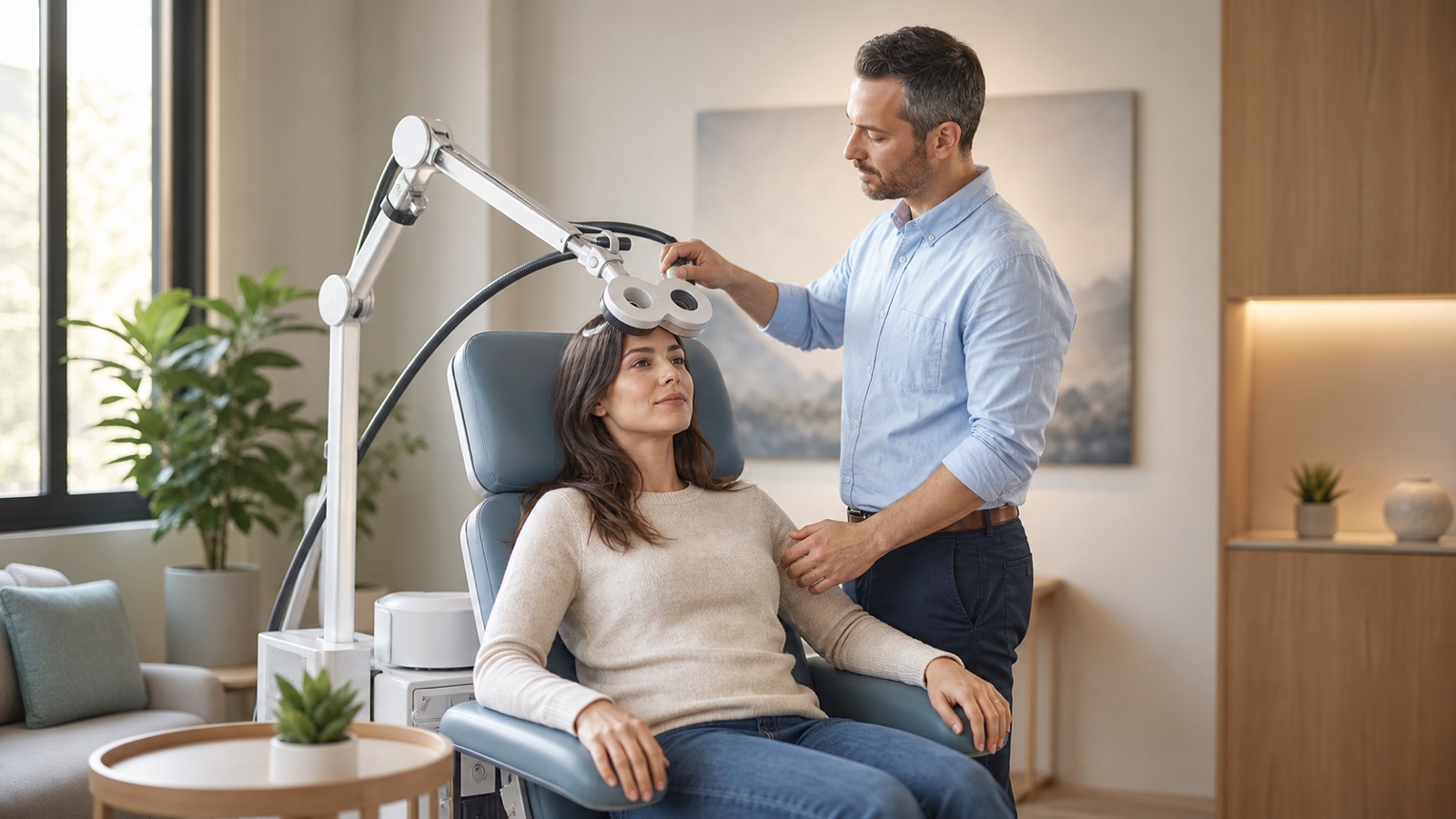
- TMS uses magnetic pulses from a coil placed against the scalp; you stay awake, and typical treatment doesn’t require anesthesia.
- The sensation is often described as repeated tapping or knocking, with scalp discomfort or headache being common early side effects.
- Standard repetitive TMS and shorter theta-burst protocols have different session lengths, so ask which exact treatment is being proposed.
- TMS is evidence-based for appropriately selected patients, but response isn’t guaranteed and rare serious risks require careful screening.
You sit in a padded chair holding a paper cup of water while a clinician moves a curved arm toward your forehead. There’s no hospital gown, no operating room, and no dramatic countdown. Then the machine starts tapping. It sounds a little like a determined woodpecker has earned a medical license.
Transcranial magnetic stimulation, usually shortened to TMS, is a noninvasive treatment that uses changing magnetic fields to stimulate targeted brain tissue. Several devices and protocols are cleared in the United States for specific conditions. This article focuses on the most common conversation: TMS for depression, often after medication or psychotherapy hasn’t helped enough or hasn’t been tolerable.
The first visit is mostly measuring, screening, and making the strange less strange
Before treatment, the clinician should review your diagnosis, previous treatments, medications, sleep, substance use, history of seizures, head injuries, implanted devices, metal in or near the head, and symptoms that might suggest bipolar disorder or psychosis. Don’t edit the history to become a better candidate. Screening exists because the safest protocol depends on the actual person in the chair.
You’ll remove magnetic-sensitive items near the head and use hearing protection. Depending on the system, the team may measure your head and find a treatment location using landmarks or imaging-based guidance. They may determine a motor threshold by delivering pulses over a movement area and watching for a small finger or hand twitch. That threshold helps set an individualized stimulation intensity.
I’ll be direct: “magnetic brain stimulation” sounds much larger than the room usually feels. You’re awake and able to speak. The coil stays outside your skull. Typical outpatient TMS doesn’t involve anesthesia, an incision, or the deliberately induced seizure used in electroconvulsive therapy. TMS and ECT are both legitimate treatments, but they aren’t interchangeable procedures.
The tapping can be odd before it becomes ordinary
During a session, a coil rests against your scalp, commonly near the forehead for depression treatment. Pulses arrive in a pattern. You may hear clicking and feel tapping, tingling, pressure, or contractions in nearby scalp or facial muscles. Some people find it mildly annoying. Others find the first sessions painful enough that the team needs to adjust positioning or increase intensity more gradually.
Tell the clinician what you feel. You don’t win treatment by silently enduring a bad coil angle. Small changes can matter, and the team needs to distinguish expected scalp sensation from symptoms that require stopping. You can usually sit quietly, listen to something if the clinic allows it, or talk between pulse trains.
Session length depends on the exact protocol. A traditional high-frequency repetitive TMS session may take roughly half an hour, while intermittent theta-burst stimulation can deliver the active pulses in about three minutes. The large THREE-D randomized trial found that a brief theta-burst protocol wasn’t inferior to standard 10-hertz treatment for adults with treatment-resistant depression. That doesn’t make every short protocol equivalent to every longer one.
The calendar is often harder than the chair
Many acute courses involve treatment on weekdays for several weeks, sometimes followed by tapering or maintenance based on response and the clinic’s plan. The exact schedule varies by device, protocol, condition, insurance authorization, and clinical judgment. Ask for the calendar before deciding. A treatment can be noninvasive and still be logistically invasive.
You generally leave without recovering from sedation, and many people return to ordinary activities afterward. Follow the clinic’s instructions, especially after your first session or if you feel lightheaded or unwell. Transportation, time off, childcare, and parking aren’t side effects in a trial table, but they’re real parts of whether treatment is workable.
Insurance requirements can also shape access. Coverage policies may require documentation of diagnosis and previous treatment trials, and coverage for one condition doesn’t guarantee coverage for another. A good clinic should explain authorization, expected fees, missed-session rules, and alternatives before the calendar fills itself.
Improvement usually arrives as a trend, not a cinematic reveal
Some people notice changes in sleep, energy, concentration, or the ability to begin tasks before they describe a clear mood lift. Others improve later in the course, and some don’t respond. Research supports TMS as an effective option for appropriately selected people with depression, including treatment-resistant depression, but group averages can’t predict your result.
Track symptoms and function at baseline and during treatment. Can you get out of bed sooner, answer messages, eat more regularly, or feel less trapped by hopelessness? Rating scales can help, but so can two or three concrete markers from your actual life. If nothing changes, the answer shouldn’t automatically be “more pulses forever.” The team should review diagnosis, targeting, dose, adherence, medications, and other options.
TMS may be used alongside medication or psychotherapy. Don’t change either on your own because treatment has started. If activation, reduced need for sleep, racing thoughts, impulsivity, worsening agitation, or suicidal thinking appears, contact the treating team promptly. Those changes deserve assessment, not a motivational poster about sticking with it.
Common discomfort is different from rare serious risk
Headache and scalp discomfort are common, especially early, and may lessen as treatment continues. Facial twitching can occur during pulses. Hearing protection matters because the device is loud. The clinic should ask about side effects rather than treating tolerance as assumed.
Seizure is a rare but serious risk. Risk depends on the protocol and individual factors, which is why seizure history, medications, substance use, sleep deprivation, and other clinical details matter. Metal or electronic implants near the head may make treatment unsafe or require device-specific review. A social media checklist can’t clear you for treatment.
Ask what emergency training the staff has, who supervises treatment, how often a qualified clinician reviews progress, and which adverse symptoms should trigger a call. Also ask what evidence supports the exact device, target, and protocol for your condition. “TMS” is a family name, not one identical recipe.
Bring five questions to the consultation
Ask which diagnosis is being treated, why TMS fits now, what protocol and target will be used, how response will be measured, and what happens if you improve only partly. Then ask about schedule, cost, side effects, maintenance, and alternatives. You’re not being difficult. You’re checking whether the plan has nouns and verbs.
Your brain isn’t being rebooted, and you’re not a broken appliance. TMS is a medical treatment with a meaningful evidence base, practical burdens, uncertain individual benefit, and real safety procedures. That’s less magical than advertising and more useful than fear.
If depression is worsening, you’re thinking about suicide, or you can’t stay safe, don’t wait for the next scheduled TMS session. Call or text 988 in the United States; call 911 for immediate danger. Contact the treating clinician urgently and involve someone you trust.
The bottom line: TMS usually feels like repeated tapping against the scalp while you sit awake in an outpatient chair. The sensation is only part of the decision. The right diagnosis, protocol, screening, schedule, measurement plan, and honest discussion of benefits and risks matter just as much.
Sources: American Psychiatric Association, position statement on transcranial magnetic stimulation (2024); National Network of Depression Centers and colleagues, TMS for depression consensus review, Biological Psychiatry (2025); U.S. Food and Drug Administration, repetitive TMS systems special-controls guidance (accessed August 2026); Blumberger and colleagues, THREE-D randomized noninferiority trial, The Lancet (2018); Liu and colleagues, theta-burst versus repetitive TMS randomized-trial meta-analysis, Neuromodulation (2024).

Therapy, medication, or both? How to actually decide
How to match treatment options to symptoms, preferences, and practical life.

What does off-label mean in psychiatric care?
Why clinicians prescribe off label and how to ask about the evidence.

How do I know if my antidepressant is working?
Which changes matter, how long improvement may take, and what to track.
Would a clearer plan help?
A free 15-minute intro call can help you decide whether psychiatric care could support your next step.