How much alone time is healthy in a relationship?
Why couples can need different amounts of solitude, how to ask for space without creating alarm, and what makes alone time restorative rather than distancing.

- There’s no research-backed number of hours that makes alone time healthy for every couple.
- Restorative solitude is chosen, understandable, and followed by reliable reconnection. Withdrawal is vague, punishing, or used to avoid the relationship.
- Ask for space by naming the need, duration, and return plan rather than making your partner guess what the distance means.
- A healthy relationship has room for closeness and autonomy without using either one as leverage.
It’s 9:13 a.m. on Saturday. Your partner is describing brunch options with the energy of a regional tourism board. You’re looking at the quiet chair by the window and thinking, with real tenderness, “Love you. Please become unavailable for an hour.”
You ask for some time alone. Their face changes. You’re asking for oxygen; they’re hearing an eviction notice.
Couples can care deeply about each other and need very different amounts of solitude. The useful question isn’t who has the healthier need. It’s whether both people can ask for closeness or space without turning the request into a verdict on the relationship.
There isn’t a correct number to negotiate toward
No credible formula says a strong couple should spend a certain number of hours together or apart. A daily diary study found no one-size-fits-all balance between solitude and social time. More time alone was linked with less stress and greater autonomy on some measures, but also with more loneliness and lower satisfaction on others. Whether solitude felt chosen mattered.
That’s inconvenient if you wanted a calendar rule, but useful if you live with an actual person. Needs change with work, parenting, caregiving, illness, travel, sensory load, social demands, and the size of your home. The partner who wants a whole afternoon alone after a conference may want constant company during a difficult week.
Don’t measure health by symmetry. One partner may reset through quiet while the other resets through contact. Fairness doesn’t require identical nervous systems. It requires that neither person’s preferred setting automatically outranks the other’s.
Chosen solitude feels different from being shut out
Studies of everyday solitude repeatedly find that autonomy changes the experience. Time alone tends to feel better when it’s wanted rather than imposed. In a relationship, that distinction affects both partners. “An hour to read can help you come back more present” creates a different experience from disappearing into another room after conflict and refusing to say when you’ll return.
Healthy alone time usually has a purpose, even if the purpose is simply rest. You come back more available, less irritable, or more able to choose what you’re doing next. Avoidant withdrawal tends to postpone every difficult conversation, punish the other person, or keep the relationship in permanent suspense.
The activity doesn’t decide which kind it is. A walk can restore you or become a way to vanish. An evening gaming can be a hobby or a sealed border. The question is what the time does to your capacity for connection and whether your partner can understand the pattern without decoding smoke signals.
Ask for space before you’re desperate for escape
If you wait until every sound feels personal, your request may arrive as a complaint: “Could we make some room for quiet?” The need is legitimate. The delivery makes your partner carry the accumulated overload as rejection.
Ask earlier and make the request concrete: “I’m socially spent, and I want 40 quiet minutes after dinner. I’ll come find you at 8:00 p.m., and I’d like to watch the show together.” You’ve named the reason, the length, and the return. A request for quiet doesn’t need a press conference, but it does need enough information to feel safe.
I’d avoid apologizing for having a need while also presenting it as a command. “I’m sorry I’m impossible, but don’t talk to me tonight” invites reassurance and blocks negotiation at the same time. Try warmth without self-indictment: “Nothing is wrong between us. My brain is full, and some quiet will help me be present later.”
Reconnection makes the pause believable
A return plan only works if you return. If you routinely ask for an hour and stay gone all evening, your partner’s alarm isn’t irrational. You’ve taught the relationship that time estimates are decorative.
Reconnection doesn’t have to be elaborate. Make tea, sit together for 10 minutes, touch their shoulder, ask how the call went, or start the shared plan you named. The point is to let your behavior say, “This was solitude, not an exit.”
The partner who wanted closeness also has a job. Don’t spend the entire pause sending check-in texts, sighing outside the door, or preparing a cross-examination. Space that must be constantly defended won’t feel restorative. Agree on what would justify interrupting and let ordinary discomfort remain ordinary.
Closeness shouldn’t require constant access
Some couples confuse intimacy with complete availability. They expect every errand, hobby, friendship, and free hour to be shared. That can feel romantic at first, especially when a relationship is new. Over time, it may leave both people with fewer experiences to bring back to the relationship.
Autonomy isn’t indifference. It’s the ability to have preferences, friendships, interests, and internal space while staying connected. Research on daily companionship shows that shared time can support positive mood and relationship satisfaction. Solitude research suggests that chosen time alone can also support lower stress and a sense of autonomy. A healthy relationship can contain both truths without putting them in a cage match.
Look at quality, not only quantity. Two people can spend an entire day in the same room while barely meeting each other. They can also spend several hours apart and reconnect with attention and interest. Proximity isn’t the same as presence.
Some distance isn’t a neutral preference
Alone time becomes concerning when it’s used to punish, intimidate, conceal major shared information, sustain compulsive behavior, or avoid all repair. It also isn’t healthy autonomy when one partner controls the other’s access to friends, family, work, money, transportation, communication, or care. That’s isolation and control, not a difference in social battery.
Pay attention when the pattern is new and paired with depression, anxiety, substance use, sleep disruption, major irritability, loss of interest, or a broad decline in functioning. A sudden need to withdraw may deserve a compassionate mental health or medical check rather than a relationship trial.
If relationship distress brings thoughts of self-harm, you might act on suicidal thoughts, or you can’t stay safe, call or text 988 in the United States or go to the nearest emergency department. If another person is threatening or controlling you, contact emergency services when danger is immediate and seek confidential domestic-violence support when it’s safe to do so.
Couples therapy can help when every request for space triggers panic, every request for connection feels intrusive, or agreements collapse repeatedly. The goal isn’t to declare one attachment style the winner. It’s to make each need understandable and build agreements both people can trust.
Try a one-week space agreement
Each person names one predictable period of alone time and one predictable period of focused connection for the coming week. Keep both realistic. A quiet commute may count for one person; it won’t count for someone who spends it answering work calls. Sitting beside each other while clearing email may be pleasant; it isn’t automatically focused connection.
At the end of the week, ask what changed. Did solitude reduce irritability? Did planned connection lower the fear around separation? Did either agreement feel controlling or impossible? Revise from the evidence of your actual lives, not an imagined couple who owns matching linen and never needs a door.
The bottom line: Healthy alone time doesn’t have a universal dose. It’s chosen, clearly communicated, and paired with reliable reconnection. Ask before you’re desperate, name how long you need, and return when you said you would. The aim isn’t maximum togetherness or perfect independence. It’s a relationship roomy enough for two people to breathe and still find each other.
Sources: Weinstein and colleagues, “Balance between solitude and socializing,” Scientific Reports (2023); Nikitin, Rupprecht, and Ristl, “Experiences of solitude in adulthood and old age,” International Journal of Behavioral Development (2022); Lay and colleagues, “Having time to oneself in times of extended togetherness,” Applied Psychology: Health and Well-Being (2023); Ross and colleagues, “How is companionship related to romantic partners’ affect, relationship satisfaction, and health behavior?” Applied Psychology: Health and Well-Being (2023); Centers for Disease Control and Prevention, “About Intimate Partner Violence” (2024).
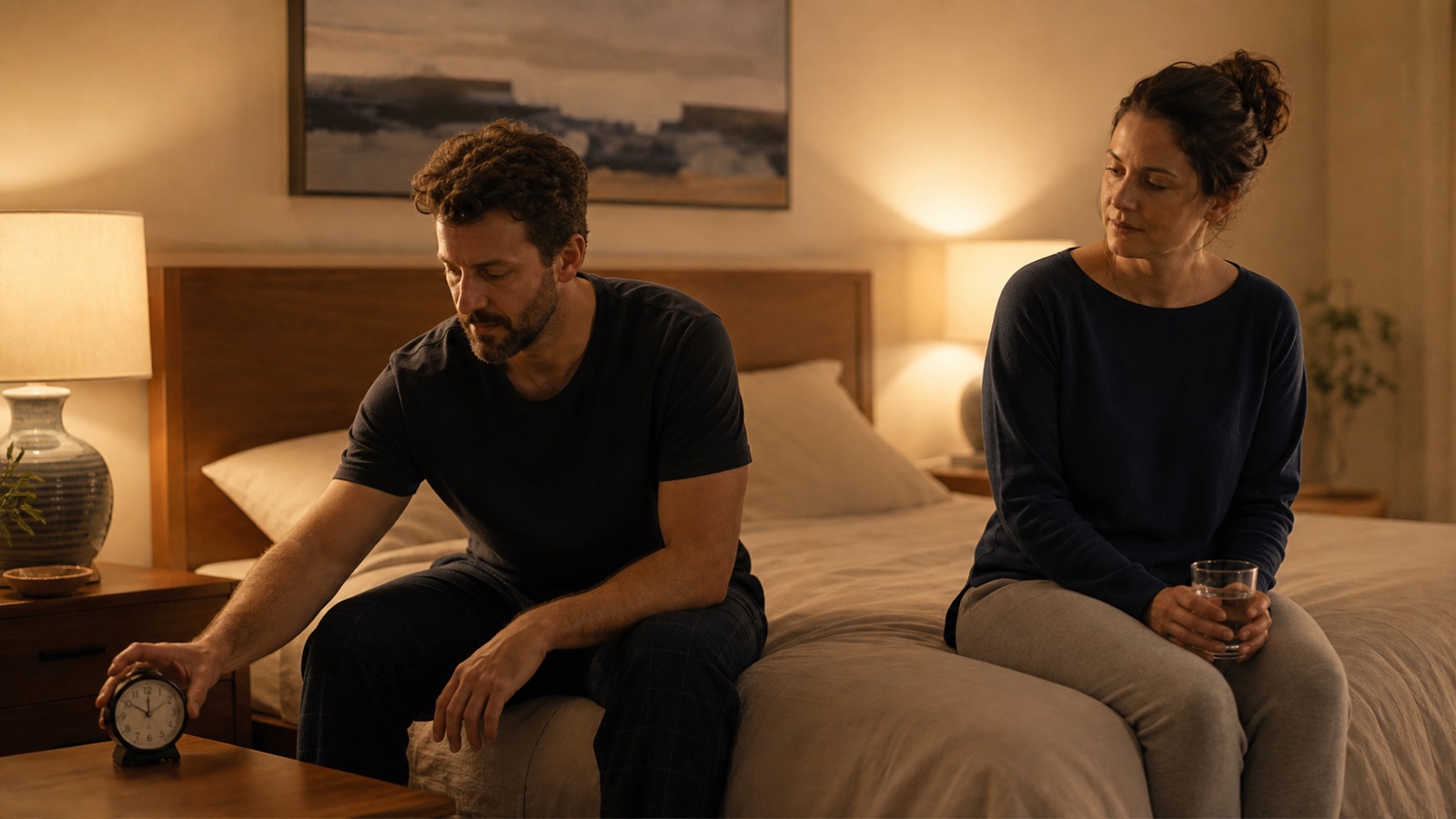
Should couples go to bed angry?
How to pause a late-night conflict without turning sleep into another weapon.

How to set a boundary without making it a threat
What boundaries control, what they don’t, and how to make yours clear.

Is our relationship bad enough for couples therapy?
Why you don’t have to wait for a crisis to learn a better pattern.
Would a clearer view of the pattern help?
A free 15-minute intro call can help you decide whether a psychiatric evaluation makes sense.