What helps when your child is afraid to sleep alone?
How to respond to bedtime fear without shaming your child, build gradual confidence sleeping alone, and know when the pattern needs more help.
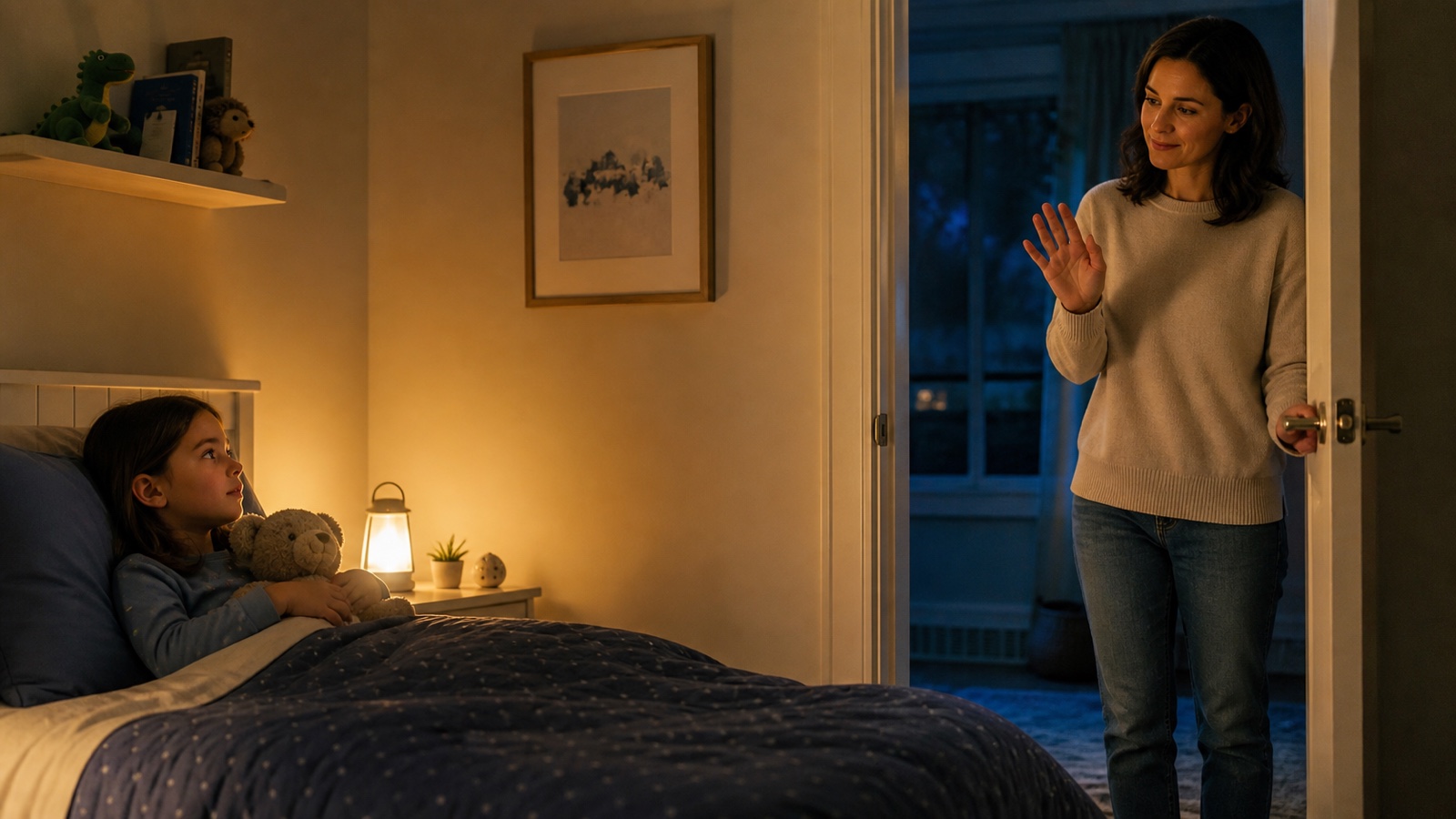
- Fear of darkness, separation, or imagined danger can be common in childhood without being fake or manipulative.
- Validate the feeling while communicating confidence that your child can practice sleeping safely in their own space.
- A gradual, predictable plan usually teaches more than either endless reassurance or a sudden forced separation.
- Persistent fear, daytime anxiety, trauma signs, major sleep loss, or medical symptoms deserves professional evaluation.
It’s 9:08 p.m. The story is finished, the water has been delivered, the closet has passed inspection, and you’re one careful step into the hallway when a small voice says, “Wait. What if something happens?”
You sit down again. Ten minutes later, you try the door. Another question arrives. By the fifth exit, bedtime has become a low-budget hostage negotiation, and everyone is too tired to remember the original plan.
A child who’s afraid to sleep alone isn’t necessarily being manipulative, immature, or dramatic. The fear can be completely real. Your job isn’t to prove that darkness is ridiculous. It’s to help your child feel understood while they practice doing something safe that still feels hard.
Bedtime gives worries a very quiet stage
During the day, there’s light, movement, noise, and access to you. At bedtime, stimulation drops and separation becomes obvious. A shadow gets promoted. A hallway sound earns a backstory. A thought about burglars, illness, nightmares, or losing a parent has room to finish its presentation.
Some bedtime fears are developmentally ordinary and short-lived. Children may fear the dark, imaginary creatures, storms, being alone, or sleeping away from home. Stress, a scary video, a move, family conflict, illness, loss, or a frightening event can also make sleep feel less safe.
The pattern matters more than one bad night. Ask when it began, what your child predicts, whether the fear appears during the day, and what happens after reassurance. Don’t conduct the entire investigation at lights-out, when everyone’s reasoning has changed into pajamas.
Validate the fear without confirming the danger
“There’s nothing to be scared of” may be factually confident and emotionally useless. Your child already feels scared. Arguing with the feeling can add shame without adding sleep.
Try two truths together: “I believe that this feels scary, and I know you’re safe in your room.” You aren’t agreeing that a monster exists. You’re showing that fear can be present without becoming the household safety director.
Keep your voice calm and your message boringly consistent. Long explanations, repeated inspections, and fresh promises can accidentally teach that each new worry deserves another safety procedure. Reassurance feels helpful for a minute, but if it must be renewed endlessly, bedtime never gets to close the question.
Check the room once, then trust the plan
Real comfort starts with ordinary safety. Make sure the room is physically safe, the temperature and bedding are comfortable, needed medications or devices are handled as directed, and your child knows how to reach you. A dim night-light, open door, comfort object, or predictable sound can be reasonable supports.
Then decide what won’t become a ritual. One closet check may fit the routine. Seven checks teach that the first six were unreliable. If you’ve promised to check in after a short interval, return when you said you would. Predictability builds trust better than a surprise disappearance.
Safety also means not locking a frightened child in a room, mocking them, threatening abandonment, or using darkness as punishment. Confidence isn’t the same as force. A plan should be firm enough to teach and humane enough to repeat.
Build a ladder your child can actually climb
Behavioral and cognitive approaches can improve childhood sleep problems, and small trials have found benefit from parent-based treatment for nighttime fears. The useful principle is gradual practice: reduce support in planned steps rather than waiting for fear to vanish first.
Your ladder might begin with the parent sitting beside the bed, then moving to a chair farther away, then the doorway, then brief scheduled check-ins. Each step should be specific and practiced for several nights. If the jump is enormous, add a rung. If it’s effortless, move forward.
Tell your child the plan during the day: “Tonight I’ll sit by the door for 10 minutes, then I’ll check on you twice.” Let them help choose a comfort object or the order of the bedtime routine. Choice makes practice more collaborative without giving fear control of whether practice happens.
Reward brave behavior, not a perfectly calm body
Praise what your child did: stayed in bed until the check-in, used the coping phrase, called once instead of five times, or returned to bed after waking. Don’t make the reward depend on never feeling afraid. That standard would disqualify most adults from trying anything difficult.
A simple morning chart can mark the practiced step. Keep rewards small and predictable: choosing breakfast music, an extra story the next evening, or a special activity with you. The message is “you practiced courage,” not “you purchased parental closeness by performing sleep.”
If the night goes badly, don’t stage a trial at breakfast. Review what was too hard, adjust one part, and try again. Progress often looks uneven because illness, school stress, travel, and family changes can temporarily raise the volume.
When your child appears in your doorway, be kind and brief
Decide in advance what you’ll do if your child leaves the room. Calmly walk them back, repeat the same short line, and avoid starting a new conversation. The first return shouldn’t earn a warmer hour than the original bedtime routine.
If co-sleeping is your family’s chosen arrangement and everyone sleeps well, an article doesn’t need to declare it a problem. If your goal is independent sleep because the current pattern is exhausting the family, change works better when the adults agree on the response.
Mixed signals are understandable when you’re tired. They’re also powerful. If one night brings 40 minutes of protest followed by access to the parent’s bed, a child may learn that longer protest is the working key. Consistency is not coldness. It’s how the rule becomes predictable enough to trust.
Look beyond bedtime when the fear keeps growing
Seek an evaluation when fear persists, causes major sleep loss, prevents sleepovers or separation, drives school refusal, produces frequent stomachaches or panic, or affects the whole family’s functioning. The American Academy of Child and Adolescent Psychiatry recommends help when anxiety becomes severe or interferes with ordinary activities.
A pediatrician can also assess snoring, breathing pauses, pain, reflux, restless legs, seizures, medication effects, or other medical contributors. Nightmares after trauma, abrupt behavioral change, or a child reporting that someone has hurt or threatened them needs careful attention beyond a bedtime plan.
Qualified care may include parent guidance, cognitive behavioral treatment for anxiety, behavioral sleep treatment, family work, or another approach based on the evaluation. Medication isn’t an automatic answer to sleeping alone, and you shouldn’t give sleep products without discussing safety and dosing with your child’s clinician.
If your child is in crisis, may hurt themselves, or can’t stay safe, call or text 988 in the United States or go to the nearest emergency department. Bedtime independence can wait while safety gets immediate attention.
Today’s experiment is to write one bedtime ladder with four rungs and choose only the first. Tell your child the plan before dinner, practice the coping sentence while the lights are on, and praise the attempt tomorrow. You’re building a skill, not winning a single night.
The bottom line: Your child’s bedtime fear can be real without the feared danger being real. Meet the feeling with warmth, keep the safety message steady, and reduce support in small planned steps. If fear is spreading into daytime life, sleep, school, or safety, bring in qualified help.
Sources: American Academy of Child and Adolescent Psychiatry, The Anxious Child (updated 2023); Aji and colleagues, sleep-related fears in children systematic review, Clinical Child and Family Psychology Review (2025); El Rafihi-Ferreira and colleagues, parent-based treatment for nighttime fears randomized trial, Journal of Anxiety Disorders (2019); Åslund and colleagues, cognitive and behavioral sleep interventions systematic review and meta-analysis, Journal of Clinical Sleep Medicine (2018).

When your child refuses school
What the morning fight may be telling you and how to respond.

Why am I afraid to fall asleep after trauma?
How nighttime can keep an alarm active and what supports recovery.

What to say when your child asks for therapy
How to listen, assess urgency, and make the next step feel possible.
Would a clearer plan help?
A free 15-minute intro call can help you decide whether a psychiatric evaluation makes sense.