What if your child keeps comparing themself to a sibling?
Sibling comparisons can sting even in a loving home. Hear what your child is saying, drop family labels, and make space for each child to grow.
- Acknowledge the sting without ranking the children in another way.
- Describe each child’s effort and interests instead of assigning fixed labels.
- Different needs can call for different support; explain the reason clearly.
- Persistent self-criticism or withdrawal deserves a closer look.
The comparison starts at the kitchen table
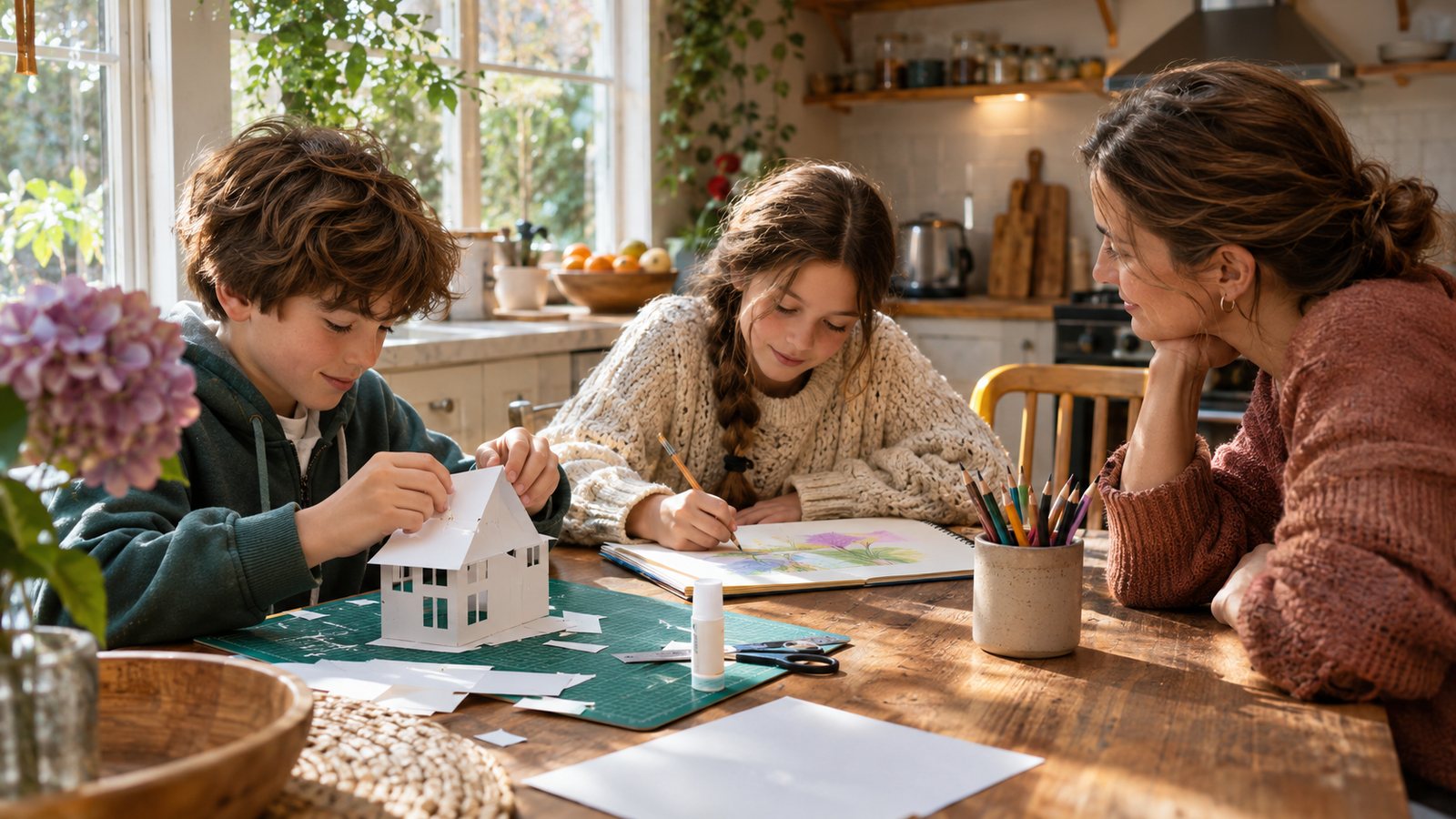
One child holds up a drawing. Before you can admire it, they glance at their sibling’s paper model and say, “Mine isn’t as good.” You reach for reassurance. “Of course it is!” They don’t believe you. Later, the sibling who built the model asks whether you’re disappointed that they don’t like drawing. Somehow a quiet afternoon has become a family talent show nobody signed up for.
Children compare themselves for many reasons. They’re trying to understand what they can do, where they belong, and how adults see them. A sibling is close enough to make the comparison easy and different enough to make it sting. You can’t remove every comparison from your child’s mind. You can change what happens next in the room.
Research on parental differential treatment finds associations between how differently siblings experience parenting and children’s emotional and behavior difficulties. A 2025 review combined studies but couldn’t prove that one comment causes a mental health problem. Children have different needs, and their behavior also shapes a parent’s response. The useful lesson isn’t “treat everyone identically.” It’s to notice the messages each child may hear about their worth.
Don’t make one child the family standard
If your child says, “My sister is smarter,” resist a quick ranking in the other direction. “You’re better at sports” may sound kind, but it keeps the contest running. Try, “It sounds hard to see her finish that so quickly. What part of your own project are you proud of?” You can acknowledge the sting without pretending the two children have the same skills.
The American Academy of Pediatrics explains that siblings can grow up in the same home and still differ in temperament, interests, abilities, and experiences. A different teacher, friend, or hobby can matter. That’s good news for a parent tempted to look for a single family scoreboard. Your children aren’t separate entries in one race. They need room to become people with different starting points and different aims.
I would pay attention to the labels adults repeat without meaning to: the responsible one, the sensitive one, the easy one. A label can seem flattering until a child feels required to keep performing it. “You’re our math kid” may leave no room for frustration in math. “You’re the artistic one” can make another child feel that art isn’t theirs to try. Describe what you notice today instead of assigning a permanent role.
When you praise, make it specific and private when possible. “You kept working when the roof of that model fell over” tells a child what they did. “You’re the clever one” tells the family who they are supposed to be. Ask each child what they enjoy, not only what they do well. A child can love drawing without winning a contest, and can dislike a sport while still wanting time with you.
Fair can look different without being secret
Maybe one child needs more help with reading while another needs a ride to practice. You don’t have to make every minute or dollar identical. You do need a way to explain differences without turning a sibling into the reason someone misses out. “Your brother needs support with this assignment” is clearer than “He needs me because you never struggle.” One sentence describes a need; the other hands a child a role.
Set aside a little one-to-one attention that isn’t earned by achievement or crisis. It can be a walk to the mailbox, a ride, or a few minutes on the couch. Ask about the child’s own day without bringing up the sibling. This isn’t a magic equalizer. It gives you a place to learn what that child thinks the family sees. You might be surprised by which moment they remember.
If a child says you favor the other one, don’t open with a courtroom defense. Ask, “What makes it feel that way?” Listen for a repeated pattern, not just a single disputed decision. You can explain a particular choice and still take the feeling seriously. “Your sister’s games have been coming up first every evening” is a more useful discovery than winning an argument about your intentions.
You can also stop adults outside your home from comparing the children. “We don’t rank them against each other” is enough for a grandparent, coach, or friend. If you can’t control the comment, you can repair it afterward: “That was an unfair comparison. Your path doesn’t need to match hers.” Children often need you to name what happened, not pretend they didn’t hear it.
Notice when comparison becomes a bigger burden
An occasional “not as good” doesn’t tell you a child has a disorder. But if they regularly call themself worthless, stop trying things they used to enjoy, withdraw from friends, struggle at school, or seem persistently sad or anxious, talk with their pediatrician or a mental health professional. Ask what else is happening, including stress at school, bullying, learning needs, and family changes. A Journal article can’t sort those causes for your child.
If one sibling is being mocked or pushed around by the other, intervene. Don’t assign them the job of becoming tougher. Set a limit on the behavior and help each child explain what happened without making a winner. Repeated cruelty needs more attention than a reminder to be nice. Your job is to make home safer for both children, including the one whose behavior needs a firm boundary.
Try one small experiment today. Pick a moment you would usually compare, even kindly, and describe the child’s own effort or interest instead. Then ask a question that belongs only to them: “What would you like to try next?” You won’t erase every comparison by dinner. You may give your child a new way to hear you.
If your child talks about wanting to die or you think they may be unsafe, seek immediate help. In the United States, call or text 988 for a mental health crisis; call 911 for immediate danger. You don’t have to decide whether a statement is “serious enough” alone.
The bottom line: Your children don’t need identical treatment or a family ranking. Notice the comparison, ask what it means to each child, and make room for their different needs without assigning permanent roles.
Sources: Jiang et al., 2025 network meta-analysis; American Academy of Pediatrics, Why Siblings Are Not Always Alike; 2024 meta-analysis of parental differential treatment.
Why siblings fight, and when parents should step in
What ordinary sibling conflict can teach, when power or harm changes the response, and how parents can coach without becoming a courtroom.
How do you explain different rules to siblings without making one child the problem?
How parents can explain different supports or limits to siblings, protect each child’s privacy, and make fairness visible without making one child the problem.

Why does your teenager apologize for everything?
How to tell repair from reassurance seeking when a teen says sorry often, respond without shame, and notice when more support may help.
Want help sorting through what you are noticing?
A free 15-minute intro call can help you decide whether psychiatric care fits the next step.