How do you make homework less of a nightly fight?
Why homework conflict can grow, how structure and autonomy can lower the temperature, and when school struggles deserve a closer look.
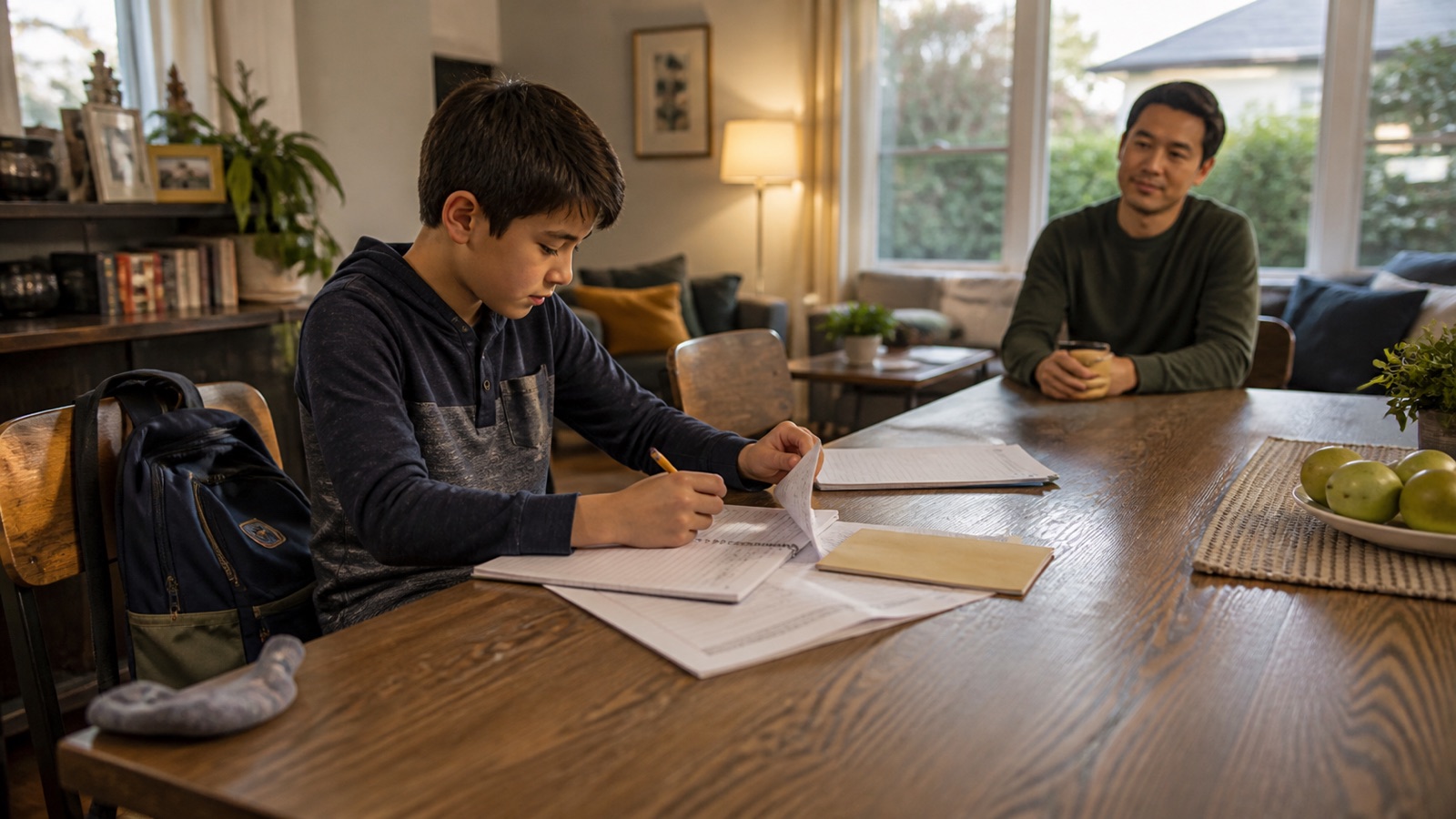
- Homework conflict often reflects a broken step in the system, not a child who simply does not care.
- Structure helps most when your child has meaningful choices inside it.
- Parents can support planning and persistence without becoming the student, editor, or nightly police department.
- Persistent struggle may point to sleep, learning, attention, mood, anxiety, bullying, or workload problems worth assessing.
It’s 7:16 p.m. The worksheet is on the table, the pencil has rolled to the floor, and your child has announced that the assignment is both impossible and somehow already finished. You’ve asked nicely, then firmly, then in the voice you reserve for assembling furniture without instructions. Nobody is learning much except new ways to resent fractions.
Homework fights can make a caring parent feel like a failed manager and a struggling child feel like a defective employee. Usually, the useful move isn’t more intensity. It’s finding where the chain breaks, adding enough structure to support it, and returning as much ownership as the child can handle.
Find the broken step before judging motivation
“Do your homework” sounds like one task. It’s actually a small corporation. Your child has to know the assignment, bring home the right materials, understand the directions, estimate time, begin, sustain attention, tolerate mistakes, check the work, pack it, and turn it in. A problem at any link can look like defiance from across the kitchen.
Ask neutral questions. Is the assignment visible somewhere reliable? Are materials making it home? Does your child understand the first step? Is the work too easy, too hard, too long, or arriving after their attention and medication support have worn off? Can they finish but not submit? The American Academy of Pediatrics recommends examining this sequence rather than assuming one perfect homework setting fits every child.
The goal isn’t to excuse every refusal. It’s to solve the right problem. A missing planner needs a capture system. Confusing algebra needs instruction. Exhaustion needs a different conversation. None of those improves because the volume goes from concerned parent to airport tarmac.
I often want to know what happens during the first five minutes. If the child can work once started, initiation may be the bottleneck. If they stall at every new question, understanding or frustration tolerance may matter more. The behavior is giving you data, even when it’s delivering the data with theatrical sighing.
Structure works better when it includes a vote
Children generally need boundaries around homework, but control and structure aren’t the same thing. Structure makes the next step predictable. Control tries to force the child’s internal state. You can establish that schoolwork happens before gaming without demanding that your child feel cheerful about this remarkable opportunity.
Offer two or three real choices: kitchen table or desk, snack first or after the first task, music or quiet, math or reading first, a short break now or after 15 minutes. Do not offer choices you can’t accept. “Would you like to do homework?” is not autonomy support when the only survivable answer is yes.
Recent meta-analyses found that parental homework involvement overall was not reliably linked with better achievement, while autonomy-supportive involvement showed a more favorable association than intrusive or controlling help. These studies cannot prove that a particular parenting style causes grades to change. Parents understandably help more when a child is already struggling. The practical signal is still useful: how you help may matter more than how much you hover.
Agree on a regular starting window and a workable place, then test it for a week. Some children need quiet. Others work better near ordinary household activity. A child who has held it together at school may need food, movement, or decompression first. The best routine is not the one that looks most scholarly in a brochure. It’s the one your family can repeat.
You don’t need a perfect color-coded chart. If the routine isn’t working, change one variable instead of replacing everything. If your child can’t explain the assignment, more reminders won’t create understanding. If they’re hungry, a lecture doesn’t count as a snack. And if you’ve chosen a plan together, don’t revise it mid-task unless safety or new information requires it. Predictability won’t make homework delightful, but it’ll stop the rules from moving while your child is trying to follow them.
Be the support crew, not the substitute student
Your job can include helping make a list, finding materials, breaking a large project into steps, clarifying when to ask the teacher, and noticing effort. It usually should not include rewriting sentences, correcting every error, or sitting beside the child until your combined nervous systems file a grievance.
Use prompts that return the thinking: “What does the direction ask?” “Which part do you know how to start?” “What could you ask the teacher tomorrow?” If your child asks for an answer, help them locate the method instead. Teachers need to see what the student understands, not what a well-rested adult with internet access can produce.
Keep praise specific and believable. “You started after the timer and stayed with the first section” gives useful feedback. “You’re a genius” creates a strange burden for the next worksheet. Notice strategy, persistence, help-seeking, and recovery after frustration.
If you’re helping, ask what kind of help is wanted. Your child might say, “Stay nearby, but don’t talk,” which isn’t exactly a greeting-card moment. It’s still useful information. You can’t build independence by doing everything, and you won’t build trust by disappearing whenever the work gets hard. Support can be present without taking the steering wheel.
If conflict starts rising, pause the interaction before the lesson becomes secondary to the power struggle. Say what you see: “We’re both getting louder and the work isn’t moving. Let’s take 10 minutes, then choose the first step.” A pause needs a return time. Otherwise it’s just homework escaping through a side door.
Bring the school into a school problem
If homework routinely consumes the evening, email the teacher with concrete observations rather than a verdict. Include how long the work takes, where the child gets stuck, how much help is required, and whether the same pattern appears across subjects. Ask what the assignment is meant to practice and what level of parent support is expected.
A short daily exchange may help when assignments or completed work keep disappearing. For older students, build the communication around them rather than secretly operating a parallel school administration. The aim is increasing independence over time, not proving they should already have it.
Persistent homework trouble can be associated with ADHD, learning disorders, anxiety, depression, sleep problems, vision or hearing issues, bullying, family stress, language barriers, or a poor match between workload and developmental level. None can be diagnosed from a messy backpack. Consider a pediatric, school, or mental health evaluation when the struggle is sustained, affects self-esteem or family functioning, or appears alongside broader changes.
Pay special attention to hopelessness, harsh self-criticism, school avoidance, major sleep or appetite change, withdrawal, substance use, self-harm, or talk about death. Ask directly about safety when you’re concerned. Call or text 988 in the United States for suicidal thoughts or a mental health crisis, and call 911 for immediate danger.
Try one reset, not a complete family rebrand
Tonight, take five minutes before the work begins. Ask: What has to be done? Which part should come first? What help do you want from me? Write the plan where both of you can see it, choose a short work interval, and step back far enough for your child to own the pencil.
Afterward, review the system rather than the child: What worked? Where did it jam? What should change tomorrow? You’re building a routine, not conducting a character trial. Homework may never become the family’s favorite evening entertainment. A peaceful truce with decent follow-through is an entirely respectable outcome.
The bottom line: Treat homework conflict as a system to understand, not proof that your child is lazy or that you have failed. Find the broken step, create a repeatable routine with real choices, support without taking over, and involve the school or a clinician when the struggle is persistent or broader than homework.
Sources: American Academy of Pediatrics, HealthyChildren guidance on homework habits and ADHD-related homework problems (updated 2025); Xu and colleagues, Psicothema, three-level meta-analysis of parental homework involvement (2024); Jiang and colleagues, Frontiers in Psychology, meta-analysis of supportive and intrusive homework involvement (2023); American Academy of Child and Adolescent Psychiatry, Children and Schools resources (current August 2026).
Why are mornings so hard for a child with ADHD?
How to reduce decisions and build a routine that can actually repeat.

Why does my child fall apart after school?
What after-school collapse may be communicating.

What do you say when your child says “I’m stupid”?
How to respond without arguing away the feeling.
Would a clearer family plan help?
A free 15-minute intro call can help you decide whether psychiatric care could support what your family is noticing.