Why does my child fall apart after school?
Why some children unravel when the school day ends, how to make the transition gentler, and when frequent outbursts need more support.
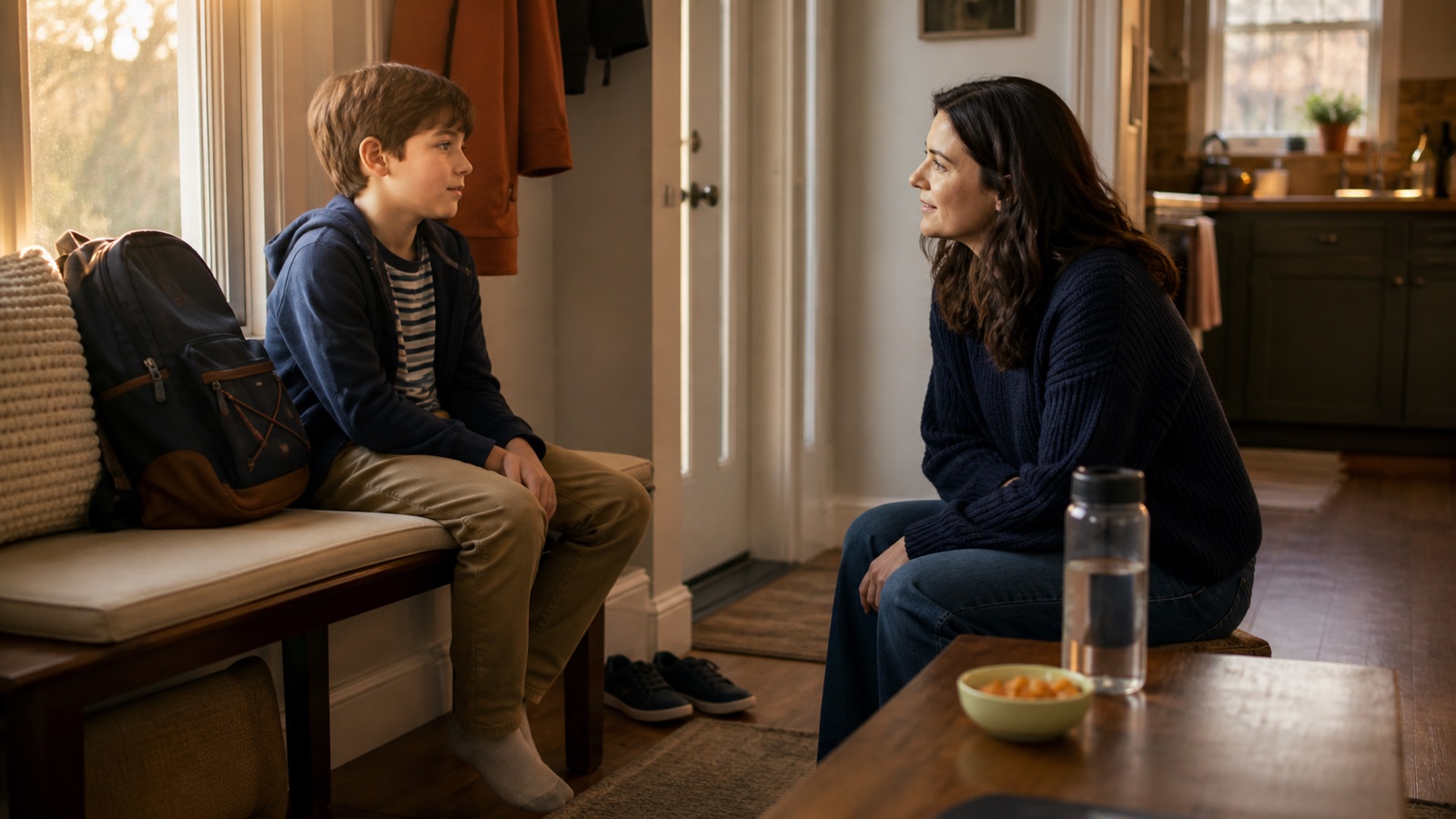
- A child can hold it together at school and still have little regulatory capacity left at home.
- The popular phrase after-school restraint collapse describes a pattern, not a medical diagnosis.
- Connection, food, movement, quiet, and predictability usually work better before questions and homework.
- Frequent, dangerous, prolonged, or impairing outbursts deserve a broader evaluation.
The front door closes at 3:42 p.m. Your child drops a backpack that has apparently gained 40 pounds since breakfast. You ask, “How was school?” They say, “Fine.” Ninety seconds later, the wrong color cup becomes evidence that civilization has failed.
If the teacher reports a pleasant day, you may wonder whether your child saves their worst behavior for you. Sometimes they do save it for home, but not because home matters less. Home may be the place where effort finally stops. The collapse can be real without making the behavior acceptable.
Good at school does not mean easy at school
A school day asks children to shift attention, follow instructions, manage noise, tolerate frustration, read social cues, sit still, move on schedule, and recover from small embarrassments in public. A child can complete those tasks successfully while spending nearly all the regulation they had.
Daily-diary research suggests that school problems can track with greater distress on the same day. Broader research describes emotion regulation as a skill that develops across childhood and is shaped by temperament, environment, learning, and relationships. It isn’t a tank we can measure at the door, but the empty-tank picture can help explain timing.
You may hear this called “after-school restraint collapse.” It’s a popular description, not a diagnosis or a settled scientific mechanism. It isn’t proof that your child masks all day, and it doesn’t identify one cause. Don’t use the label to stop asking what the particular child’s afternoon is made of.
I’ll want to know what happens before the outburst. Hunger, thirst, poor sleep, sensory overload, bullying, academic strain, masking, medication timing, long transportation, or a rushed transition can each contribute. The pattern matters more than the internet’s favorite name for it.
Safety comes first, teaching comes later
During a large outburst, use fewer words. Move siblings and breakable objects if needed. Keep your voice low and your limit simple: “I won’t let you hit. I’m staying nearby.” Don’t demand an explanation from a child whose available language has just left the building.
Calm doesn’t mean permissive. A child can be overwhelmed and still need a boundary. Avoid bargaining away every limit to end the noise, but postpone lectures, consequences, and forensic questioning until everyone can think. You can’t install a smoke detector while the kitchen is smoking.
Your own regulation matters too. Systematic reviews link parents’ ability to regulate themselves with more supportive responses to children’s emotions. That doesn’t mean a parent causes the outburst by getting frustrated. It means your steadiness can reduce the number of nervous systems applying for the role of fire alarm.
If you’re becoming too angry to stay safe, step back when another responsible adult can take over. Never use humiliation, threats, or physical force. If anyone is in immediate danger, get emergency help.
Build a landing strip before adding homework
Try a predictable 20-minute arrival routine for one week. Keep it simple: shoes and backpack in one place, water, a filling snack, then a choice between quiet, movement, or closeness. Some children want to talk. Others need the emotional equivalent of airplane mode.
Skip the question parade at the door. “Good to see you” may work better than “What did you learn, who did you sit with, and why is this paper folded?” You aren’t being incurious, and you haven’t surrendered your parental interest. You’re choosing a time when answers have a chance of existing.
Offer two realistic options: music or quiet, couch or backyard, snack first or change clothes first. Too many choices can feel like another worksheet. If screens make the transition smoother but stopping them creates a second explosion, use a clear start and end rather than hoping the tablet will negotiate its own retirement.
Try this today: greet first, feed second, ask one gentle question later. Write down what happened before and after the usual hard moment. One calmer afternoon won’t prove a theory, but a week of patterns can show whether the landing strip needs adjusting.
Look upstream instead of grading the explosion
Ask the teacher what your child’s day looks like, not only whether they behaved. Do they skip lunch, avoid the bathroom, stay silent in groups, hold back tears, miss instructions, or unravel during transitions? A child who causes no disruption can still be working painfully hard.
Compare weekdays, weekends, extracurricular days, and school breaks. Notice sleep, meals, sensory demands, homework, friendships, and medication timing. If the pattern appears only after one class or one route home, investigate that piece. If it appears everywhere, the broader regulation difficulty may need attention.
Don’t turn the child into the family weather report. Siblings still need safety and attention. Adults still need limits. Repair after the episode can be brief and concrete: name what happened, restate the boundary, make amends for damage, and plan one different move for next time.
“You were overloaded” and “You can’t throw the water bottle” can share a sentence. Understanding isn’t an acquittal. It’s how you choose a response that might work again tomorrow, and it doesn’t erase repair.
Persistent outbursts are a reason to get curious
All children have hard moments. You don’t need to pathologize one rough afternoon. Seek professional input when outbursts are frequent, prolonged, worsening, dangerous, far beyond what is expected for age, or interfering with school, friendships, family life, or the child’s own sense of control. AACAP notes that impairing emotional outbursts can occur across many conditions rather than pointing to one diagnosis.
An evaluation may consider anxiety, ADHD, autism, mood symptoms, trauma, learning differences, sleep, language, sensory needs, medical issues, family stress, and what the school environment demands. It shouldn’t begin with the assumption that your child is manipulative, and it can’t responsibly end with a label after one rough Tuesday.
Ask the pediatrician, school team, or child mental health professional for a plan that includes triggers, early warning signs, prevention, safe responses, and progress measures. Parent-focused emotion coaching and related interventions have evidence for improving supportive parenting practices and children’s emotional competence, especially in younger children.
If your child says they don’t want to live, talks about suicide, or you can’t keep them safe, don’t wait for the next routine appointment. Call or text 988 in the United States; call 911 for immediate danger.
Your child may be showing you the bill for a day that looked fine from the outside. Make home a gentler landing, keep the limits sturdy, and investigate the pattern when it keeps costing the whole family. The goal isn’t a child who never falls apart. It’s a child who increasingly knows what helps before the wheels come off.
The bottom line: An after-school collapse can reflect a child who used substantial effort all day and has little flexibility left at home. Start with safety, connection, food, and a predictable transition, then look upstream when outbursts are frequent, intense, or impairing.
Sources: American Academy of Child and Adolescent Psychiatry, Emotional Dysregulation Resource Center and impairing-outbursts parent guidance (accessed August 2026); American Academy of Pediatrics, child stress and emotional-development guidance (2024 and 2026); Edler and Valentino, parental self-regulation systematic review, Psychological Bulletin (2024); De Raeymaecker and Dhar, parent influence on emotion regulation systematic review, Children (2022); Guan and colleagues, daily school problems study, Child Development (2020).
When your child refuses school
What the morning fight may be telling you.
How do you help an anxious child without helping anxiety take over?
Support courage without making avoidance the family schedule.
Why are mornings so hard for a child with ADHD?
How to reduce decisions, friction, and repeated reminders.
Would a clearer plan help?
A free 15-minute intro call can help you decide whether psychiatric care could support what you’re noticing.