Why does my teenager sleep so late?
Why puberty shifts sleep later, why early mornings can become a family fight, and how to help your teenager get more rest without calling them lazy.
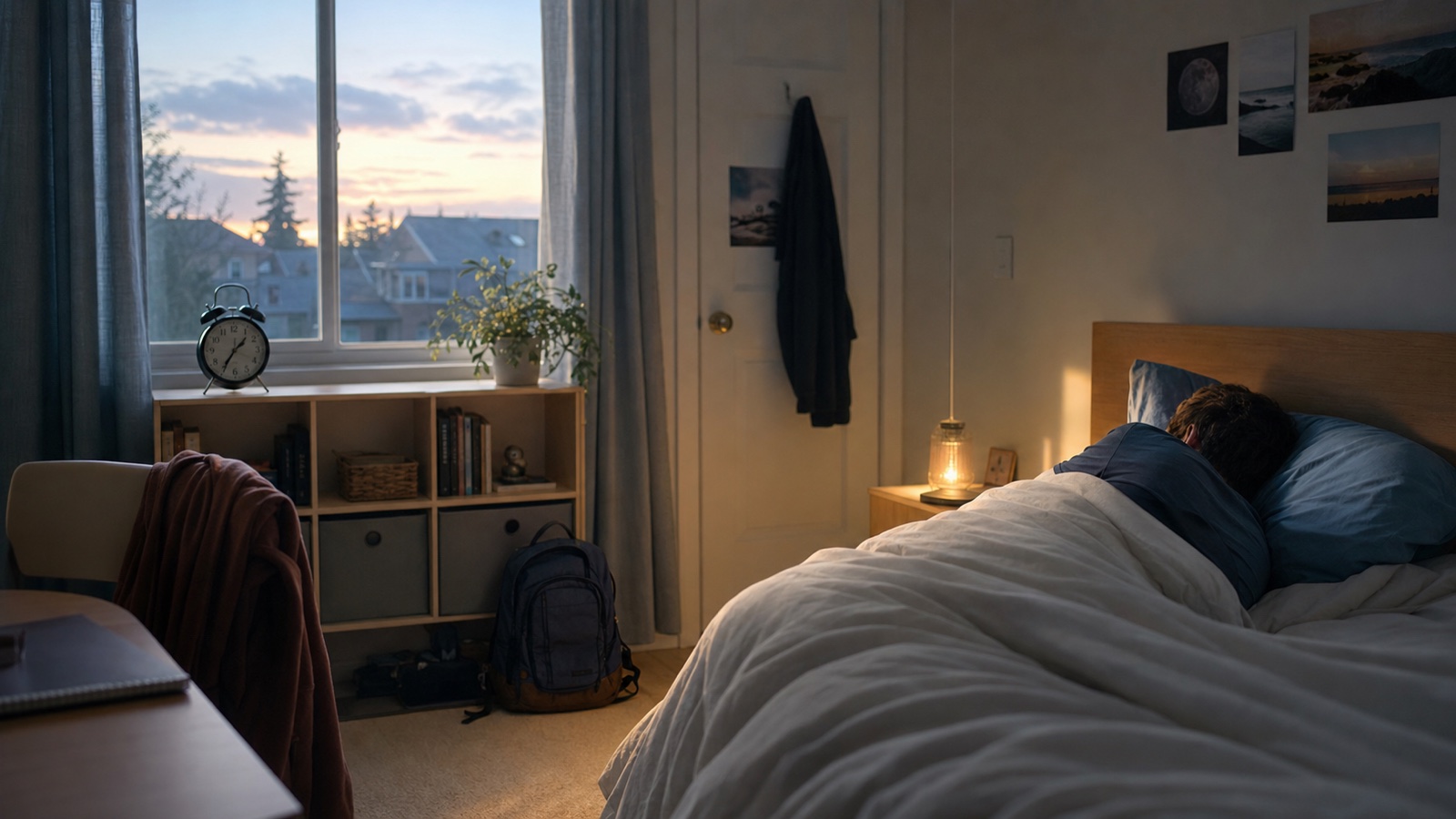
- Puberty shifts the body clock later, so many teenagers are not ready to sleep or wake as early as children.
- Teens ages 13 through 18 generally need eight to 10 hours of sleep each day.
- Phones matter, but biology, early school schedules, homework, activities, stress, and caffeine can all squeeze sleep.
- A shared family plan works better than treating morning sleepiness as a character flaw.
By the time your teenager appears in the kitchen on Saturday, you have answered email, bought groceries, and developed a small grudge.
They shuffle in near noon, hair making independent decisions, and say, “Morning.”
You consider giving a brief speech on responsibility. It will not be brief.
Teen sleep can look like laziness from the outside because you see the late wake-up, not the biology, school schedule, homework, group chat, sports practice, worry, and midnight attempt to finish an assignment that were standing behind it.
That does not mean every sleep habit is healthy or every late morning should be ignored. It means moral judgment is a poor alarm clock.
Puberty moves the clock
Sleep is influenced by at least two broad systems. One is sleep pressure, which builds the longer you are awake. The other is your circadian system, the roughly 24-hour timing process that helps organize when your body expects wakefulness and sleep.
During adolescence, circadian timing tends to shift later. Many teens become sleepy later in the evening and naturally prefer a later wake time. The American Academy of Pediatrics has described this pubertal shift as a major contributor to insufficient adolescent sleep when it collides with early school schedules.
So “just go to bed at 9:00 p.m.” may sound to a teenager the way “just fall asleep at 6:00 p.m.” sounds to you. A bedtime can create an opportunity for sleep. It cannot negotiate directly with circadian timing.
Teenagers still need substantial sleep. The American Academy of Sleep Medicine recommends eight to 10 hours per 24 hours for ages 13 through 18, a recommendation endorsed by the American Academy of Pediatrics. An early bus can turn that range into a daily arithmetic problem with no pleasant answer.
The phone is part of the story, not the whole villain
Yes, screens can push bedtime later. Light in the evening can affect circadian timing, notifications can interrupt sleep, and an endless feed has never once announced, “You seem tired, so I will conclude now.”
But taking away a phone does not move soccer practice, shorten homework, quiet anxiety, change a work shift, or delay first period. If the family explanation begins and ends with “teenagers have no discipline,” you may miss the actual bottleneck.
Ask for a one-week sleep map before prescribing a family revolution. Track bedtime, estimated sleep onset, wake time, naps, caffeine, evening activities, late homework, and nighttime device use. The goal is not surveillance. It is finding where sleep is being squeezed.
Sometimes the phone is taking an hour. Sometimes the phone is what your teen reaches for during an hour when they cannot sleep. Those problems can overlap, but they are not identical.
Why later school starts matter
Medical organizations have recommended that middle and high schools start no earlier than 8:30 a.m. because early starts conflict with adolescent sleep timing. Families cannot always change the bell schedule, but the mismatch is worth naming. Your teenager did not personally invent sunrise.
A 2022 meta-analysis pooled 28 studies with more than one million young people. Later school start times were associated with longer sleep, better overall developmental outcomes, and less negative mood. The authors also noted important gaps and differences across students and schools. Much of this research is observational, so it cannot prove that changing the clock causes every benefit.
A 2024 systematic review likewise found that later start times were associated with longer weekday sleep and less social jet lag, the shift between school-day and free-day schedules. The size of the effect varied.
This is useful evidence for school policy. At home, it is also permission to stop interpreting every difficult morning as disrespect.
Build a plan your teenager can help design
A sleep plan imposed during an argument tends to become a referendum on freedom. Start during daylight. Use the shared goal: enough sleep to feel safer, steadier, and less miserable in the morning.
- Anchor the wake time. Keep school-day and weekend wake times reasonably close, often within about an hour when practical. A large weekend swing can make Sunday night feel like flying across time zones without earning miles.
- Work backward from actual sleep need. If wake time is 6:30 a.m., count back eight to 10 hours, then leave room to fall asleep. If the schedule makes that impossible, identify what has to move rather than pretending motivation creates extra clock.
- Use morning light. Open the curtains and get outside when possible. Bright morning light helps cue the body clock toward wakefulness.
- Lower evening activation. Dim lights, move intense homework earlier when possible, and create a predictable wind-down rather than a sudden confiscation followed by fury.
- Set a family media boundary. Choose a device parking time and place, silence notifications, and let adults follow a version of the rule too. Hypocrisy is surprisingly alert at bedtime.
- Move caffeine earlier. Caffeine can interfere with sleep for hours. Energy drinks, coffee, tea, soda, pre-workout products, and some medications all count.
If bedtime needs to move earlier, use small adjustments rather than demanding a two-hour jump in one night. Protect the wake anchor and morning light while shifting the evening routine gradually.
Do not turn the bedroom into a courtroom
A teenager who is sleep deprived will have less patience, attention, and emotional flexibility available for your excellent lecture about patience, attention, and emotional flexibility.
Keep the morning script boring and kind. Wake, light, water, clothes, food, exit. Discuss the plan later.
Use observation instead of accusation: “You slept through two alarms and felt awful at breakfast three days this week. Let’s look at the schedule tonight.” That is easier to work with than, “You do not care about anything.”
Parents can set limits. The difference is whether the limit solves the sleep problem or merely displays parental despair. A specific agreement about devices, caffeine, rides, or homework is more useful than a global verdict about maturity.
When late sleep deserves an evaluation
Some teenagers are simply on a later schedule. Others have a sleep disorder, a mental health condition, a medication effect, substance use, or a medical issue that needs attention.
Talk with a pediatrician or qualified clinician if your teen snores loudly, gasps, stops breathing, has uncomfortable leg sensations, falls asleep unintentionally, cannot wake despite adequate opportunity for sleep, regularly needs far more than 10 hours and remains exhausted, or has a persistent pattern of being unable to fall asleep until very late.
Also pay attention to a new sleep change alongside withdrawal, loss of interest, hopelessness, severe anxiety, elevated or unusually irritable mood, risky behavior, a major drop in functioning, or concern about safety. Sleep can be affected by depression, anxiety, bipolar disorder, ADHD, trauma, and other conditions, but a schedule alone does not diagnose any of them.
Bring the one-week sleep map to the appointment. It gives the clinician more than “sleeps weird,” which is emotionally accurate but diagnostically underpowered.
The bottom line: Teenagers often sleep later because puberty shifts their internal timing while school still demands an early morning. Habits matter, but the solution is not to call biology lazy. For one week, replace the morning argument with a simple sleep map. Then choose one shared change: a steadier wake time, morning light, earlier caffeine cutoff, or a family device-parking rule. If exhaustion is severe, persistent, or paired with concerning symptoms, get an evaluation.
Sources: American Academy of Sleep Medicine, “Recommended Amount of Sleep for Pediatric Populations” (2016); American Academy of Pediatrics, “School Start Times for Adolescents” (2014); Yip and colleagues, “School Start Times, Sleep, and Youth Outcomes,” Pediatrics (2022); “Effects of school start time and its interaction with the solar clock on adolescents’ chronotype and sleep,” Sleep Medicine Reviews (2024); CDC, “Sleep and Health” (2024).
Why is it so hard to talk to my parents?
Why love and connection can coexist with awkward silence.

When to take a struggling child to a psychiatrist
How to tell a hard stretch from a pattern that deserves more help.
Why can’t I sleep?
What your brain is doing at night, and what helps when sleep will not arrive.
When sleep starts running the whole household.
If a teenager’s sleep, mood, attention, or anxiety has become hard to sort out, we can help you understand what deserves evaluation and what to try next. Ask us anything on a free 15-minute intro call.