Why does tinnitus feel louder when you’re anxious?
Why tinnitus can demand more attention when you’re anxious, which changes need medical evaluation, and how evidence-based care can reduce its impact.

- Anxiety can make tinnitus harder to ignore without proving that the ear signal has suddenly become stronger.
- New tinnitus still deserves an ear and hearing evaluation, especially when it is one-sided, pulse-like, or paired with hearing loss.
- CBT can reduce tinnitus distress and its effect on daily life, even when it doesn’t erase the sound.
- Constant checking and total silence can keep attention pinned to tinnitus; a steadier environment often works better.
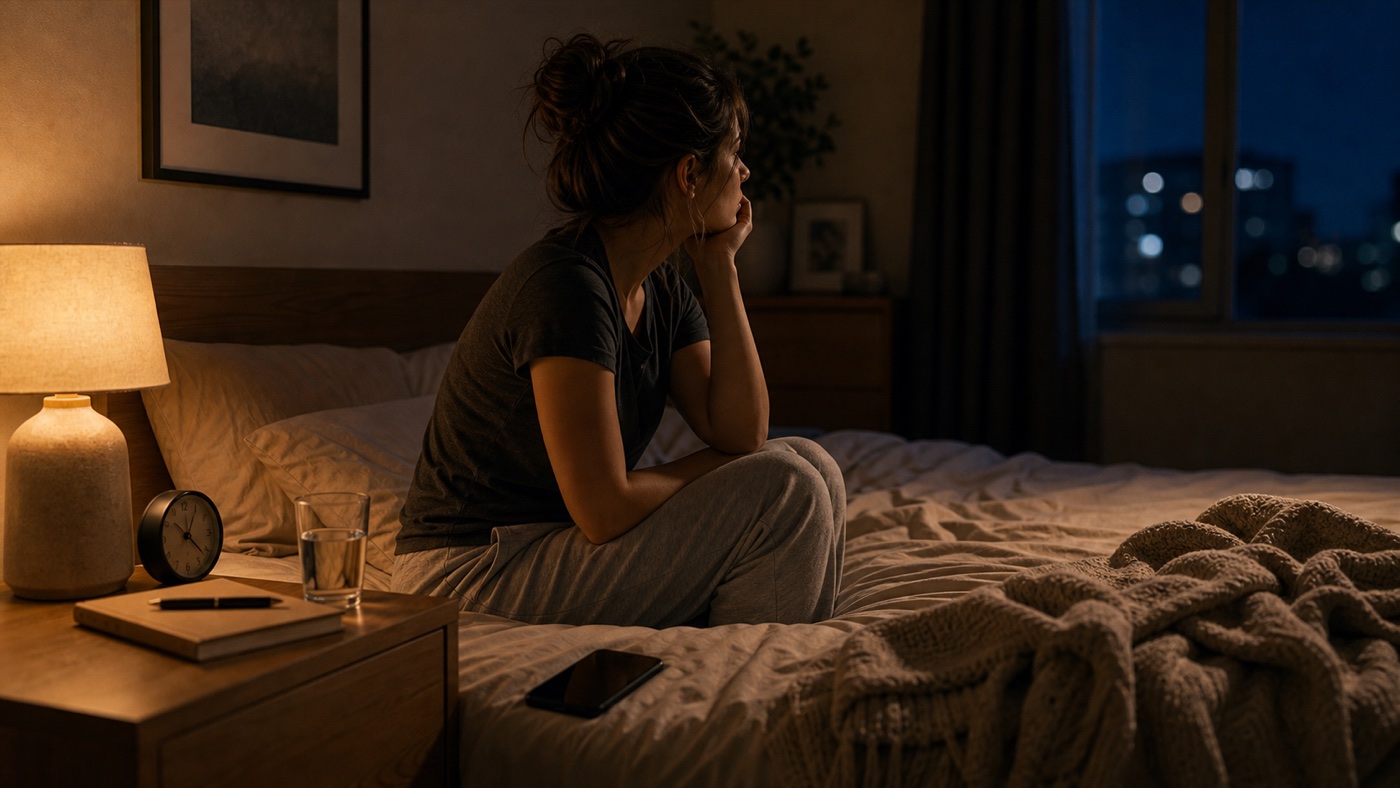
It’s 11:47 p.m. The dishwasher clicks off, the room goes still, and the thin ringing in your ear walks straight to center stage. You turn the fan on. You turn it off to check. You hold your breath. The sound is still there, and now your heart has joined the percussion section.
If tinnitus feels louder when you’re anxious, you’re not imagining the experience. The important distinction is that louder can mean more noticeable, more intrusive, or more threatening. It doesn’t always mean the underlying sound signal has physically intensified.
Attention can change the size of the experience
Tinnitus is the perception of sound without an outside source. It may ring, buzz, hiss, hum, click, or pulse. Some people notice it occasionally. Others hear it most of the time. Hearing loss is common alongside tinnitus, but earwax, jaw problems, noise exposure, injuries, medical conditions, and some medications can also matter.
Your attention system constantly decides which signals deserve promotion. A refrigerator hum disappears until somebody mentions it. Your nose leaves your visual field until you look for it. Tinnitus can behave similarly, except the signal may feel more urgent because you can’t locate or switch off its source.
When you’re anxious, your mind scans for danger and uncertainty. If tinnitus has already been filed under “possible threat,” every check tells attention to keep the file open. Silence hasn’t created a new sound. It has simply fired the competition.
I’ll ask two separate questions: “What are you hearing?” and “What happens after you notice it?” The first helps guide medical and hearing evaluation. The second reveals the fear, checking, sleep loss, avoidance, and catastrophic predictions that may be making the sound occupy more of the day.
Anxiety and tinnitus can become an unpleasant duet
Tinnitus can interfere with sleep and concentration, which can leave you more tense and depleted. Anxiety can then increase monitoring, muscle tension, and the sense that the sound must be solved immediately. The sequence loops: notice, fear, check, notice more.
Research often finds tinnitus distress alongside anxiety, depression, and insomnia. That association doesn’t prove one simple direction of cause. Some people become anxious because tinnitus is disruptive. Some notice tinnitus more during an already anxious period. Hearing loss, poor sleep, pain, trauma, and other health concerns may affect both.
The useful target isn’t convincing yourself that the sound is pleasant. It’s reducing the emergency meaning and the behaviors that keep your attention handcuffed to it. You can dislike a sound without holding a committee meeting every time it appears.
Start with your ears, not a personality theory
Anxiety shouldn’t become a shortcut that skips medical evaluation. If tinnitus is new, persistent, changing, or disruptive, tell a health professional. An ear, nose, and throat clinician or audiologist may review hearing, ear health, medications, noise exposure, jaw symptoms, and whether further testing makes sense.
Sudden hearing loss in one or both ears is a medical emergency, especially when tinnitus, ear fullness, or dizziness appears with it. Seek urgent medical care rather than waiting to see whether anxiety settles. Tinnitus that beats with your pulse, begins suddenly in one ear, or comes with new neurological symptoms also deserves prompt assessment.
Don’t stop a prescription because tinnitus appeared on a medication list. Many lists include reports without proving that the medicine caused your symptom, and abrupt changes can create other risks. Bring the timing, dose changes, and every medication or supplement to the prescriber or pharmacist so the review can be specific.
Treatment doesn’t have to erase the sound to help
The promise “we’ll make it disappear” is usually too tidy. The better-supported goal is reducing tinnitus’s effect on sleep, concentration, mood, and daily life while treating an identifiable cause when one exists.
A 2020 Cochrane review of 28 studies found that cognitive behavioral therapy may reduce the negative impact of tinnitus on quality of life. It didn’t reliably prove that CBT lowers the perceived loudness. That’s not a consolation prize. A sound that no longer organizes your evenings is a meaningful clinical outcome.
CBT for tinnitus may work on threat interpretations, attention, avoidance, sleep habits, and the urge to keep testing the sound. Hearing aids can help some people who also have hearing loss. Sound enrichment may make quiet rooms easier, while education and audiology support can reduce the mystery that anxiety keeps trying to fill.
No single treatment works for everyone. Evidence for supplements, devices, and branded cures varies widely. If a product promises silence by Friday, your wallet may be the organ receiving the clearest signal.
Stop taking the sound’s attendance
Checking seems sensible: Is it louder now? Is it in both ears? Can you still hear it over the fan? Unfortunately, repeated checking trains your attention to return. You get a few seconds of certainty and another appointment with the same question.
Try choosing one neutral background sound at bedtime, such as a fan, quiet nature audio, or low music. Keep it soft enough that you aren’t fighting tinnitus in a volume contest. The aim isn’t total masking. It’s giving attention more than one place to land.
Protect your hearing around genuinely loud noise, but don’t wear ear protection all day in ordinary environments unless a hearing professional recommends it. Overprotecting can shrink your sound tolerance and keep daily life organized around avoidance.
When you notice the ringing, name the sequence once: “There’s the sound, and there’s the alarm about the sound.” Then return to the next visible action, whether that’s reading one page, washing a cup, or letting the fan remain a fan instead of a diagnostic instrument.
Use one two-column reset tonight
Write two headings: “The sound” and “My response.” Under the first, record location, quality, timing, and any hearing change. Under the second, record what you predicted, checked, avoided, or stopped doing. This isn’t homework for eternity. It’s a way to separate the symptom that needs evaluation from the distress loop that may be trainable.
If tinnitus is keeping you from sleeping, working, studying, or enjoying ordinary quiet, ask about audiology care and tinnitus-focused CBT. Seek mental health care when anxiety or low mood is persistent, or when the sound has begun shrinking your life.
If you’re thinking about suicide, might hurt yourself, or can’t stay safe, call or text 988 in the United States or go to the nearest emergency department. Tinnitus distress can become severe, and you don’t need to wait until somebody else understands its volume before asking for urgent help.
The bottom line: Anxiety can make tinnitus more intrusive by changing attention, threat, sleep, and checking. Get new or changing symptoms evaluated, treat sudden hearing loss as urgent, and aim for less distress rather than a perfect silence test. The sound may still visit. It doesn’t have to chair the evening.
Sources: National Institute on Deafness and Other Communication Disorders, What Is Tinnitus? and Sudden Deafness; NICE, Tinnitus: Assessment and Management (NG155); Fuller and colleagues, cognitive behavioral therapy for tinnitus, Cochrane Database of Systematic Reviews (2020); Cima and colleagues, specialized CBT for tinnitus randomized trial, The Lancet (2012).

Why do ordinary sounds make me so angry?
How misophonia differs from tinnitus and ordinary annoyance.

When checking your body makes health anxiety louder
Why checking brings relief and then asks for another check.
Why can’t I sleep even when I’m exhausted?
What keeps a tired brain awake and what helps.
Is tinnitus feeding anxiety?
A free 15-minute intro call can help you decide whether psychiatric support belongs alongside hearing care.