How do you help a child adjust to a new sibling?
How to prepare an older child for a new baby, respond to jealousy or regression, and protect connection while the whole family finds a new rhythm.
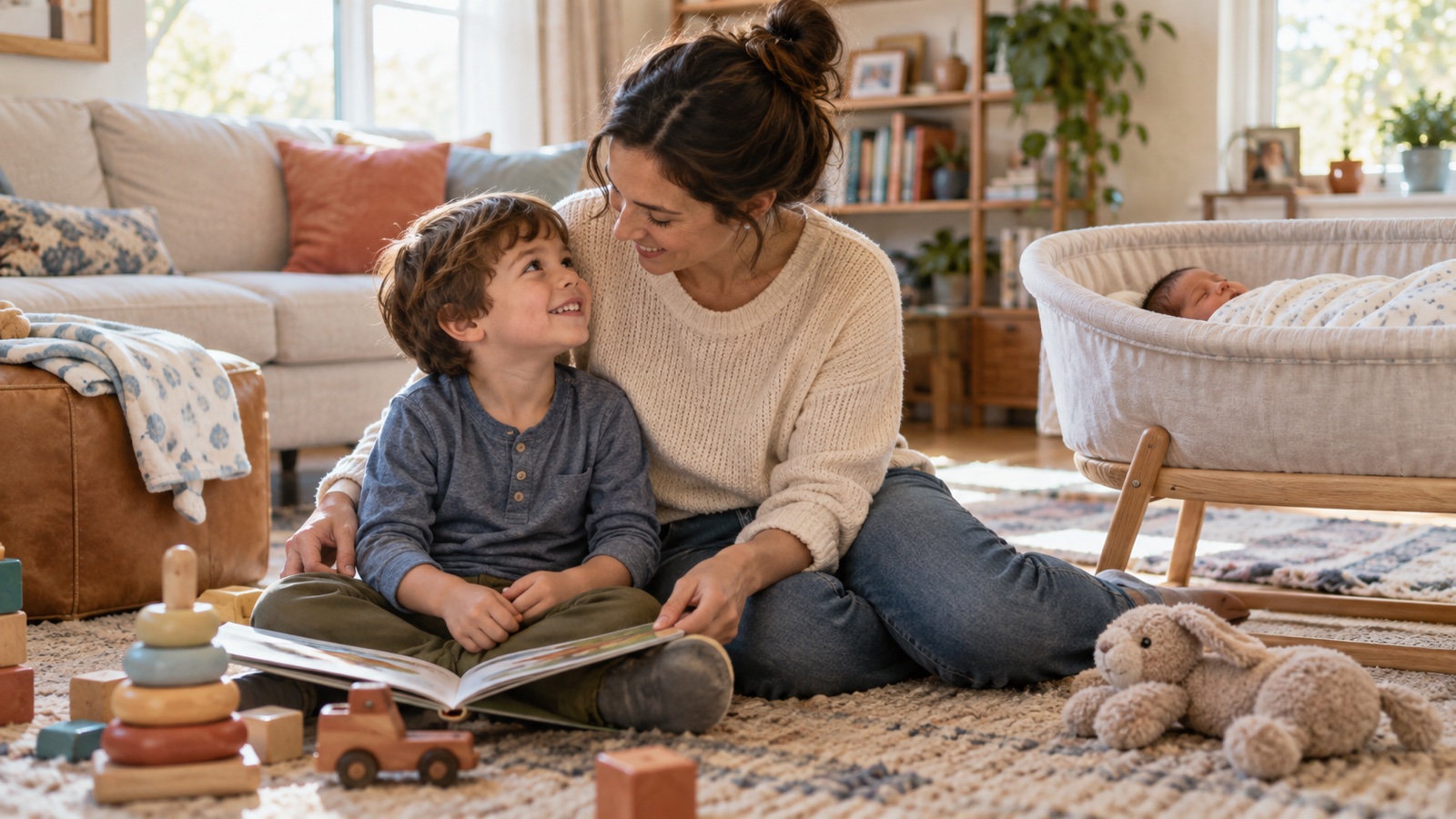
- A new sibling is a real family transition, but research does not support the idea that it becomes a crisis for every older child.
- Prepare children with concrete, age-appropriate details about what will change, including the less photogenic facts about crying and waiting.
- Jealousy, clinginess, sleep changes, and temporary regression can be bids for connection rather than evidence that the sibling bond is ruined.
- Protect brief one-on-one time, keep important routines recognizable, invite help without forcing it, and get support when distress is intense or persistent.
The baby is finally asleep. You lower yourself onto the couch with the precision of someone defusing a tiny, swaddled alarm. Then your older child climbs into your lap, asks for the cup they stopped using six months ago, and announces that the baby should go back to the hospital.
Welcome to the transition to siblinghood, where joy and territorial negotiations can share a snack bowl. A child can love the baby, resent the baby, ignore the baby, and ask to hold the baby before lunch. Mixed feelings don’t mean you’ve failed to create a bond. They mean the family changed.
This is a transition, not a guaranteed crisis
Research following families before and after a second child is born finds more than one adjustment pattern. An empirical review of 30 studies did not support the idea that most firstborn children go through a universal developmental crisis. Some children show few difficulties. Others become more clingy, anxious, aggressive, withdrawn, or interested in acting like the baby.
The wide range matters. It keeps you from treating every tantrum as sibling trauma and from dismissing a child who is struggling because the transition is common. Newborn arrival changes parental attention, routines, sleep, noise, and expectations all at once. Even a welcome change can be a lot of change.
I’d be cautious with predictions based only on age, birth order, or the child’s first reaction. Adjustment unfolds over time. The toddler who ignores the baby may be doing fine. The delighted school-age child may feel the loss of private time two weeks later, when visitors have stopped arriving with muffins.
Prepare them for the baby who is actually coming
“You’ll have a best friend!” is a lovely hope and a terrible job description for a newborn. Babies mostly sleep, cry, eat, and require adults to interrupt other plans. Tell your child what they’ll see in language that fits their age.
For a toddler or preschooler, use concrete details: who will stay with them during the birth, where the parent will sleep, when they can visit, and what the baby can and cannot do. Books, photos of your older child as a baby, and simple play with a doll can make the idea less abstract. For an older child, talk honestly about schedule changes and invite questions without assigning enthusiasm.
If possible, avoid stacking major changes. Moving out of the crib, starting toilet training, dropping a caregiver, and welcoming a baby in the same week is a family calendar asking for a dramatic monologue. Some changes can happen well before the birth or wait until the household is steadier.
Don’t require the older child to audition for “big kid”
Adults often praise an older sibling for being mature, helpful, and gentle. That can feel good. It can also make the child wonder whether babyish needs are now disqualifying. They’re still allowed to need comfort, play, and help even if they can fetch a diaper.
Invite participation without turning it into unpaid infant management. Offer small choices: pick the baby’s pajamas, bring the clean cloth, sit beside you during feeding, or keep playing. If your child says no, let no be an ordinary answer. The sibling relationship doesn’t need a corporate onboarding plan.
Keep safety rules direct and calm. An older child should not carry or handle the baby without adult permission and supervision. If roughness happens, protect the baby immediately, then help the older child name what was happening without shaming them as dangerous or bad.
Jealousy is information, not a moral emergency
A child who announces that the baby is hated may really hate waiting for you. You can hold the boundary and the feeling: hitting isn’t allowed, and waiting while the baby has your arms is hard. You don’t have to correct the emotion into love before the child is allowed to be heard.
Temporary regression can show up as accidents, baby talk, wanting a bottle, sleep trouble, or needing more help with tasks they could do yesterday. The American Academy of Pediatrics advises parents to expect some regression and respond with attention rather than ridicule or demands to act their age.
That doesn’t mean every change should be ignored. Persistent toileting problems, major sleep disruption, severe aggression, intense withdrawal, loss of skills, or distress that is worsening deserves a conversation with the child’s pediatrician or mental health clinician. Context matters, and children don’t always send neatly labeled support tickets.
Protect connection in portions small enough to survive newborn life
One-on-one time doesn’t need to be a theme-park afternoon. Ten minutes reading the same book, walking to the mailbox, or sitting on the floor while the child directs play can say that a parent is still available. Put the phone away if you can. Predictable and brief often beats ambitious and repeatedly canceled.
Keep a few anchor routines recognizable, especially bedtime, school drop-off, and the goodbye ritual. Another parent, grandparent, or trusted adult can provide continuity, but the goal isn’t to outsource the older child while everyone admires the baby. Ask visitors to greet the older child too.
Language can reduce unnecessary blame. Instead of “we can’t go because the baby needs to eat,” try “we’re leaving after feeding, at three o’clock.” The baby will cause enough inconvenience without becoming the family’s tiny official villain.
Your adjustment is part of the child’s environment
Parents are often exhausted, touched out, physically recovering, and trying to meet incompatible needs at the same time. You may be more irritable or less available than you intended. Repair matters more than pretending the strain isn’t there.
Name the repair plainly: you were short, the child needed connection, the adults were overwhelmed, and it wasn’t the child’s fault. If postpartum depression, anxiety, trauma symptoms, or severe sleep loss are affecting the household, get help. Supporting the adults isn’t separate from supporting the children.
Try not to compare the children out loud, even in praise. “The baby is so easy, but you never slept” sounds like family trivia to an adult and a performance review to a child. Describe each child without creating a winner.
Try one protected ritual this week
Choose one repeatable moment that belongs to your older child: the bedtime page, Saturday cereal, a short walk, or five minutes of floor play after feeding. Name it: “This is our time.” Keep it modest enough that a difficult newborn day won’t erase it.
Then make room for one honest feeling. Ask, “What’s the hardest part about having the baby here?” Don’t sell the upside before you hear the answer. Your child doesn’t need a perfect sibling bond this month. They need evidence that a new relationship didn’t cancel the old one.
If you’re worried about safety, severe behavior, persistent sadness or anxiety, or a change that interferes with eating, sleep, school, or family life, involve the child’s pediatrician or a qualified mental health professional. Early support can be ordinary family care, not a verdict on anyone’s parenting. You don’t have to wait until the whole household can’t cope.
If a child or adult is at risk of self-harm, suicide, or immediate danger, seek urgent help. In the United States, call or text 988 for crisis support and call 911 for an immediate emergency. A new baby doesn’t make a safety concern less important, and exhaustion shouldn’t have to argue the case alone.
The bottom line: A child doesn’t need to welcome a new sibling with uninterrupted delight. Prepare them honestly, allow mixed feelings, protect small doses of reliable connection, and keep limits calm. The goal isn’t instant friendship. It’s helping every child remain securely part of the family while the family learns its new shape.
Sources: American Academy of Pediatrics, Preparing Your Older Child for a New Baby (updated 2026); Volling, family transitions after the birth of a sibling empirical review, Psychological Bulletin (2012); Volling, Oh, and Gonzalez, stability and change in children’s adjustment after a sibling’s birth, Monographs of the Society for Research in Child Development (2017); Volling and colleagues, Family Transitions Study, a longitudinal study of 241 families.

Why siblings fight, and when parents should step in
What ordinary conflict teaches and where safety changes the plan.
How do you support the sibling who seems fine?
Make room for the child who is coping quietly.

Why do couples fight more after having a baby?
How sleep, workload, and changed roles can strain the team.
Is one child’s adjustment becoming the center of family life?
A free 15-minute intro call can help you decide whether psychiatric care fits the next step.