What should you do when your child is being bullied?
How to listen when your child reports bullying, build a practical safety plan with the school, and know when more support is needed.
- Start by listening, thanking your child for telling you, and making clear that the bullying isn’t their fault.
- Ask about immediate safety, document the pattern, and build a specific plan with the school or organization.
- Don’t tell your child to ignore it, fight back, or handle the other family alone.
- Changes in sleep, school, mood, eating, self-harm, or safety deserve prompt professional attention.
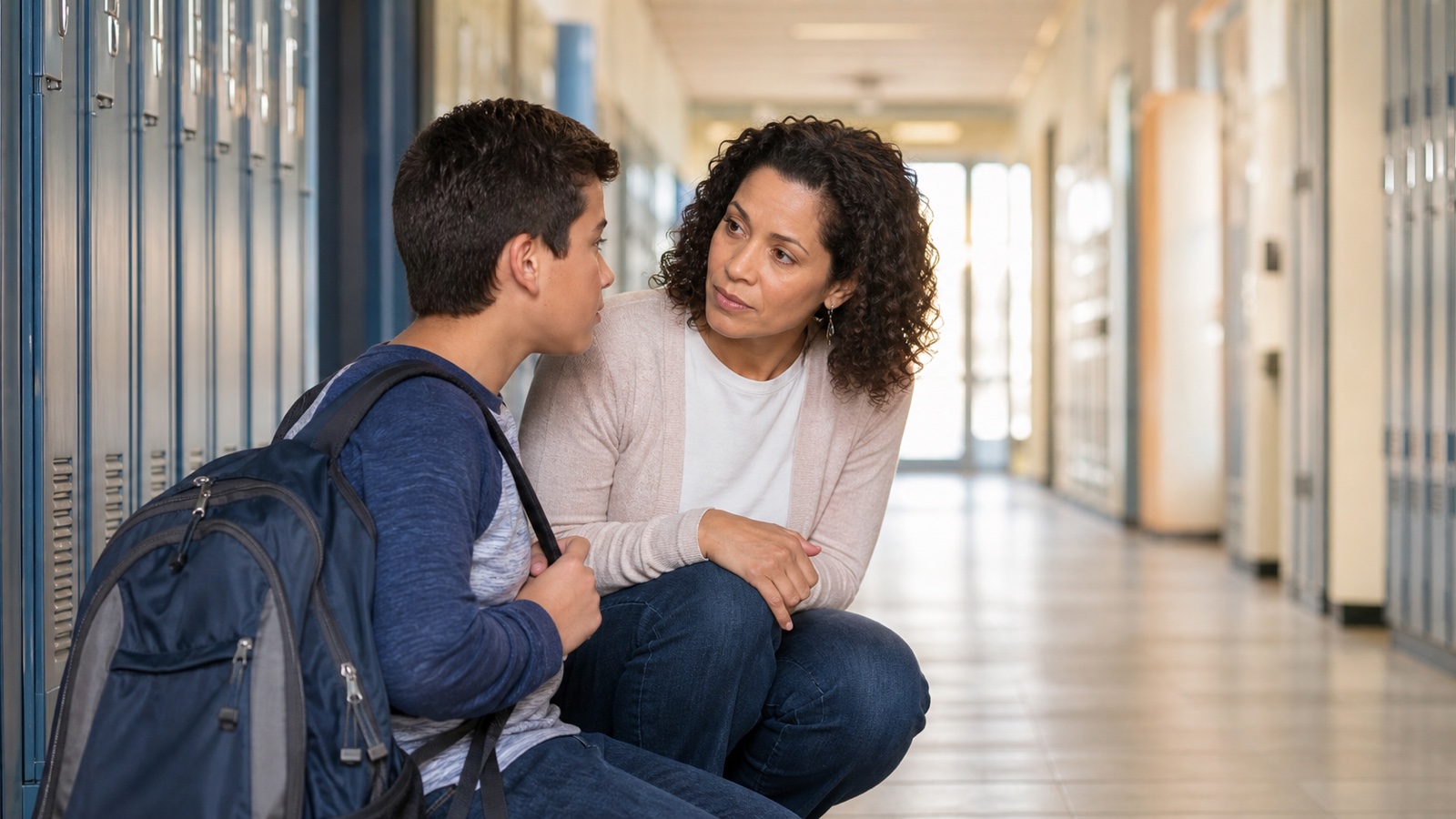
Your child gets into the car after school and closes the door harder than necessary. Their backpack lands on the floor. You ask what happened, expecting a complaint about homework, and hear, “They put it in the group chat again.” Then comes the sentence that makes your whole body lean forward: “Don’t tell anyone.”
You may want to call the school, the other parent, and possibly a small press conference before leaving the parking lot. Pause. Your child has just handed you something they may have carried alone for weeks. The first job isn’t to produce the perfect consequence. It’s to make telling you feel safer than staying silent.
Your first response teaches your child what happens next
Start with three messages: “Thank you for telling me. This isn’t your fault. We’ll figure out the next step together.” You can be angry about what happened without making your child manage your anger. If your reaction becomes the largest emotion in the room, they may start protecting you from future information.
Ask what happened, where, how often, who was present, what has already been tried, and what your child fears will happen if adults intervene. Don’t cross-examine. You’re building a map. A child who leaves out details isn’t necessarily hiding something suspicious. Shame, fear, and the wish to keep one corner of school life under control can make the story arrive in pieces.
I’d ask about safety early and plainly: “Has anyone threatened to hurt you? Do you feel safe going back tomorrow? Have you felt like hurting yourself or someone else?” Asking won’t plant the idea. It gives a frightened child permission to tell the truth before the plan becomes a scheduling problem.
Not every conflict is bullying, but labels shouldn’t delay protection
Bullying generally involves aggressive behavior, a real or perceived power imbalance, and repetition or the potential to repeat. It can be physical, verbal, relational, or electronic. A cruel rumor, coordinated exclusion, repeated humiliation, threats, account impersonation, and damaging belongings can all matter even when nobody throws a punch.
Ordinary peer conflict usually involves children with more equal power who can disagree, repair, and move on. Bullying is harder for the targeted child to stop because the power isn’t equal. Still, you don’t need a committee to approve the vocabulary before addressing a threat, harassment, assault, or unsafe environment.
Notice the pattern beyond the incident. Has your child begun avoiding the bus, bathroom, cafeteria, team, or phone? Are belongings missing? Are there headaches on school mornings, sleep changes, falling grades, sudden requests for money, or a new insistence that nobody likes them? Those signs don’t prove bullying, but they deserve a calm question.
Bullying is associated with anxiety, depression, sleep difficulty, self-harm, academic problems, and school dropout. Association doesn’t mean every bullied child develops a mental health condition, or that every mood change was caused by bullying. It does mean the impact belongs in the plan, not just the behavior you want the school to stop.
Build a record that describes behavior, not a courtroom drama
Write down dates, locations, exact words or actions, witnesses, injuries, missing property, and previous reports. Save screenshots, usernames, links, and timestamps for cyberbullying before blocking or reporting accounts. Don’t redistribute humiliating images to make your point. Preserve what responsible adults need and protect your child’s privacy.
Contact the teacher, counselor, coach, principal, or organization staff member who can act. Use specific language: “On three afternoons this week, two students blocked the locker area, called him a slur, and posted a photo after he asked them to stop. What is the safety plan for arrival, lunch, and dismissal, and when will we review whether it’s working?”
Ask who your child can approach, where they can go, how staff will supervise known trouble spots, how missed work will be handled, and when you’ll receive an update. Schools may not be able to tell you another student’s discipline or services. That privacy limit doesn’t prevent them from explaining how they’ll protect your child and monitor the plan.
Follow up in writing and keep the tone factual. Bullying may not stop after one meeting. Persistence matters more than a spectacular first email. Research on school-wide programs suggests coordinated, multilevel approaches can reduce bullying, although effects vary and no program guarantees an immediate end for one child.
Skip the advice that makes the child carry the whole solution
Don’t tell your child to ignore it. They’ve probably tried, and silence can feel like adult abandonment. Don’t tell them to fight back. That can increase injury, discipline, and the belief that protection depends on winning. Assertive words and leaving may help in some situations, but only when your child believes they’re safe enough to use them.
Resist contacting the other child’s parents directly. StopBullying.gov advises using school or organization staff as mediators because direct contact can make the situation worse. Don’t arrange a surprise face-to-face apology. Repair isn’t repair when the targeted child has to sit beside someone they fear so adults can enjoy a tidy ending.
Don’t solve the problem by removing everything your child enjoys unless safety truly requires it. A child who loses school, sports, friends, and a phone while the person bullying them keeps ordinary life may experience protection as punishment. Preserve supportive routines and relationships wherever you can.
For online harm, block and report accounts after saving evidence, review privacy settings, and change compromised passwords. Keep your child involved in decisions about their device. Total confiscation may stop one channel while also removing friends, evidence, and the reason they tell you next time.
Give your child one small plan they can actually remember
Choose one trusted adult, one safer location, and one sentence. The adult might be the counselor. The location might be the library at lunch. The sentence might be, “This keeps happening near the gym, and help is needed now.” A child under stress won’t reliably execute a 12-step safety protocol printed in tasteful colors.
Practice without turning home into another performance. Ask what would make tomorrow 10 percent safer. Walking with a friend, changing a route, arriving near supervised time, or checking in after second period may help. These steps aren’t admissions that your child caused the bullying. They’re temporary supports while adults address the behavior.
Keep asking about life beyond the bullying. Encourage time with people and activities where your child feels competent and known. The goal isn’t to distract them from harm. It’s to prevent the harm from becoming their entire identity. They’re still a musician, goalkeeper, science nerd, cousin, and excellent maker of toast.
Know when this needs more than a school meeting
Seek immediate help for credible threats, weapons, assault, stalking, sexual exploitation, severe injury, or a child who can’t be kept safe. Contact emergency services when danger is immediate. For explicit images or online threats, preserve evidence and use the platform, school, and appropriate law-enforcement reporting channels without circulating the material.
Arrange a pediatric or mental health evaluation when your child has persistent fear, panic, nightmares, school refusal, depressed mood, major eating or sleep changes, substance use, self-harm, hopelessness, or a sharp decline in functioning. Therapy shouldn’t be used to make a child tolerate an unsafe environment. It can help them recover while adults make the environment safer.
Try one sentence today: “You don’t have to tell me everything at once, but you won’t have to handle this alone.” Then name the next action and when it will happen. Your child doesn’t need a promise that nobody will ever be cruel again. They need evidence that adults can listen, act, and keep showing up.
If your child is talking about suicide, has a plan to harm themselves or someone else, or can’t stay safe, call or text 988 in the United States; call 911 for immediate danger. Stay with them and reduce access to lethal means when you can do so safely.
The bottom line: Listen first, check safety, document the behavior, and build a specific plan with the adults who can change the environment. Your child shouldn’t have to fight, ignore, or outgrow bullying alone.
Sources: StopBullying.gov, parent response and child-support guidance (accessed August 2026); Centers for Disease Control and Prevention, bullying and youth-violence guidance (accessed August 2026); Patel and colleagues, school antibullying interventions systematic review, Psychiatric Services (2024); Gaffney and colleagues, school-based programs systematic review and meta-analysis, Campbell Systematic Reviews (2021).

When your child refuses school
What the morning fight may be telling you and how to respond more usefully.
What do you say when your child says “I’m stupid”?
How to stay curious when shame turns one hard moment into a verdict.
How do you help a teenager who feels left out?
How to listen without minimizing and help social pain become more manageable.
Would a clearer plan help?
A free 15-minute intro call can help you decide whether psychiatric care could support what you’re noticing.