How do you help an anxious child without helping anxiety take over?
How parents can validate an anxious child, reduce unhelpful accommodation gradually, and support brave steps without becoming harsh or dismissive.
- Family accommodation is a caring response that reduces distress now but may keep avoidance going over time.
- You can validate fear without agreeing that the feared situation is dangerous or impossible.
- Change works best when it is planned, gradual, predictable, and paired with confidence in the child.
- Persistent anxiety that disrupts school, sleep, friendships, family life, or development deserves professional evaluation.
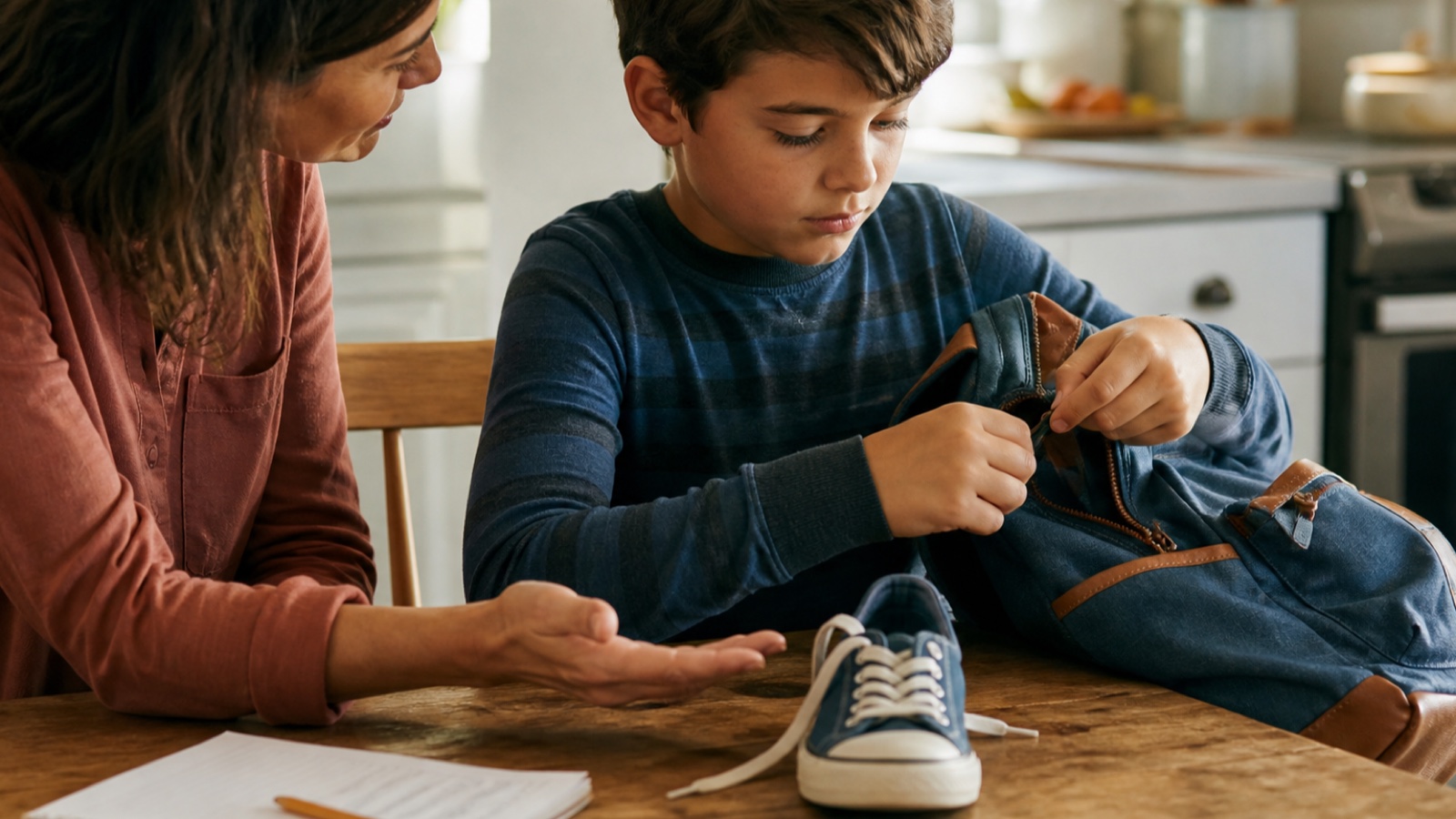
It’s 7:12 a.m. Your child is dressed, the backpack is packed, and the school bus will arrive in eight minutes. Then comes the stomachache, the tears, and the request to call the school and say they’re sick. You can feel the whole morning balancing on your answer.
You don’t want your child to suffer. You also don’t want anxiety choosing every class, sleepover, meal, and doorway. Somehow you’re expected to be comforting and firm before coffee has completed its own developmental milestones.
This tension has a name: family accommodation. It means changing family behavior to prevent or reduce a child’s anxiety, such as speaking for them, answering repeated reassurance questions, changing routines, avoiding places, or removing every uncertain step. It comes from care, not bad parenting. The problem is what the pattern may teach.
Relief can be kind now and costly later
Imagine your child is afraid to order at a restaurant. You order for them, their distress drops, and dinner continues. That’s understandable. Everyone gets to eat while the server is still young.
But if speaking never happens, the child doesn’t get a chance to discover that anxiety can rise, they can act while it’s there, and the moment can end safely. Avoidance keeps its persuasive evidence: escaping felt necessary, so the situation must have been dangerous.
Research finds that greater family accommodation is associated with more severe anxiety in young people, though association doesn’t prove that accommodation alone causes the severity. Anxiety also pulls accommodation from families. The loop can run both directions, which is one reason blame isn’t useful.
Validation and agreement aren’t the same thing
Parents sometimes hear “reduce accommodation” and picture becoming cold: no reassurance, no help, good luck out there. That isn’t the goal.
Validation says, “This feels scary.” Agreement with anxiety says, “Yes, this is too dangerous for you to handle.” You can offer warmth without endorsing the forecast.
A useful response has two parts: acceptance and confidence. “Your stomach feels awful, and you can go inside with the plan we made.” Or, “You don’t have to feel calm before you answer. We’ll stay together while you say the first sentence.”
The message isn’t that your child shouldn’t feel afraid. It’s that fear doesn’t erase capability.
Start with the accommodation, not the child’s whole personality
Trying to fix every anxious pattern at once can turn home into an exposure boot camp. Instead, notice one repeated family move. Maybe you check the closet five times, drive a different route, write every email to the teacher, let a teenager sleep in your room, or answer “Will everything be okay?” until everyone has lost count.
Ask what the accommodation prevents, what relief it brings, and what a smaller next step might be. Choose something low-risk and specific. You might move from five reassurance answers to one supportive response, from writing the entire email to helping with the opening line, or from staying until sleep to checking back after a planned interval.
Tell your child before the change. A surprise withdrawal of help can feel like punishment. A plan says, “Starting tomorrow, we won’t answer the same safety question again and again. You’ll hear that you’re loved and that you can use your coping plan.”
Bravery should be small enough to practice
Cognitive behavioral therapy, or CBT, is an evidence-supported treatment for childhood anxiety. It often includes gradual exposure: approaching feared situations in manageable steps while reducing avoidance and safety behaviors.
The step shouldn’t be so easy that nothing new is learned or so overwhelming that the lesson becomes “adults don’t listen.” A child who can’t enter school may start by visiting the parking lot after hours, then walking to the office, then attending one class with support. The sequence depends on the child, the fear, school resources, and safety.
Reward effort and approach, not the absence of anxiety. “You asked the question even while your voice shook” is more useful than “See, there was nothing to worry about.” The first notices courage. The second invites anxiety to prepare a stronger closing argument.
Parents can change the loop even when a child won’t enter therapy
Some children refuse therapy, can’t access it, or become so avoidant that parents need a starting point of their own. Parent-based approaches can help families reduce accommodation while increasing supportive communication.
In one randomized trial of children ages seven through 14 with anxiety disorders, a parent-based program called SPACE was not inferior to child-focused CBT on anxiety outcomes, and it reduced family accommodation. That’s promising, but it doesn’t mean every parent program works equally well or that a single study settles every case. A 2026 systematic review found emerging support while also rating most included studies as low quality.
I’ll be direct: reducing accommodation often makes anxiety louder before the family sees improvement. That doesn’t automatically mean the plan is wrong. It does mean the change should be thoughtful, monitored, and adjusted rather than performed as a test of willpower.
Some support isn’t accommodation at all
A child with a disability may need a legitimate accommodation at school. A bullied child needs protection, not exposure to more bullying. A child with asthma, seizures, diabetes, trauma, learning differences, or another medical or developmental condition may need specific support. Anxiety language shouldn’t be used to wave away real barriers.
The distinction is about function. Does the support provide access while preserving growth, or does it mainly remove short-term distress while making the child increasingly dependent on avoidance? Sometimes the answer isn’t obvious. School staff, a pediatrician, and a mental health clinician can help sort it out.
Seek an evaluation when anxiety repeatedly disrupts attendance, sleep, eating, friendships, activities, family routines, or age-appropriate independence. Sudden severe symptoms, major behavior change, self-harm, suicidal thoughts, psychosis, or inability to eat, drink, or function need prompt professional attention.
If your child is talking about suicide, may act, or can’t stay safe, get urgent help. In the United States, call or text 988. For immediate danger or a medical emergency, call 911 or go to the nearest emergency department. Don’t use a gradual home plan for a crisis that needs immediate assessment.
Try one sentence and one small handoff
Pick one familiar anxiety moment. Use a sentence that combines warmth and confidence: “This is hard, and you can take the next step.” Then hand back one piece of the task your child can reasonably do.
You might stand nearby while they zip the backpack, let them ask the cashier a prepared question, or help them draft a message without pressing send. Afterward, ask, “What did you learn about what you can do while anxious?” Don’t ask whether they felt perfectly calm. Calm isn’t the admission ticket for a brave action.
The bottom line: You don’t have to choose between comforting your child and helping them grow. Validate the fear, communicate confidence, reduce one unhelpful accommodation gradually, and make the next brave step small enough to repeat.
Sources: American Academy of Child and Adolescent Psychiatry, Clinical Practice Guideline for the Assessment and Treatment of Children and Adolescents With Anxiety Disorders (2020); Iniesta-Sepúlveda and colleagues, family accommodation and pediatric anxiety severity meta-analysis, Child Psychiatry & Human Development (2021); Lebowitz and colleagues, SPACE randomized noninferiority trial, Journal of the American Academy of Child & Adolescent Psychiatry (2020); Egan and colleagues, SPACE systematic review, Child Psychiatry & Human Development (2026).

When your child refuses school
What the morning fight may be telling you and how to respond.
What helps when your child is afraid to sleep alone?
How to build confidence without shaming fear at bedtime.
When your teenager refuses therapy
How to lower the temperature and keep a path to help open.
Would a clearer plan help?
A free 15-minute intro call can help you decide whether a psychiatric evaluation makes sense.