Can different sleep schedules hurt a relationship?
How different bedtimes can affect connection, conflict, and sleep, plus ways couples can protect closeness without forcing the same schedule.
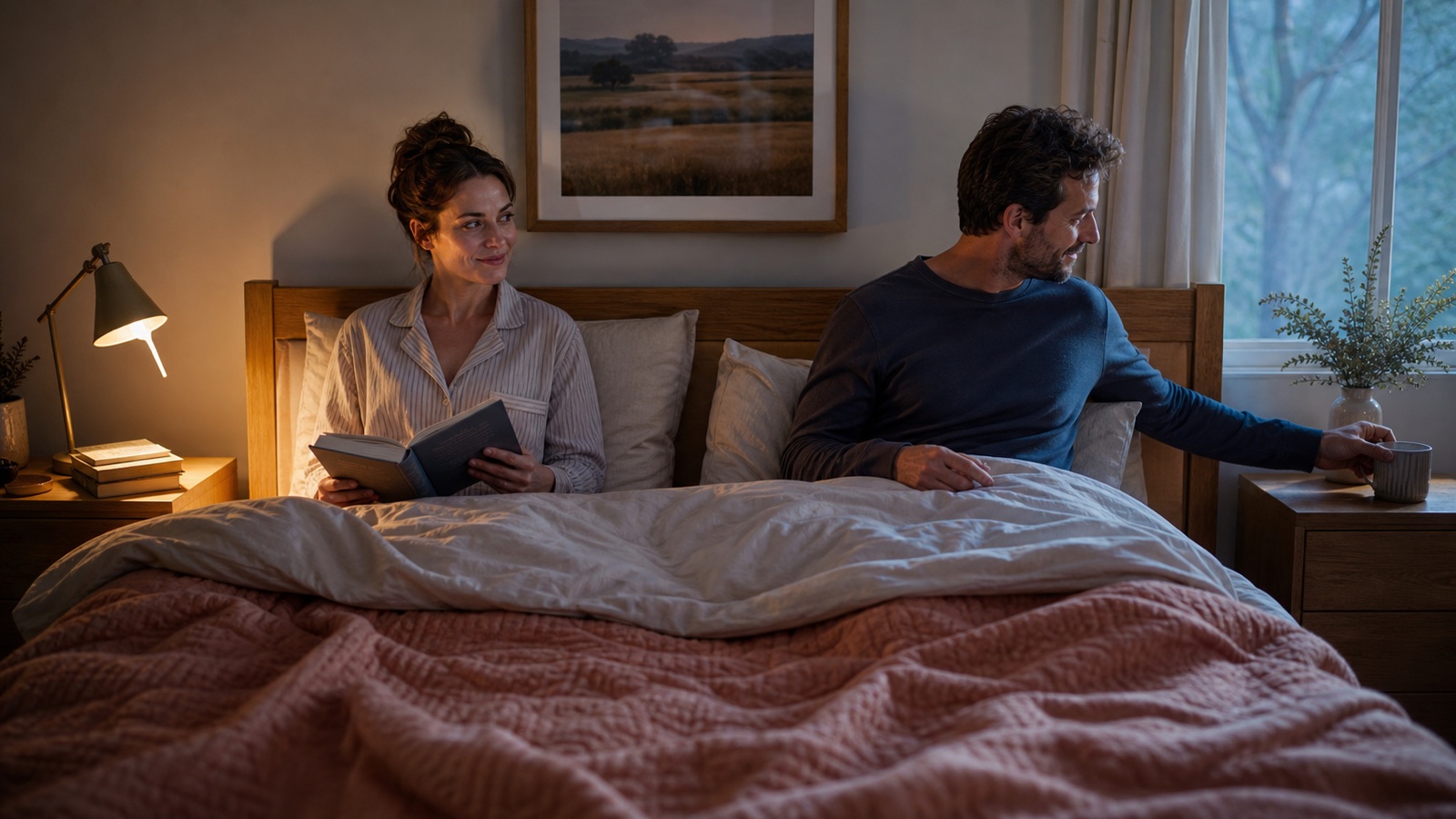
- Different bedtimes aren’t a relationship diagnosis, but chronic sleep loss and lost connection time can create real strain.
- Research on couples and sleep is mostly correlational, so a schedule mismatch isn’t proof of incompatibility.
- The useful question isn’t “Who should change?” It’s which needs, meanings, and disruptions the schedule is creating.
- Protecting sleep and choosing a small shared ritual often works better than forcing identical bedtimes.
It’s 10:58 p.m. You’ve brushed your teeth, turned down the sheets, and made the reckless suggestion that the day might end. Your partner has just opened a laptop, poured cereal, and announced they’re finally awake enough to get things done. Romance has entered a scheduling dispute.
One of you may naturally get sleepy earlier. The other may work late, study after the house quiets down, or protect midnight as the only hour nobody wants anything. Different sleep schedules don’t automatically damage a relationship. Trouble begins when the difference repeatedly steals sleep, intimacy, shared responsibility, or the feeling that you still choose each other.
Your bedtime isn’t a character reference
People differ in circadian preference, often called chronotype. Age, light exposure, work, parenting, health, medication, and habit also shape when sleep feels possible. An earlier sleeper isn’t inherently more disciplined. A later sleeper isn’t necessarily avoiding adulthood, although the kitchen at midnight has hosted some ambitious theories.
Small dyadic studies have found associations between matched chronotypes, sleep quality, sexual satisfaction, and relationship satisfaction. Those studies are interesting, but they don’t prove that matching clocks creates a better relationship. Samples have often been small, cross-sectional, and limited in who they included. You shouldn’t use a questionnaire about morningness to issue a compatibility verdict.
A broader systematic review of more than 200 studies found that sleep and social relationships appear to influence each other, but much of the research is correlational. Good relationships may support sleep, and better sleep may support relationships. The honest answer is reciprocal and a little untidy, like most shared bedrooms.
The mismatch matters most through what it displaces
If your schedules differ by two hours and both of you sleep well, share affection, and feel connected, there may be nothing to fix. If those two hours contain your only chance to talk, have sex, divide tomorrow’s labor, or sit together without a child asking for a charger, the gap has a larger emotional price.
Meaning gets attached quickly. The early sleeper hears, “You’d rather scroll than be with me.” The late sleeper hears, “You only love me if I become a different person by 10 p.m.” Neither statement may be accurate. Both can feel true after enough lonely bedtimes and irritated wake-ups.
I’ll often ask couples to separate the clock from the story. What exactly is being lost: sleep, touch, conversation, help in the morning, or reassurance at night? “Go to bed with me” might mean “I miss you.” “I need another hour” might mean “I need time that belongs to me.” You can negotiate needs more easily than accusations.
A tired brain is a terrible couples therapist
Sleep loss doesn’t create every argument, but it can make patience and positive emotion harder to access. In a small randomized experiment, couples assigned to one night of total sleep deprivation showed higher cortisol during a conflict discussion and less positive affect than couples who slept normally. That’s preliminary evidence, not permission to blame every sharp sentence on a pillow.
The practical point is simpler: don’t hold the relationship summit when one person is fighting sleep and the other has just reached peak conversational speed. A midnight discussion about whose mother is visiting will not become wiser because everyone is wearing softer pants.
Sleep can also be physically shared. Light, sound, movement, alarms, snoring, children, pets, and late entries may disturb both partners. A recent systematic review found partner disturbance across the small body of co-sleeping studies, while also finding that no single mechanism explains whether sharing a bed helps or harms sleep. The answer depends on the couple and the problem.
Build overlap on purpose instead of hoping bedtime supplies it
Start with a two-week experiment. Protect one brief connection ritual at a time both people can reliably manage: tea at 9:30 p.m., 15 minutes on the couch, a shared dog walk, or getting into bed together before the later sleeper gets back up quietly. It shouldn’t become an attendance sheet with kissing.
Agree on the purpose. Is the ritual for conversation, affection, planning, or sex? Trying to accomplish all four in 12 minutes turns connection into airport security. One clear promise is easier to keep: “We’ll put phones away and talk until 10:15” beats “We should spend more quality time.”
Then protect the sleeping partner. Use headphones, dim light, prepare clothes outside the bedroom, silence unnecessary alerts, and handle doors as if the hinges have feelings. The early riser owes the same care with morning alarms, drawers, and overhead lights. Consider separate blankets, a larger bed, or occasional separate sleep when movement or temperature is the problem.
Sleeping separately isn’t automatically rejection, and sharing a bed isn’t proof of closeness. If separate rooms improve sleep, discuss how you’ll preserve affection and reunion. If one person feels abandoned, don’t dismiss that feeling with sleep science. A practical solution still needs emotional consent, not a surprise migration with a pillow under your arm.
Some schedule problems are really health or workload problems
A night owl schedule that still allows enough restorative sleep may be a preference. A person who can’t sleep until dawn, can’t wake for obligations, or cycles between very little sleep and unusually high energy needs a clinical assessment. So does loud habitual snoring with breathing pauses, gasping, morning headaches, or severe daytime sleepiness.
Shift work, a new baby, caregiving, pain, menopause, anxiety, depression, ADHD, substance use, and medication effects can all complicate sleep. Don’t moralize a pattern that may need treatment or a different division of labor. If the later sleeper handles every nighttime wake-up and the earlier sleeper handles every school morning, put that workload on paper before debating virtue.
I also wouldn’t force a chronically exhausted partner to stay awake for connection. Healthy adults generally need at least seven hours of sleep regularly, though individual needs vary. A relationship ritual that reliably creates sleep deprivation will send the bill back through mood, attention, health, and conflict.
Get professional help when insomnia persists, sleepiness creates driving risk, possible sleep apnea is present, or the schedule fight has become contemptuous, coercive, or impossible to discuss safely. Couples therapy can help when the clock is carrying older arguments about care, freedom, sex, or fairness. A sleep clinician can help when the clock itself is the problem.
Try a smaller promise tonight
Ask each other two questions before choosing a rule: “What do you lose when we keep different schedules?” and “What do you protect by keeping yours?” Listen for the need underneath the hour. Then choose one overlap ritual and one sleep-protection change for the next two weeks.
You’re not trying to become synchronized swimmers. You’re trying to make sure different rhythms don’t become accidental distance. If the experiment helps, keep it. If it doesn’t, revise the arrangement rather than putting your partner’s circadian system on trial.
If relationship distress becomes frightening, controlling, or unsafe, prioritize safety and seek local support. If despair becomes unbearable, you’re thinking about suicide, or you can’t stay safe, call or text 988 in the United States; call 911 for immediate danger.
The bottom line: Different sleep schedules don’t doom a relationship. Protect enough sleep, name what the mismatch is actually costing, and create deliberate overlap so bedtime doesn’t have to carry the entire job of keeping you connected.
Sources: Gordon and colleagues, sleep and social relationships systematic review, Sleep Medicine Reviews (2021); Rayward and colleagues, partner disturbance in co-sleeping systematic review, Sleep Health (2026); Sprajcer and colleagues, matched and mismatched chronotypes dyadic study, Chronobiology International (2022); Kahn and colleagues, sleep deprivation and couple conflict randomized experiment, Affective Science (2022); American Academy of Sleep Medicine and Sleep Research Society, adult sleep duration consensus statement.
Should couples go to bed angry?
When rest helps a hard conversation and when silence turns into punishment.

How much alone time is healthy in a relationship?
How to protect solitude without making your partner decode your absence.
Why you keep having the same fight
How recurring conflict gets stuck and what changes the pattern.
Would a clearer plan help?
A free 15-minute intro call can help you decide whether psychiatric care could support what you’re noticing.